Michigan vs Ohio State Football – Looking Back – 1996

The second installment of this year’s series looking back at the football rivalry between Michigan and Ohio State takes us back to 1996. On the morning of the game, I was driving up to Buffalo, N.Y. with my wife to watch the worst Jets team in history take on the Buffalo Bills. On the radio while we were driving, someone on the radio referred to The Game, and noted that Ohio State was the favorite. He added that he expected OSU fans to sing “Buckeye Battle Cry” many times after the end of the game.

That’s exactly when I knew Michigan was going to win.

Yes, that sounds corny. Call it what was defined in “Star Wars” as a “tremor in the force.” Sure, that sounds even cornier, but the fact is that I just had a sudden feeling that Michigan was going to win that day. By the time we checked into our hotel room in Hamburg, N.Y., the game was down to the final play, and sure enough, Marcus Ray intercepted a Joe Germaine pass and eventually came to a sliding halt. Man, those were the days!

In retrospect, when you watch the game on YouTube, Ohio State had the better of play in the first half, but the 9-0 half time margin was far from commanding. Then came the second half. Brian Griese entered the game, and the beginning of the Griese legend was about to take shape. Griese connected with Tai Streets on a post pattern that produced a touchdown, and it was evident that Michigan was determined to play the role of the less-than-cooperative underdog. Oddly enough, Michigan wound up losing to Alabama in the Outback Bowl. Still, in my mind, many of the seeds for that glorious 1997 season were planted on that day in Columbus, Ohio.

Thanks, as always, to ABC Sports and YouTube poster j bakkar. I own nothing and this blog and the attached video are strictly posted for the enjoyment of readers.

Michigan vs Ohio State Football – Looking Back – 1998

The first installment of this year’s series on the Michigan-Ohio State football rivalry takes us to 1998. The late ‘90s were heady times for the Maize & Blue, and the offseason leading up to the ’98 season might have been the headiest time of all. Coming off a perfect season and a share of the national championship, Michigan had vanquished all the ghosts of seasons past. An expansion of 5,000 seats enabled Michigan Stadium to reclaim the title of nation’s largest college football stadium, and the addition of highly-touted quarterback recruit Drew Henson and highly-touted running back Justin Fargas had Michigan fans dreaming of even more glory.

Unfortunately for Michigan, the 1998 season unfolded with all the charm of a hangover. Many critical players graduated or left early to join the National Football League. My wife and I attended the home opener in the newly expanded stadium, hoping to see the raising of the National Championship banner (in our native New York, the raising of a world championship banner borders on a religious experience). Sadly, Michigan didn’t raise a national championship banner in the stadium, and Donovan McNabb and Syracuse thrashed Michigan.

Still, by the final week of the regular season, Michigan had righted the ship, and was in position to win the Big Ten championship with a victory in Columbus. Unfortunately, Ohio State was lying in wait for Michigan, still smarting from a loss in Ann Arbor the previous season. By now, everyone knows how that game turned out. A year earlier, Michigan cornerback Andre Weathers had been one of the heroes for the Wolverines; this time, Ohio State receiver David Boston burned him for a pair of touchdown receptions on the way to a 31-16 Ohio State win.

Fortunately for Michigan, the Wolverines adhered to Bo Schembechler’s old rule not to let one loss become two losses, as they routed Hawaii in a rare season-ending non-conference game, and then overcame two deficits to top Arkansas in the Florida Citrus Bowl.

Thanks, as always, to ABC Sports, and to YouTube poster Stephen Barnett. We own nothing, and this post is strictly for the enjoyment of readers.

https://www.youtube.com/watch?v=IPB76vENTwg

Michigan Football vs Michigan State — Looking Back — 2000

The fifth and final installment of this year’s series looking back at the football rivalry between Michigan and Michigan State takes us back to 2000. Prior to the new year, there were widespread fears about Y2K, and what it would mean to computers around the world. There were fears of mass transit problems, complete with concerns that Y2K could seriously hurt the trains in this country.

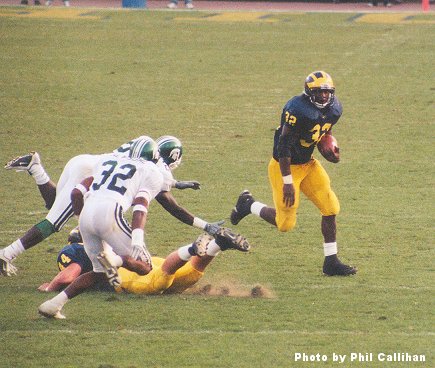
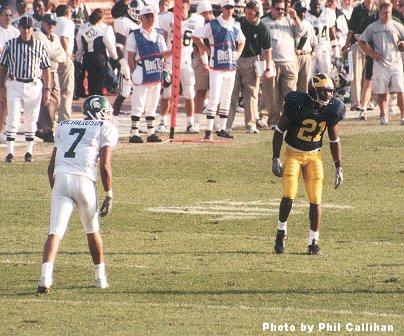
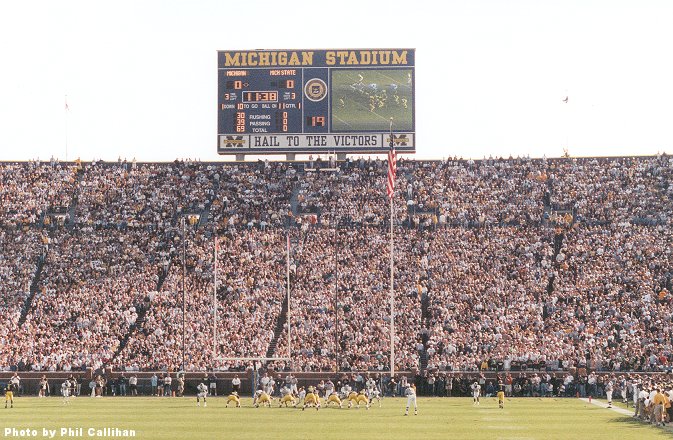
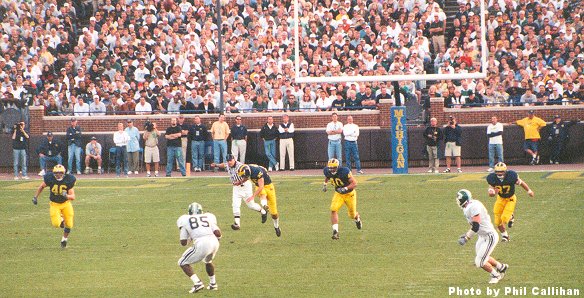
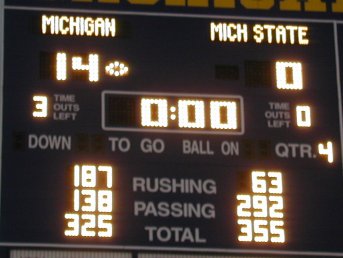
As it turned out, the Y2K computer problems never materialized, and computer problems were really Michigan State’s only hope of stopping the A Train, Anthony Thomas. In his final game against the Spartans, Thomas rushed 25 times for 175 yards and two touchdowns, averaging a whopping seven yards per carry. Throw in a Michigan defense that had bad memories of the previous year in East Lansing, and it was the perfect recipe for a 14-0 shutout of the Spartans.

The game started with junior quarterback Drew Henson deftly mixing the run and the pass, but the Wolverines failed to score very much. In the first quarter, Thomas punched the ball over from the 1-yard line, and that was really all Michigan would need. Later in the game, the Wolverines’ defense put its stamp on this game with a goal line stand that ended with Michigan linebacker Victor Hobson stripping the ball away and Eric Wilson making the recovery to give Michigan possession of both the ball and the momentum. In the third quarter, Thomas scored on a 31-yard run that was just icing on the cake. The Wolverines’ defense had already established which team was better.

All in all, the Wolverines were young in 2000 and struggled when playing away from Michigan Stadium. The Pasadena heat doomed them in an early season loss to UCLA, and losses to Big Ten foes Purdue and Northwestern prevented the Wolverines from going to a more serious bowl. The season ended with a 31-28 win over Auburn in the Citrus Bowl, hardly a fitting conclusion to the careers of Thomas and offensive lineman Steve Hutchinson. Henson left school permanently in the offseason, lured by the baseball dollars of New York Yankees owner George Steinbrenner.

Thanks to ABC Sports and YouTube poster WolverineHistorian. As always, we own nothing, and this video and blog are strictly for the enjoyment of readers.

Michigan Football vs Michigan State — Looking Back – 1986

The fourth installment of this year’s series looking back at the football rivalry between Michigan and Michigan State takes us to 1986. Wall Street was roaring and Americans were feeling good. On the gridiron, Michigan was enjoying a very good season, though we don’t hear much about it. I suspect that’s due to a loss the Little Brown Jug game and a loss to Arizona State in the Rose Bowl. Other than those games, the Maize & Blue were hitting on all cylinders that year.

The Spartans came to Ann Arbor in 1986 much as they will this week, fresh off a loss to Iowa. They had a pair of good receivers in Andre Rison and Mark Ingram, Sr., and they had an All-Big Ten linebacker in Shane Bullough, whose family is required to send players to Michigan State every 10 years or so. Michigan had Jim Harbaugh at quarterback, with diminutive tailback Jamie Morris running behind massive offensive tackle Jumbo Elliott. Harbuagh also had a reliable tight end in 6-foot-8 Paul Jokisch, and a pair of underrated receivers in John Kolesar and Greg McMurtry. The Wolverines also had an excellent secondary, featuring All-America cornerback Garland Rivers, and Erik Campbell, who split time at safety and cornerback.

Once the game started, it was pretty clear that Harbaugh & Company would rule the day. Harbaugh connected with a wide open Kolesar early, while Morris and Thomas Wilcher each found easy running lanes outside the tackles., and placekicker Pat Moons kicked a field goal to give the Wolverines the early lead. The play that best illustrated Michigan’s dominance was the Wolverines’ first touchdown, which came when Jim Harbaugh dove into the end zone on a busted play. Even when the Wolverines didn’t perform perfectly, they were still able to ad lib their way to success.

That’s not to say that Michigan was flawless. Harbaugh threw an interception when he was hit while throwing, which ultimately led to a Michigan State field goal.

The Wolverines led by 10 in the third quarter when Harbaugh broke the game open with a 42-yard touchdown pass to John Kolesar in the north end zone to give Michigan a 20-3 lead. In the fourth quarter, Harbaugh found sophomore tight end Jeff Brown for a short touchdown pass to close out the scoring in a game in which the Wolverines dominated play much more than the score would indicate.

Thanks to CBS Sports and YouTube poster WolverineHistorian. As always, we own nothing, and this blog and video are provided strictly for the enjoyment of readers.

Michigan Football vs Michigan State — Looking Back — 1979

The third installment of the series looking back at the football rivalry between Michigan and Michigan State takes us to 1979. The Wolverines finished 8-4 that year, which was odd, given the fact that their roster included linebackers Ron Simpkins, Andy Cannavino and Mel Owen, receivers Ralph Clayton and Anthony Carter, and running backs Butch Woolfolk and Stan Edwards, whose sons later played at Michigan. Some of our younger readers might remember Edwards’ son, Braylon, who could play some wide receiver.

In the late ‘70s, the spread offense had yet to arrive in Big Ten football, so both teams spent much of the day operating out of the I formation, literally banging heads. In the second quarter, Woolfork scored from two yards out on a sweep to give Michigan the lead. It stayed that way into the third quarter, when Derek Hughes scored from six yards out to tie the score, 7-7. At that point, the Wolverines seized control of the game, going 80 yards in five plays, 66 of them coming on a 66-yard scoring pass from B.J. Dickey to Clayton. After that, the Wolverines were in the driver’s seat, and they put the game away when Dickey connected with Carter for a 6-yard touchdown that made the final score 21-7.

Sadly, that was the high point of Michigan’s season. The Wolverines finished with the three consecutive losses, Simpkins and defensive end Curtis Greer were named the All-America team, and the Wolverines easily reloaded for the 1978 season.

Thanks to ABC Spots and YouTube poster Wolverine Historian. As always, we own nothing, and this blog and video are strictly for the enjoyment of viewers.

https://en.wikipedia.org/wiki/1979_College_Football_All-America_Team