Final Score: 6-13 OT, Indiana by 7 over Michigan SP+ Projection: Indiana by 8.1 (+1.1) CD Projection: Indiana by 11 (+4)
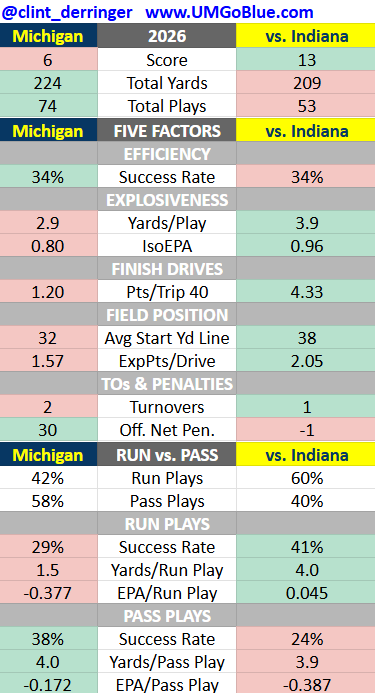
FIVE FACTORS
GAME 7 RECAP vs. Indiana
There is everything to say, and nothing to say at the same time about the offense. A 29% success rate running the ball is bad, but also understated. Seven games into the season, the offense has no identity on offense from down-to-down. If there is anything consistent from the offense, it’s Jason Beck’s overuse of the extra OL, or Rhino package. During Michigan’s best series in the third quarter, Tommy Carr found JJ Buchanan deep in the middle and grabbed 34 yards on two snaps. The Wolverines could never get behind the linebackers again the rest of the game and overtime. The lack of pass threat from the Rhino, and the block-heavy FB/TE players is making things far too easy for the opposing defensive coordinators.
This was a heroic effort by the Michigan defense, which was the necessary minimum to steal a win this afternoon. Indiana only ran 53 offensive plays, and may have been shut out if the Wolverines had not gifted two short-field opportunities for field goals. Chris Bracy led the way for a second consecutive week, notching 13 tackles. The secondary held two elite Indiana WRs to 57 total receiving yards, no scores, and also forced Josh Hoover’s first interception of the season. The core challenge right now for the defense is not turning on the offensive personnel and staff at Schembechler Hall.
The offense will be under the media microscope, but two missed field goals were also killer in a game that ended regulation as a tie. One miss from 50+ yards is certainly understandable, and was canceled out in a way by IU’s missed FG attempt at the end of the first half. But not scoring points after driving down to the 1-yard line to open the third quarter proved to be a fatal blow. 3rd & 1 was a bad play call, poor execution, and then made fatal by the missed kick.
This team is out of sync, the fan base is fracturing, and there is a threat of discontent to spread through the whole program. I mentioned during an in-game tweet that I was worried the past few weeks about players slumping into lack of effort and enthusiasm. I was pretty proud that we didn’t see any of that on the field Saturday against the Hoosiers, but another tough loss filled with question marks and excuses carries the same concern. Maybe Michigan can put together a get right game in Piscataway against Rutgers on Halloween Night. Go Blue!
The University of Michigan men’s basketball team played one (exhibition) game this past week, and they won it. On Friday (10/16/2026), they beat Oregon State 98-93 in Crisler Arena. Since this was just an exhibition game, Michigan’s record is still 0-0.
What Happened?
This one didn’t feel like an exhibition game. Both teams were playing hard to win, and it was a close, exciting, back-and-forth game. Neither team could pull away, and either team could have won it in the last minute. Fortunately, Michigan played just better enough in the final minute to win it.
Game Flow
Oregon State jumped out to a quick 7-2 lead in the first 2 minutes. Yikes. OSU made their first 5 shots before they finally missed, and they led 17-13 at the 12:20 mark. Michigan finally got their act together and pulled ahead 22-17 with 11:21 to go. That was a nice 9-0 run. The lead went back and forth for a few minutes, and it was tied (25-25) at the 9:01 mark. Michigan went on a 14-1 run to lead by 13 (39-26) with 4:06 to go, and it looked like they might have the game under control, when OSU started coming back. They got the deficit down to 7 points (41-34) at the 2:04 mark, then down to 3 points (45-42) at halftime.
OSU scored the first 4 points of the 2nd half, and completely erased the 13-point Michigan lead, going up 46-45 at the 19:00 mark. The next 10 minutes saw 5 ties and 11 lead changes, with neither team able to pull more than 4 points ahead. Michigan finally got a 5-point lead (72-67) with 9:40 to go, but it didn’t last. OSU went ahead 76-74 at the 7:12 mark, and that was the last time they led. Michigan tied it up (76-76) with 7:00 to go, and went ahead for good 79-76 a few seconds later. They got their lead up to 6 a few times, and OSU got within a point once (89-88 at the 1:46 mark), but Michigan played tough down the stretch to hang on for a 5-point win.
Cadeau was the leading scorer, with 27 points on decent shooting: 7/16 overall, 1/6 from deep, 12/15 from the line. He also had 8 assists. He scored 1 point in the 1st half and 26 points in the 2nd half. He put Michigan on his back in the last 10 minutes.
Thiam had a much better offensive game this time, with 19 points and 10 rebounds, for a double-double. He also had 5 assists. He shot pretty well: 7/11 overall, 2/6 from deep, 3/7 from the line. He fired up a couple ill-advised 3-pointers, but he did make 2 of them.
McKenney had another good game, with 18 points on decent shooting: 7/13 overall, 2/6 from deep, 2/2 from the line. He should shoot 3-pointers better than that.
Estrella almost hit double figures, with 9 points (and 7 rebounds) on decent shooting: 4/6 overall, 1/2 from deep.
Quinn Costello had a good game off the bench, with 10 points on good shooting: 2/4 overall, 2/4 from deep, 4/4 from the line. When he squares up for his 3-point shot, he’s deadly. The 2 he missed were wild shots where he wasn’t set.
Kenny Noland played for almost 24 minutes as the backup point guard, and he did a nice job. He scored 6 points on decent shooting: 3/6 overall, 0/2 from deep. He had 3 assists.
Who Looked Not-So-Good?
Liburd started, but he didn’t do much offensively: he scored Michigan’s first basket on a steal-dunk, and he scored Michigan’s last point on a free throw, and in between he didn’t do much. He ended up with 3 points on lousy shooting: 1/3 overall, 0/2 from deep, 1/4 from the line.
Jalen Reed didn’t do much off the bench. He scored 4 points on decent shooting: 2/4 overall, 0/1 from deep.
Joseph Hartman didn’t do much off the bench, with 2 points.
Oscar Goodman played for 4+ minutes and didn’t score, missing his only shot attempt, a 3-pointer.
Malachi Brown played for 4+ minutes, and didn’t score, missing his only shot attempt.
Who Else Played?
No one else played.
Who Didn’t Play?
Roddy Gayle Jr. is still waiting for the legal details of his eligibility to be worked out, so he didn’t play.
Marcus Møller was dressed and on the bench, but didn’t play. His medical trip to Denmark disrupted his practice time.
We learned a lot more from this exhibition game than from the exhibition game against Eastern Michigan last week. Oregon State is a much better opponent, and they gave Michigan all they could handle. Regardless, Michigan looked better than OSU, but it was their own sloppiness that kept the game close. If they can clean up some of the dumb mistakes, they should be able to take control of the game more easily.
This game has no effect on Michigan’s standing or post-season chances. It was just an exhibition.
This Week
This week Michigan plays their third and final exhibition game. On Sunday (10/25/2026, 1:00 p.m., B1G+) they play Houston in Grand Rapids, MI. The first AP Poll hasn’t come out yet, but when it does, Houston will probably be ranked higher (around #18) than Michigan (maybe #22).
Houston was 30-7 (14-4 in Big 12) last season. They lost in the semifinals of their conference tournament, and made it to the Sweet 16 in the Big Dance. They had impressive wins over (#22) Auburn, (#14) Arkansas, (#14) Texas Tech, (#16) BYU, and (#16) Kansas. They didn’t have any unimpressive losses. They don’t have any noteworthy players, and they don’t have much height: a 6’10” player and a 7’0” player. This game is a true “toss up”. Michigan certainly has the talent to beat anyone this season, but they need to have the right lineups out there, based on who’s hot, and they need to stop making dumb mistakes. That’s why they play exhibition games, to work these things out.
Check back next week to find out what happened and why.
The University of Michigan men’s basketball team played their first exhibition game this past week, and they won it. On Sunday (10/11/2026), they beat Eastern Michigan 87-62 in Crisler Arena. Since this was just an exhibition game, Michigan’s record is still 0-0.
What Happened?
Michigan won the game handily, which was to be expected, but they took a while to pull away, which was a little concerning. It isn’t surprising that they still have some kinks to work out, since this was their first game. It’s obvious that they have tons of talent, and the big challenge for Coach Boynton is going to be figuring out who is hot at any given moment, and getting the right combinations of players out there for the given situations.
Game Flow
Michigan never trailed, although the score got close a few times in the 1st half. Michigan won the opening tip, and two passes later they had a dunk to start the scoring, with just 5 seconds gone. They opened up a quick 8-0 lead, and pushed it up at 11-2 at the 15:25 mark. It looked like they were going to run away with the game, then they stalled. EMU went on a 10-4 run, and suddenly Michigan was only up 3 points (15-12) with 12:38 to go. Michigan settled down, and went on their own 12-2 run to push their lead back up to a comfortable 13 points (27-14) at the 7:27 mark. They fell asleep again, and let EMU get back within 3 points (31-28) with 2:09 left before halftime. Fortunately, they closed out the half with an 8-0 run, to make it 39-28 at the half.
The 2nd half was a little more comfortable for Michigan. They let EMU get within 9 points a few times, but never closer than that. They kept the lead in the 15-17 point range for much of the half, finally going over 20 points (71-49) at the 7:39 mark. They got the lead as high as 27 points before winning by 25. All the healthy scholarship players got to play, and almost everyone scored.
McKenney was the leading scorer, with 21 points on good shooting: 8/13 overall, 3/7 from deep. He was a leader on the floor.
Estrella looked very good out there, playing both power forward and backup center. He scored 14 points on good shooting: 6/9 overall, 2/3 from deep.
Thiam looked good on defense (4 blocked shots), but wasn’t very effective on offense. He did hit double figures (11 points), but most of them were from the free throw line: 7/9. He only shot 2/5 overall, 0/1 from deep.
Cadeau was the 4th starter in double figures, with 10 points on poor shooting: 2/7 overall, 1/4 from deep. He did lead the team in assists (8) and rebounds (7). Also, turnovers (3).
Quinn Costello had a very good game off the bench, with 16 points on good shooting: 6/10 overall, 4/8 from deep. He looked very comfortable and poised out there, especially for a true freshman in his first game.
Joseph Hartman also had a good game off the bench, with 10 points on very good shooting: 4/5 overall, 2/3 from deep.
Who Looked Not-So-Good?
Liburd started, and looked very fast and athletic out there, but he didn’t do much offensively: 2 points on decent shooting: 1/2 overall, 0/1 from deep. He’s still recuperating from a hip injury, so he’s on a “minutes restriction”, and only played 10+ minutes, all in the 1st half.
Oscar Goodman played for 15+ minutes and didn’t score, missing all 3 of his shot attempts, all from deep.
Kenny Noland played for almost 14 minutes as the backup point guard, and he didn’t do much. He scored 2 points on mediocre shooting: 1/3 overall, 0/1 from deep.
Jalen Reed played for almost 13 minutes, and he didn’t do much. He scored 1 point on lousy shooting: 0/3 overall, 1/3 from the free throw line.
Malachi Brown played for 8+ minutes, and he didn’t do much. He didn’t attempt a shot.
Who Else Played?
No one else played.
Who Didn’t Play?
Six players on the roster didn’t play in this game. Here’s the breakdown:
Two players are out for the season, both with ACL (knee) injuries: Lincoln Cosby and Brandon McCoy Jr. I won’t be mentioning them again in my weekly “Who Didn’t Play” list.
Roddy Gayle Jr. is healthy and ready to play, but his eligibility status is still up in the air. Until the legal details are worked out, Michigan is not going to let him play. I don’t know how soon the legal stuff will be resolved.
Marcus Møller is healthy and ready to play, but he had a medical checkup back in his home country (Denmark) that kept him out of this game. He should play in the next game.
There are only two players who are obviously on the Scout Team (Howard Eisley Jr. and Harrison Hochberg), and neither of them played in this game.
What Does It Mean?
The EMU game was only an exhibition game against an opponent that Michigan was expected to handle easily, so there’s only so much you can learn from it. We saw that Michigan has a lot of talented players, but we also saw that they have a lot to work on.
This game has no effect on Michigan’s standing or post-season chances. It was just an exhibition.
This Week
This week Michigan plays at another exhibition game. On Friday (10/16/2026, 7:00 p.m., B1G+) they play Oregon State in Crisler Arena.
Oregon State was 17-16 (9-9 in WCC) last season. They lost in the 2nd round of their conference tournament, and didn’t play in a post-season tournament. Their only impressive wins were over Arizona State and Washington State, and they had unimpressive losses to Evansville, Iona, Massachusetts, Cal Baptist, Sam Houston, Santa Clara (twice), Pacific (twice), Portland, St. Mary’s, and Seattle. They don’t have any noteworthy players, but they do have a lot of height: a 6’11” player, a 7’0” player, a 7’1” player, and a 7’2” player. That’s a lot of tall players! This will be a much more challenging exhibition game than the EMU game, although Michigan is certainly expected to win.
Check back next week to find out what happened and why.
🎙️ Join @pcallihan and @Clint_Derringer on Michigan’s latest loss 20-14 to Minnesoto. Another frustrating loss. Another offensive meltdown. And now some serious questions about the direction of Michigan football.
Yeah, it’s time for college basketball again. Basketball games start this week. Let’s check out this season’s team.
Here’s my traditional standard description of this weekly column:
Yeah, it’s time for University of Michigan men’s basketball, and this is the place to read all about it: “Nothing But ‘Net” on UMGoBlue.com. Check back every Monday morning between now and the end of the season for a quick, concise wrap-up of the previous week, and a look ahead at the upcoming week, all in one easy-to-read article.
As always here at UMGoBlue.com, the perspective is “by fans, for fans”. I’m a fan (since 1974), and I go to all the home games, and watch/listen to all the away games. I don’t have any special access (other than being an usher in Sections 209-210), I don’t go to the press conferences, and I don’t interview high school recruits. I see the same things you do, and write about them as a fan.
Once again, this will be a very unpredictable year, but that’s true for most college sports these days. With the infamous Transfer Portal and open payment for “amateur” athletes, it’s the Wild West out there. I’m not a fan of the Transfer Portal or NIL money, but they’re a fact of life, and I just need to get used to it.
Executive Summary
The big question: how good is Michigan going to be this season?
The big answer: pretty good, but not as good as last season. Of course, last season was a magical season, and it would be tough to match it. Still, Michigan should be one of the top teams in the nation, just maybe not a Final Four team. Maybe Sweet Sixteen or Elite Eight.
What’s New?
Oh my goodness, where to start? I’ve been following Michigan basketball for 53 years now, and this is undoubtedly the most change I’ve ever seen from the end of one season to the start of the next season.
Let’s start at the top: after winning a convincing National Championship last season, head coach Dusty May unexpectedly bolted for the NBA in June. It was quite a shock. So, Michigan has a new head coach, although he’s not new to the program: Mike Boynton Jr. was promoted from assistant coach to head coach.
Why did Coach May leave Michigan for the NBA? I’ve read several interviews and articles on this topic, and it appears that the main reason is that the head coach, and all the assistant coaches, at a top-level college program never get a day off. 365 days a year, no breaks. NBA head coaches have a much less demanding schedule, and can have a life outside of basketball. There was a telling example from one of Michigan’s assistant coaches. He was on the floor in Indianapolis after Michigan won the National Championship, celebrating with the team. A reporter asked him how he was going to celebrate this great achievement, and he looked at his watch and said that it was 11:49 p.m., and the Transfer Portal opened at midnight, so he had 11 minutes left to savor the victory, then it was time to hit the phones hard. 11 minutes. Coach May also mentioned the chaos of NIL and the Transfer Portal, and I agree with him. Coaching college basketball sounds like a real grind.
Besides a new head coach, Michigan experienced a predictable amount of roster upheaval. When I wrote my Season Wrap-Up article last April, there were two players who hadn’t officially announced their NBA Draft decisions: Morez Johnson Jr. and Aday Mara. I guessed that the odds were 50/50 for Johnson, and 90/10 (for leaving) for Mara. They both entered the NBA Draft, and they were both selected in the top 12: Johnson (#9) and Mara (#12). In addition, Yaxel Lendeborg, who was out of eligibility, was drafted #11. There goes the entire starting forecourt. Sigh.
Of the 5 players who had eligibility left, all 5 announced at the end of the season that they planned to return for this season, but one of them decided to transfer when Coach May left for the NBA: L.J. Cason. This was quite a surprise. He transferred to Miami (FL). He will be missed.
On the other hand, one of the players who we thought was out of eligibility is (probably) going to return to the team: Roddy Gayle Jr. He played for 4 years (2 at Ohio State and 2 at Michigan), entered the NBA Draft, and wasn’t selected. He signed an “undrafted free agent” contract with the Detroit Pistons, and played in the NBA Summer League, but was never paid to play as a professional. When the NCAA adopted the new “five-for-five” eligibility model over the summer, Roddy sued the NCAA to allow him to play a 5th year, and he won his court case. As of today, he is on the team and expecting to play, but the legal battles aren’t over yet. We’ll have to just wait and see.
When Coach May unexpectedly left for the NBA, there was some concern about how many of the 6 incoming freshmen would still come to Michigan. The answer: all 6 of them! That’s the good news. The bad news is that one of them, the prize of the class, the highest ranked of the bunch, blew out his knee over the summer, and he’s out for this whole season: Brandon McCoy Jr. This is terrible news, especially since he’ll probably never play for Michigan. It looks pretty likely that he’ll enter the NBA Draft after this season. Sigh.
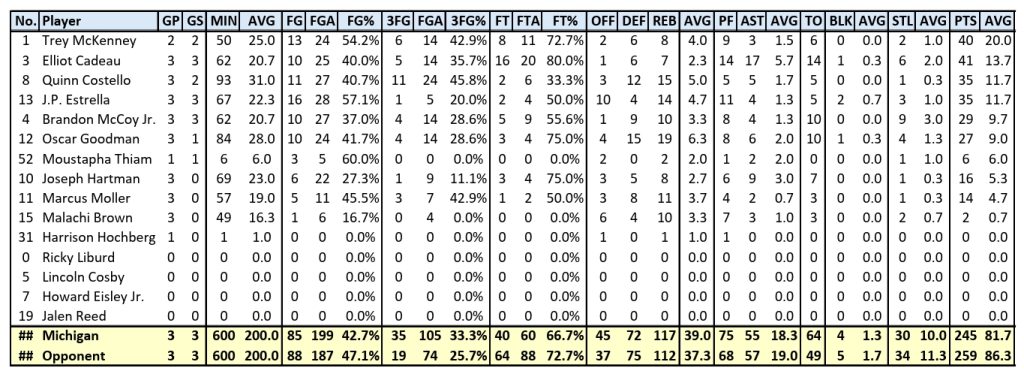
About that knee injury: it happened in the first minute of an exhibition game on 08/27/2026 in Montenegro. What was Michigan doing in Montenegro? It was the third game (of three) on a quick European tour. The other two games were in Lithuania. I had no idea that Michigan was planning a European tour this summer. Anyway, they lost the first two games in Lithuania, and won the third one in Montenegro. Coach Boynton got to see his new team in action against other opponents, and he got to try lots of unusual lineup combinations.
Here are the stats from the trip:
When I wrote my Season Wrap-Up article last April, Coach May had only secured one player from the Transfer Portal: J.P. Estrella. Since then, he and Coach Boynton have grabbed a few more players: Kenny Noland, Jalen Reed, and Moustapha Thiam. More about that below.
So, here are all the roster changes from last season:
Players Leaving:
2 players entered the NBA Draft early
4 seniors/grad students graduated
3 players transferred
Players Arriving:
6 incoming freshmen
4 incoming transfer players
Players Who Entered The NBA Draft Early
Two players entered the NBA Draft with eligibility remaining:
Morez Johnson Jr. – Morez only played at Michigan for one season, but he was a key component in their National Championship run. He was selected 9th overall by the Dallas Mavericks, now coached by Dusty May.
Aday Mara – Aday only played at Michigan for one season, but he was another key component in their National Championship run. He was selected 12th overall by the Oklahoma City Thunder.
Graduating Seniors/Grad Students
Four players from last season “graduated”:
Nimari Burnett – He was a valuable part of the team for the last 3 seasons. He started every game for all 3 years, 109 games in a row. He will be missed.
Yaxel Lendeborg – He only played at Michigan for one season, but he was the most valuable player in their National Championship run. He entered the NBA Draft, and was selected 11th overall by the Golden State Warriors. He will be missed.
Charlie May – He was a rarely used player on the Scout Team. He was a nice guy, but he will not be missed.
Will Tschetter – He was a true rarity in this brave new era of the infamous Transfer Portal: he played for all 4 years at just one school. He was a team leader and a great guy. He will be missed.
Players Who Transferred
Three players transferred to other schools after last season. They are:
L.J. Cason – It was quite a surprise when L.J. announced that he was transferring from Michigan to Miami (FL). He seemed happy at Michigan, and he was a key contributor. On the other hand, he is from Florida, so he’ll be closer to home. He will be missed.
Winters Grady – He never really fit in at Michigan. He wanted to fire up 3-pointers, and all the other players who got more playing time were more versatile. He transferred to Minnesota, who might have a scheme that allows for a “Just A Shooter” player to thrive. He won’t be missed.
Malick Kordel – He is a project. He’s tall, he’s strong, he’s athletic, but he’s not really a basketball player yet. He can go somewhere where he can play a lot more, and get more experience and develop some basketball IQ. He also transferred to Minnesota. He won’t be missed.
Incoming Freshmen
In this new age of building a roster from the Transfer Portal, it’s refreshing when there is a solid class of incoming freshmen. Michigan is doing both, hitting the Transfer Portal hard and bringing in a great freshman class. Here are the 6 incoming freshmen:
Malachi Brown #15 (6’6”, 205 pounds, G) – Malachi is a 3-star wing from Knoxville, Tennessee. He played in all 3 games in Europe, but didn’t do much: 49 minutes, 1/6 overall, 0/4 from deep, 2 points.
Lincoln Cosby #5 (6’10”, 215 pounds, F) – Lincoln is a 4-star forward from Montverde, Florida. It appears that he’s a good outside shooter who can also go to the rim. He’s still recovering from an injury, so he didn’t play in any of the games in Europe.
Quinn Costello #8 (6’10”, 220 pounds, F) – Quinn is a 4-star power forward from Medford, Massachusetts. He’s a McDonald’s All-American. He played in all 3 games in Europe (with 2 starts), and he did well: 93 minutes (the most on the team), 11/27 overall, 11/24 from deep, 35 points (3rd most on the team). Yes, he shot 11 3-pointers and only 3 2-pointers, and he missed all 3 of his 2-pointers.
Joseph Hartman #10 (6’6”, 200 pounds, G) – Joseph is a 4-star wing from Gainesville, Florida. He played in all 3 games in Europe, and did pretty well: 69 minutes, 6/22 overall, 1/9 from deep, 16 points. He needs to work on that 3-point shot.
Brandon McCoy Jr. #4 (6’5”, 200 pounds, G) – Brandon is a 5-star shooting guard from Chatsworth, California. He’s a McDonald’s All-American, and Michigan’s highest ranked recruit in this class. He’s also out for the season with a knee injury. Before his injury, he played in all 3 games in Europe (with 3 starts), and he did well: 62 minutes, 10/27 overall, 4/14 from deep, 29 points.
Marcus Møller #9 (7’3”, 230 pounds, C) – Marcus is an unranked center from Denmark, although he last played for a team in Malaga, Spain. He’s unranked because he’s an international student. He’s had some serious medical issues (testicular cancer), but it appears that he’s recovered enough to play this season. He played in all 3 games in Europe, and he did pretty well: 57 minutes, 5/11 overall, 3/7 from deep, 14 points.
This is the #1 ranked freshman class in the country, or at least it was at one point in the spring.
They’re freshmen, so the odds are that they’ll need some seasoning before they’re ready to contribute. A couple of them may play regular minutes. A couple more may get a few chances, then sit for most of the season. A couple may not work out, and hit the Transfer Portal after the season. That’s the way it goes with freshmen.
Incoming Transfer Players
With 9 players leaving the team (2 to the NBA early, 4 to graduation, and 3 to the Transfer Portal), and only 6 incoming freshmen, Coach May and Coach Boynton had to work the Transfer Portal hard to fill out the roster. They were very successful, getting 4 players:
J.P. Estrella #13 (6’11”, 240 pounds, F) – J.P. transferred to Michigan from Tennessee, where he played for 3 seasons, leaving him with 2 seasons of eligibility. He played in all 3 games in Europe (with 3 starts), and he did very well: 67 minutes, 16/28 overall, 1/5 from deep, 35 points. He will probably be the starting power forward this season.
Kenny Noland #2 (6’2”, 185 pounds, G) – Kenny transferred to Michigan from Columbia, where he played for 4 seasons, leaving him with 1 season of eligibility. His eligibility to play this season is still up in the air, in court, but he’s currently eligible. He was not on the team at the time of their European tour. He will probably be the backup point guard this season.
Jalen Reed #19 (6’9”, 245 pounds, F) – Jalen transferred to Michigan from LSU, where he played for 4 seasons, leaving him with 1 season of eligibility, although there is talk about a court case to get another year of eligibility. He was with the team for their European tour, but he did not play. He is recovering from an injury, but might be healthy by the start of the regular season.
Moustapha Thiam #52 (7’2”, 250 pounds, C) – Moustapha (“Mo”) transferred to Michigan from Cincinnati, where he played 1 season. He transferred to Cincinnati from Central Florida (UCF) the year before, where he played 1 season. So, he has 3 seasons of eligibility. He only played in 6 minutes of the first game in Lithuania, then he suffered a minor injury and didn’t play again over there. He should be healthy for the start of the season. He will probably be the starting center.
Who’s Coming Back?
Along with all the subtractions and additions to the team listed above, there are actually 7 players returning from last season’s team. I used to list players by class year (Freshman Eligibility, Sophomore Eligibility, etc.), but with the new “five-for-five” rule from the NCAA, that doesn’t make sense any more. Instead, I’ll list players by how many years of eligibility they have left:
4 Years Of Eligibility Left
Ricky Liburd #0 (6’5”, 200 pounds, G) – Ricky sat out all of last season with an injury, which burned 1 of his 5 years of eligibility, so he’s got 4 years of eligibility left. He expects to be healthy by the start of the season. He traveled with the team to Europe, but he didn’t play in any of the games.
Trey McKenney #1 (6’4”, 220 pounds, G) – Trey played in all 40 games last season, all off the bench. He averaged 9.9 points/game on pretty good shooting: 126/273 (46.2%) overall, 68/174 (39.1%) from deep. He improved steadily as the season went on, and he became a key contributor. The most impressive thing was that he was one of the best defenders on the team, and he was often in the game during “crunch time”. His 3-pointer in the final minutes of the National Championship game was the dagger. He will be the starting shooting guard this season, and he’s one of the team leaders.
3 Years Of Eligibility Left
Howard Eisley Jr. #7 (6’0”, 180 pounds, G) – Howard was on the Scout Team last season, and he didn’t play much: 9 games, 11+ minutes, 1/5 shooting (all 3-point shots).
Oscar Goodman #12 (6’7”, 235 pounds, F) – Oscar is technically a redshirt sophomore, but in the brave new world of “five-for-five”, he has used up 2 years of eligibility. He’s been on the team since January 2025. He practiced with the team, but didn’t play, for the end of the 2024-2025 season, then he played a little last season: 16 games, 85 minutes. He scored 22 points on decent shooting: 10/24 (41.7%) overall, 0/6 from deep. He played in all 3 games in Europe (with 1 start), and he did OK: 84 minutes, 10/24 overall, 4/14 from deep, 27 points. Note: He switched his jersey number from last season (5) to this season (12).
2 Years Of Eligibility Left
Elliot Cadeau #3 (6’1”, 180 pounds, G) – Elliot was the starting point guard all last season, and he played well. He averaged 10.5 points/game on pretty good shooting: 136/331 (41.1%) overall, 65/173 (37.6%) from deep. He led the team in assists with 234. He was the Most Outstanding Player in the Final Four.
Harrison Hochberg #31 (6’7”, 220 pounds, F) – Harrison was on the Scout Team last season, and he was voluntarily redshirted. Note: He switched his jersey number from last season (13) to this season (31).
1 Year Of Eligibility Left
Roddy Gayle Jr. #11 (6’5”, 205 pounds, G) – As I mentioned above, Roddy had to go to court to get one more year of eligibility. The legal maneuvering is not done yet, and he could still end up ruled ineligible sometime during the season. Roddy was a great “6th man” last season. He played in 39 of the 40 games, all but one off the bench. He averaged 7.3 points/game on good shooting: 101/208 (46.3%) overall, 21/66 (31.8%) from deep. He always played hard and fast when he was out there, and he was a fierce rebounder who played like a much taller player.
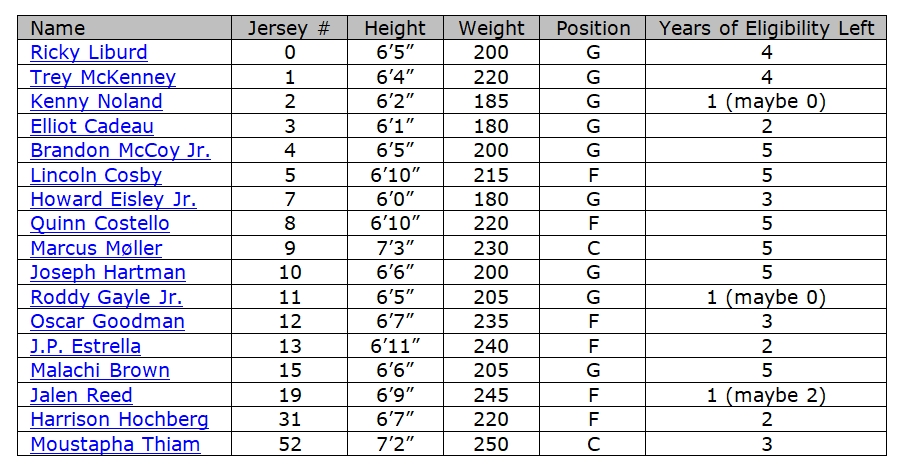
Since the roster is scattered over several different sections above, here’s the complete roster in one place, ordered by jersey number:
Starting Lineup/Depth Chart
This is really tricky this season, with all the new players. My guess:
Point guard: Cadeau (backups: Noland, McKenney, and Gayle)
Shooting guard: McKenney (backups: Gayle, Hartman, Brown, and Liburd)
Small forward: Gayle (backups: Reed, Goodman, Cosby, Hartman, and Liburd)
Power forward: Estrella (backups: Reed, Costello, Cosby, and Goodman)
Center: Thiam (backups: Møller and Estrella)
There are a lot of new players on the team this season, with lots of talents. The trick is going to be finding the right combinations for the given circumstances.
Last Season
From last season’s Wrap-Up article (lightly edited):
This season was the best season in Michigan men’s basketball history. Period. Michigan set a new record for wins in a season (37), and won the National Championship. Statistically, this team was the second best team in last 50 years, behind only the 1999 Duke team. It was a truly special team and a truly special season.
Normally, at this point I’d talk about “good wins” and “bad wins” and “good losses” and “bad losses”, but this season was made up almost entirely of “good wins”.
The 3 losses all came to teams that ended up ranked in the final AP Top 25:
Look at that: Michigan only lost one game at home, and only had one other close game at home. On the road, Michigan was undefeated (11-0). Their other two losses were on neutral courts (12-2).
Michigan won:
29 games by at least 10 points
16 games by at least 20 points
11 games by at least 30 points
7 games by at least 40 points
Even though all the wins were important, some were more important than the rest:
Home vs. Oakland – 11/03/2025 121-78 This was the season opener for Michigan, and it gave us some idea of the firepower that Michigan had. It was also the season high for points.
Neutral court vs. Wake Forest – 11/11/2025 85-84 This was an important game because Michigan (barely) lost to Wake Forest last season.
At TCU – 11/14/2025 67-63 This was Michigan’s first true road game of the season.
Neutral court vs. San Diego State – 11/24/2025 94-54 This was the first game of the Players Era Festival in Las Vegas. SDSU was supposed to be pretty good, but Michigan beat them by 40 points. It was a sign of things to come.
Neutral court vs. (#21) Auburn – 11/25/2025 102-72 This was the second game of the Players Era Festival, and Michigan’s first game of the season against a ranked opponent. It was also a rematch of the game that knocked Michigan out of the NCAA Tournament last season. It wasn’t even close, although Michigan “only” won by 30 points.
Neutral court vs. (#12) Gonzaga – 11/26/2025 101-61 This was the championship game of the Players Era Festival, and it was no contest. Michigan destroyed previously-undefeated Gonzaga by 40 points. It gave Michigan wins by 40, 30, and 40 points in the tournament.
Home vs. Rutgers – 12/06/2025 101-60 This was Michigan’s first Big Ten game of the season, and they started out with a bang: another 40+ point win.
Home vs. Villanova – 12/09/2025 89-61 Another lopsided win over a big-name school. They almost won by 30 points.
At Maryland – 12/13/2025 101-83 This was Michigan’s first Big Ten game on the road this season.
Home vs. (#24) USC – 01/02/2026 96-66 This was Michigan’s first Big Ten game against a ranked opponent, and they won by 30 points.
Home vs. (#5) Nebraska – 01/27/2026 75-72 Nebraska came into this game undefeated (20-0) and in 1st place in the Big Ten. It was a close, exciting game, and Michigan won. This was the biggest win of the season to that point.
At (#7) Michigan State – 01/30/2026 83-71 It’s always great to beat “Little Brother”, but this one was especially sweet, since it was in East Lansing against a Top-10 team by 12 points.
Home vs. UCLA – 02/14/2026 86-56 Another lopsided win (30 points) over a really big-name school. It was UCLA’s first visit to Crisler as a Big Ten team, and it gave Michigan their 2nd sweep of the new (Pac-4) Big Ten teams. Michigan went 4-0 against them last season and again this season. They’re the only Big Ten team from the non-West Coast 14 that has never lost to the Pac-4 teams in Big Ten play.
Home vs. Minnesota – 02/24/2026 77-67 This was the game where Michigan clinched at least a share of the Big Ten title.
At (#10) Illinois – 02/27/2026 84-70 This was the game where Michigan clinched the outright Big Ten title. It was also a double-digit win over a Top 10 team on the road. It also ended an 8-game losing streak to Illinois. This is the same Illinois team that made it to the Final Four.
Home vs. (#8) Michigan State – 03/08/2026 90-80 It’s always great to beat “Little Brother”, and even better to sweep them, at home, on Senior Day, by double digits. This win also got Michigan up to 19 wins in Big Ten play, a new school and conference record.
Neutral court vs. (#23) Wisconsin – 03/14/2026 68-65 This win avenged Michigan’s only regular season Big Ten loss, and made it so Michigan beat every other Big Ten team at least once. It also got Michigan into the championship game of the Big Ten Tournament, which assured them of a #1 seed in the upcoming NCAA Tournament.
Neutral court vs. (#18) Alabama – 03/27/2026 90-77 Last season, Michigan made it as far as the Sweet Sixteen before losing in the NCAA Tournament. This win got Michigan into the Elite Eight.
Neutral court vs. (#23) Tennessee – 03/29/2026 95-62 This was the game that got Michigan into the Final Four, and what a game it was! Beating a ranked team by 33 points in the Elite Eight? Wow!
Neutral court vs. (#2) Arizona – 04/04/2026 91-73 The contest between two #1 seeds in the Final Four was supposed to be a close, tense, heavyweight battle. Instead, Michigan ran the #2 team in the country off the floor. It wasn’t as close as the final score suggests. It also gave Michigan five wins in the tournament by double digits, and five wins in the tournament scoring at least 90 points.
Neutral court vs. (#7) Connecticut – 04/06/2026 69-63 This one was for all the marbles, and Michigan won it. It wasn’t a pretty game, with both teams shooting poorly, but a win is a win, and a National Championship is a huge win.
Out of all these wins, the win in the National Championship game is obviously the most important, but the wins over Michigan State were my favorites.
This Season
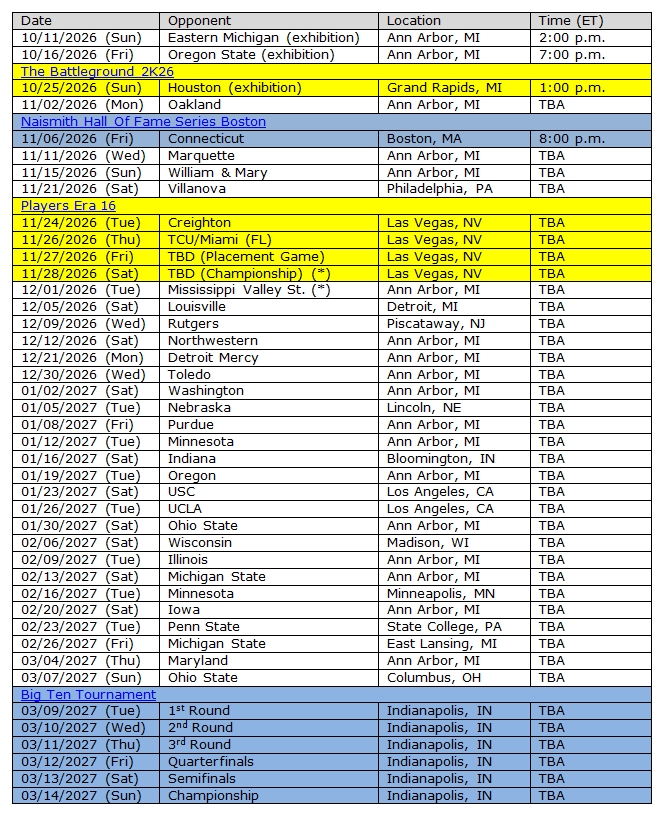
Let’s look at Michigan’s schedule for this season.
* Note: If Michigan plays in the Players Era Championship game on 11/28/2026, they will cancel the game against Mississippi Valley State on 12/01/2026.
Some comments on the schedule:
The exhibition schedule is unusual. Usually, it’s one game against an overmatched GLIAC team in Ann Arbor. This season it’s three games, two at home and one on a neutral court, against one “cupcake” (Eastern Michigan) and two solid opponents (Oregon State and Houston). The Houston game is a “toss up”.
This is a pretty tough non-conference schedule, with several big-name opponents: UConn, Marquette, Villanova, Creighton, TCU/Miami (FL), the 3rd round Players Era opponent, the Players Era Championship game (maybe), and Louisville. Michigan will be doing well to go 5-3 in these games.
The other non-conference games all look winnable: Oakland, William & Mary, Mississippi Valley State (maybe), Detroit Mercy, and Toledo.
Michigan is flying out to the West Coast in January for back-to-back games against two of the new Big Ten teams: USC and UCLA. I’m impressed that the Big Ten scheduled these two games together, so Michigan can fly out once and play both games.
Each Big Ten team plays 14 teams once (7 home/7 away) and 3 teams twice, for a total of 20 games. This season, Michigan plays:
Once (home): Northwestern, Washington, Purdue, Oregon, Illinois, Iowa, and Maryland.
Once (away): Rutgers, Nebraska, Indiana, USC, UCLA, Wisconsin, and Penn State.
Twice: Michigan State, Minnesota, and Ohio State.
Given the preseason predictions, Michigan should be happy about:
Playing Illinois and Purdue at home.
Playing Minnesota twice.
Given the preseason predictions, Michigan should be unhappy about:
Playing Michigan State and Ohio State twice.
Playing away games vs. UCLA, Nebraska, and USC.
Expectations
Looking at the schedule, I hope that Michigan wins all 4 (or 5) of their “less challenging” non-conference games, goes 5-3 (or 4-3) in their “more challenging” non-conference games, and goes 14-6 in the Big Ten. That would work out to a final regular season record of 23-8, which would be enough to get them a good seed in the NCAA Tournament. I think the ceiling for this team is 26-5, and the floor is 19-12.
This Week
This week, Michigan only plays one game. On Sunday (10/11/2026, 2:00 p.m., BTN+) they play Eastern Michigan in Crisler Arena. This is an exhibition game.
Eastern Michigan was 10-21 (4-14 in the MAC) last season. They didn’t play any postseason games. They don’t have any noteworthy players, but they do have some height: a 6’10” guy and a 6’11” guy. This should be a very straightforward exhibition game for Michigan, and they should win it handily. It should give us a chance to see most of the Michigan players in game action.
Check back next week to find out what happened and why.