𝑳𝑶𝑶𝑲𝑰𝑵𝑮 𝑩𝑨𝑪𝑲: 2015

Looking Back is a Special Feature by Jeff Cummins Highlighting Key Games

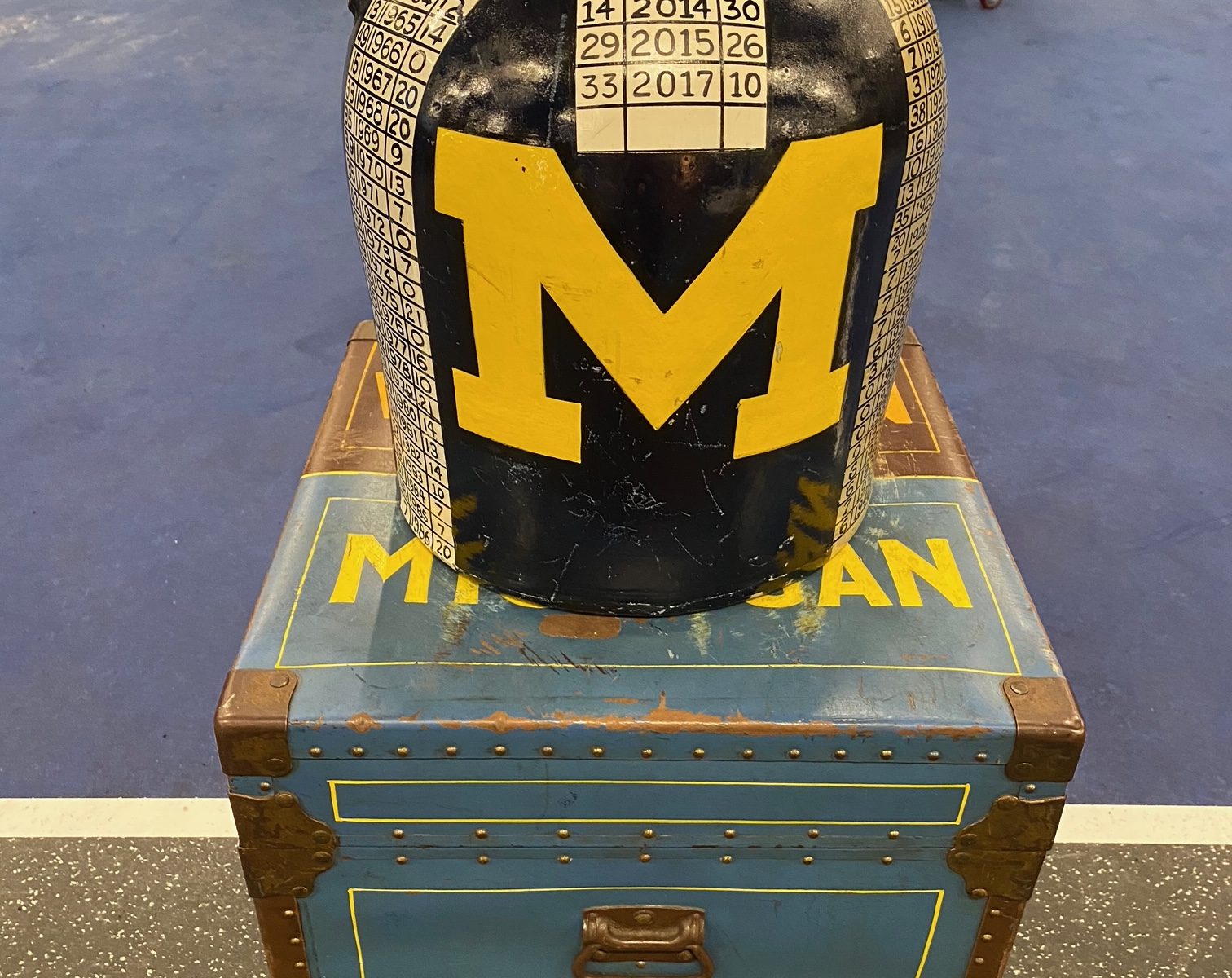
The fifth installment of the series focusing on the Little Brown Jug takes us to 2015. The Jim Harbaugh era started slowly at Michigan, as the Wolverines lost their opener at Utah and struggled to find their mojo through the first few games. Eventually, defense would become their identity, and that was on full display on the final play of the 2015 game at Minnesota.

The game began innocently enough. The Michigan defense held Minnesota to a field goal, and Jake Rudock answered by leading the Wolverines on a long drive, connecting with Jake Butt and Deveon Smith for significant gains. Joey Kerridge went in from the 1-yard line to give Michigan the lead. The Rudock connected with Jehu Chesson for a 13-yard touchdown pass, and the Wolverines were up, 14-3. All was well, or so it seemed.

But the 2015 Golden Gophers were a pesky bunch. The two teams traded scores for much of the game, with Wilton Speight connecting with Chesson for a 12-yard touchdown pass to give Michigan a 29-26 lead in the fourth quarter.

Now, it was up to the defense. Michigan alumni and fans spent a fair portion of the final minutes biting their nails. Minnesota seemed to be gaining yardage at will, and for a brief moment, it appeared the Gophers had scored the go-ahead touchdown with 19 seconds left. Upon further review, the officials ruled that the receiver was short of the goal line when he knee went down, so Minnesota had a first down at the half-yard line. Once the clock started, the Gophers managed to burn 17 seconds on an incomplete pass attempt, leaving them just two seconds on the clock, time for only one more play. Recognizing the situation, Michigan prepared its goal line defense, ensuring that every player got very low to the ground, to give them leverage.

Once the ball was snapped, the maize and blue winged helmets surged forward, knocking the Minnesota offensive line backward. The officials took a while to make the final call, but it was really just a formality. Anyone who saw the play knew that Michigan had stopped Minnesota, and the Wolverines claimed a 29-26 victory, one of the most exciting games in the history of the series.

Thanks to YouTube, ESPN and YouTube poster CFB Fans for the attached broadcast of the game. As always, we own nothing and this blog post is provided strictly for the enjoyment of readers.

This and other great content can be found at newyorkwolverine.com

𝑳𝑶𝑶𝑲𝑰𝑵𝑮 𝑩𝑨𝑪𝑲: 2001

Looking Back is a Special Feature by Jeff Cummins Highlighting Key Games

The fourth installment of the series focusing on the Little Brown Jug takes us back to 2001. The Wolverines struggled through much of the 2001 season, and they fell to Michigan State one week before the Little Brown Jug. Michigan hadn’t played Minnesota since 1998, but the Jug proved to be just the tonic the Wolverines needed.

Michigan started by leaning on its offensive line, and the line opened holes for B.J. Askew, who scored on two runs in the first half to give the Wolverines a 14-10 halftime lead. Askew scored the points, but the defense and the special teams provided the critical plays to give Michigan the advantage. After the defense stopped Minnesota deep in its own territory, Tyrece Butler blocked a punt to set the Wolverines inside the Minnesota 10-yard line. Two plays later, Askew scored from three yards out to put the Wolverines ahead to stay.

Todd Howard returned the opening kickoff of the second half to the Minnesota 40-yard line; Howard’s second big return of the game. Howard’s return gave the Wolverines excellent field position, and wide receiver Calvin Bell made it pay off when he scored on a reverse to put Michigan up, 21-10.

As the shadows grew longer over the Michigan Stadium playing field, the Wolverines completely dominated Minnesota in the second half to pull away for a 31-10 victory, their 13th consecutive win in the rivalry.

The Wolverines concluded the 2001 season with a loss to Tennessee in the Florida Citrus Bowl, but receiver Marquise Walker and linebacker Larry Foote were named to both the All-America and All-Conference teams. With plenty of young talent on hand, the Wolverines were well stocked for the future.

Thanks to ESPN, YouTube and YouTube poster WolverineDevotee for the attached highlight film of the game. As always, we own nothing and this blog post is provided strictly for the enjoyment of readers.

This and other great content can be found at newyorkwolverine.com

𝑳𝑶𝑶𝑲𝑰𝑵𝑮 𝑩𝑨𝑪𝑲: 1986

Looking Back is a Special Feature by Jeff Cummins Highlighting Key Games

The third installment of the series focusing on the Little Brown Jug takes us back to 1986. Michigan was roaring, and just one more opponent was on the schedule before Ohio State. Unfortunately, the game before “The Game” just happened to be the Little Brown Jug, and as everyone knows, anything can happen in a rivalry game.

On the surface, Michigan appeared to be well prepared for Minnesota. The Wolverines entered the game with a perfect record, while the Golden Gophers already had four losses on their record. Michigan’s roster was loaded with talent, and the game was scheduled for Michigan Stadium. It seemed ideal.

Unfortunately for Michigan, the Jug meant a lot to the Minnesota players, too. With just a few games left in the regular season, the Gophers brought a desperate hunger to the game. Michigan surrendered three turnovers in its own territory throughout the game, but with 2:26 left, Gerald White scored on a 1-yard run to the game, 17-17. Michigan’s defense was now charged with stopping the Minnesota attack to give the Wolverines’ offense one final shot at victory. The Wolverines needed one stop from their defense. Kicker Mike Gillette was pacing the sidelines; poised for a chance at a field goal that would give Michigan the victory.

Sadly for the Wolverines, Gillette never got that chance. Sparked by a 27-yard scramble by quarterback Rickey Foggie, the Golden Gophers gave Chip Lohmiller a shot at a 30-yard field goal, and he made it to win the game. Just like that, Michigan’s hope for a national title was all but finished. The Wolverines finished the season with victories over Ohio State and Hawaii, before falling to Arizona State in the Rose Bowl. Would the Wolverines have beaten Arizona if they entered that game with a perfect record and a shot at the national championship? We’ll never know.

Thanks to YouTube and YouTube poster College Football Historian for the attached broadcast of this game. As always, we own nothing, and this blog post is provided strictly for the enjoyment of readers.


This and other great content can be found at newyorkwolverine.com

𝑳𝑶𝑶𝑲𝑰𝑵𝑮 𝑩𝑨𝑪𝑲: 1975

Looking Back is a Special Feature by Jeff Cummins Highlighting Key Games

The second installment of the series focusing on the Little Brown Jug takes us back to 1975. After four consecutive double-digit victory seasons, Michigan had to break in a new quarterback in the 1975 season. Fortunately for the Wolverines, Ricky Leach possessed multiple skills, particularly carrying the ball. Leach was joined in the running attack by a trio of running backs including Rob Lytle, Gordon Bell and Russell Davis, and the backfield made it almost impossible for the Minnesota defense to concentrate on just one ballcarrier.

The Minnesota offense responded by handing the reins to quarterback Tony Dungy, ironically a native of Jackson, Michigan. Dungy riddled the Michigan defense for 17 completions, accumulating 198 yards in passing. The Golden Gophers scored 21 points on Michigan, the most points surrendered by Michigan in six seasons. Still, the Michigan offensive line controlled the line of scrimmage, allowing the Wolverines to amass 345 yards on the ground. The Wolverines had almost as much trouble with the officials as they did with the Minnesota defense. Bell appeared to have scored on a 27-yard sweep, only to have the touchdown called back by a penalty on the Minnesota offense that Michigan wasn’t permitted to refuse. Undaunted, the Wolverines scored on a 3-yard run by Leach that rendered the issue moot.

Minnesota provided feisty opposition, but the Wolverines held on for a 28-21 win, their ninth consecutive victory in the series. Michigan finished with a record of 8 wins, 2 losses and 2 ties, including a 14-6 loss to Oklahoma in the Orange Bowl, the first postseason appearance by a Big Ten team that had not won the conference title. The Wolverines’ postseason bowl appearance was one of several factors that led to bowl expansions in the 1970s and 1980s. Leach also served notice that he would be a factor for several seasons to come.

Thanks to YouTube and YouTube poster College Football Historian for the attached video of the game. As always, we own nothing, and this blog post is provided strictly for the enjoyment of readers.


This and other great content can be found at newyorkwolverine.com

𝑳𝑶𝑶𝑲𝑰𝑵𝑮 𝑩𝑨𝑪𝑲: 1998

Looking Back is a Special Feature by Jeff Cummins Highlighting Key Games

The first installment of the series focusing on the Little Brown Jug rivalry takes us back to 1998. Michigan spent much of the offseason basking in the glow of a national championship. The Wolverines had just secured two of the highest rated recruits in quarterback Drew Henson and running back Justin Fargas. As if those weren’t enough reasons to celebrate, the university had just added 5,000 seats to make Michigan Stadium the largest on-campus college football stadium in the nation. These were heady times for the Wolverines.

The Wolverines rode a 5-game winning streak into the game, but the battle for the Jug has humbled many successful teams. The game took on a traditional Big Ten style, featuring heavy doses of defense and special teams. Tom Brady gave Michigan the lead when he connected with Tai Streets for a 76-yard touchdown pass in the first quarter to put Michigan ahead, 7-3. Trevis Graham responded before the end of the quarter by recovering a Michigan punt in the end zone for touchdown. Michigan kicker Jay Feely then answered with an 18-yard field goal to send the teams in the locker room tied at 10-10.

Brady and his cohorts weren’t able to mount a scoring effort in the third quarter, so Michigan used defense to break the tie in the fourth quarter when James Hall dropped Minnesota quarterback Billy Cockerham for a safety to put the Wolverines ahead to stay. Feely then extended the lead with a 42-yard field goal, and the defense held off the Golden Gophers to secure a 15-10 victory.

Michigan completed the 1998 campaign with a 45-31 win over Arkansas in the Florida Citrus Bowl, giving the Wolverines their second consecutive 10-win season. What started out as a hangover season proved that the Wolverines still had the grit to grind out a tough win when things weren’t completely going in their favor.

Thanks to ESPN and YouTube poster College Football Historian for the attached broadcast of the game. As always, we own nothing and this blog post is provided strictly for the entertainment of readers.


This and other great content can be found at newyorkwolverine.com