Michigan vs Ohio State Football – Looking Back – 1990

Looking Back is a Special Feature Highlighting
Key Rivalry Games by Jeff Cummins

The fourth installment of this year’s series looking back at the football rivalry between Michigan and Ohio State takes us to 1990. Now, Michigan had a new coach, and the last remnants of The Ten Year War were gone. Three losses in the first six games left Michigan with no hope for a national championship, and the Wolverines played The Game strictly for pride.

Fortunately, pride is one of the greatest motivators for the Wolverines when they play Ohio State. In the third quarter, things weren’t going all that well for the Wolverines. Greg Frey (yes, that Greg Frey) completed a 12-yard touchdown pass to Jeff Graham and Ohio State took a seven-point lead. Momentum changed quickly when Derrick Alexander took the ensuing kickoff back inside the Ohio State 40-yard line. Then the Cleveland connection struck for Michigan, as Elvis Grbac found Desmond Howard on a 12-yard post pattern to tie the score, and it remained tied well into the fourth quarter. Late in the fourth quarter, Ohio State went for it on fourth and less than a yard to go from the Ohio State 30. On fourth down, the Wolverines stuffed Frey at the 29, and took possession there. Michigan moved the ball carefully, methodically, and with time for one final play, a field goal attempt.

Memories of the 1974 game were still fresh in the minds of many Michigan fans. In 1974, Mike Lantry kicked into the north end zone, and the referees ruled the kick was no good, while many said they thought it was good. This time, the kick would be toward the south end zone, and that’s when UM’s Floridian connection took over. Steve Everett snapped the ball, and J.D. Carlson kicked it straight down the middle for a 37-yard field goal as time expired to give Michigan a 16-13 win.

Michigan went on to beat Ole Miss in the Gator Bowl, 35-3, and Carlson went on to become the chief financial office of Penske Automotive Group. Everitt, one of the most ardent Wolverines of all time, made it to the NFL and is frequently seen at Michigan games. Grbac played in the NFL and served as the quarterbacks coach at St. Ignatius High School in Cleveland. Derrick Alexander enjoyed a successful career in the NFL, as did Desmond Howard, who won the Heisman Trophy, the Super Bowl MVP, and is currently seen on ESPN’s College Gameday broadcasts.

Thanks to ABC Sports, YouTube, and YouTube poster WolverineHistorian. As always, I own nothing and I do not profit from this blog post in any way.

Michigan vs Ohio State Football – Looking Back – 1989

Looking Back is a Special Feature Highlighting
Key Rivalry Games by Jeff Cummins

The third installment of this year’s series looking back at the football rivalry between Michigan and Ohio State takes us back to 1989. The 1980s were heady economic times in the United States, and the world looked on as the Berlin Wall was knocked down. Changes were starting to accelerate, but in the Big Ten, Michigan used an old school philosophy, and it proved to be just as effective as ever.

Ohio State entered Michigan Stadium with a new coach in 1989. John Cooper was an outsider, born and raised in Tennessee. He began to recruit many speed athletes to the Buckeyes, a slight change in Ohio State’s offensive attack. By contrast, Bo Schembechler, in his final year at Michigan, still believed in two running backs, using both the pro set and the I-formation. Early in the game, Michigan was allowing Ohio State to hang around a little too long. That’s when Bo put the game on the backs of his offensive line. Few drives in Bo’s 21-year tenure screamed “Michigan football” like the drive that started at the Wolverines’ 19 yard line midway through the second quarter. The drive began with Leroy Hoard knocking several Buckeyes on the rear ends as he bulled his way for a 16-yard gain on first down, and ended when running back Allen Jefferson, lined up as part of a full house backfield, took the ball two yards around left end for the touchdown. Michigan drove 81 yards on 13 plays, with not one passing play in the lot. There was no emphasis on speed in the open field; this drive was simply about old fashioned blocking, and the Wolverines used massive maulers like left tackle Tom Dohring and guard/center Steve Everett, one of the most spirited Wolverines of all time. The final score was 28-18, Michigan, but the tenor of the game was determined on that 81-yard drive, which gave the Wolverines a two-score lead and established how the game was going to unfold.

The 1989 iteration of The Game was Schembechler’s last; he retired after the season. But there was little concern for the future of the program, because both offensive coordinator Gary Moeller, who took the head coaching job in 1990; and defensive coordinator Lloyd Carr, who took the head coaching job several years after that, were accomplished coaches. Fans enjoyed the Big Ten championship that Michigan won in 1989, but few could have imagined what the team would accomplish eight years later.

Thanks to ABC Sports, YouTube, and YouTube poster expressfan. As always, I own nothing and I do not profit from this blog post in any way.

Michigan vs Ohio State Football – Looking Back – 1980

Looking Back is a Special Feature Highlighting
Key Rivalry Games by Jeff Cummins

The second installment of this year’s series looking back at the football rivalry between Michigan and Ohio State takes us back to 1980. When most historians think of the final score of 9-3 in that rivalry, thoughts usually turn to the Snow Bowl in 1950. But in 1980, Bo Schembechler’s Michigan team had started the season with two losses in the first three games, leaving many fans worried about the team.

Those worries were put to rest in the game for the Little Brown Jug, as the Wolverines routed the Minnesota Golden Gophers, establishing the identity of the ’80 team. Once November arrived, Michigan recorded three connective shutouts against Indiana, Wisconsin, and Purdue, leading to the regular season finale at Ohio State. The Buckeyes grabbed the lead first when Vlade Janakievski hit a 33-yard field goal for Ohio State’s only points of the game. Ali Haji-Sheikh then tied the score several minutes before halftime with a 43-yard field goal. The second half continued with more defense, but five minutes into the third quarter, John Wangler connected with wide receiver Anthony Carter as he darted between two defenders at the goal line, and suddenly the Wolverines had a 9-3 lead. With 1:08 remaining in the game, Ohio State got the ball back on its own 32-yard line. The Buckeyes then advanced all the way to the Michigan 32-yard line before the Wolverines’ defense stiffened. On 3rd down and 10 yards to go, the Michigan defense pressured Ohio State quarterback Art Schlichter into an intentional grounding penalty, bringing up one final chance for the Buckeyes. On fourth down, Michigan’s Robert Thompson hit Schlichter before he could react, and the sack gave Michigan the ball and the victory, as Wangler took the snap from center and kneeled down on the game’s final play.

When the season was over, Michigan finished with a 10-2 record, recording a 23-6 win over Washington in the Rose Bowl, and allowing just nine points in the last five games. Michigan’s defense had entered the Ohio State game with 14 consecutive scoreless quarters. The argument could certainly be made that no team coached by Schembechler improved as much over the course of a season as the 1980 team did.
Many members of the 1980 team went on to prominent careers. Reserve linebacker Jim Herrmann became the Michigan defensive coordinator, and coached the Wolverines’ defense during the perfect season in 1997, and coached the New York Giants’ linebackers during the Giants’ Super Bowl-winning campaign in the 2011 season. Defensive back Brad Bates became the athletic director at Boston College. Assistant coaches Bill McCartney, Lloyd Carr, and Les Miles each went on to coach national championship teams at the collegiate level. Finally, Anthony Carter and George Lilja both went on to be named All-Americans.
Thanks to YouTube, ABC Sports, and YouTube posters WolverineHistorian and Dr. Sap. As always, I own nothing and do not profit from this blog post in any way.
Michigan vs Ohio State Football – Looking Back – 1968

Looking Back is a Special Feature Highlighting
Key Rivalry Games by Jeff Cummins

The first installment of this year’s series looking back at the football rivalry between Michigan and Ohio State takes back to 1968. Richard Nixon had just been elected president, the nation watched nightly TV reports on the Vietnam War, and, well, you probably already know that Ohio State routed Michigan, 50-14.

But the truth is, that’s just the outer edges of the story. Anyone who thinks the ’68 Wolverines were bad simply doesn’t see the whole picture. The 1968 team had a roster that was loaded with talent, including running backs Ron Johnson and Grave Craw, tight end Jim Mandich, defensive back Tom Curtis, defensive linemen Tom Goss (future UM AD) and Henry Hill, offensive lineman Dan Diedorf, and junior end Mike Hankwitz, who went on to become one of the best defensive coordinators in college football. After suffering an opening day loss to Cal, the Wolverines reeled off eight consecutive victories, including back-to-back shutouts against Northwestern and Illinois.

The Game occurred on Nov. 23, 1968, and in the first half, Michigan was competitive, with the game tied at 14. Then Ohio State overwhelmed Michigan, and after their final touchdown, the Buckeyes went for two points, and failed. If anything, the attempted two-point conversion may have ignited a spark in the Wolverines for the following season. Shortly after the season ended, Michigan coach Bump Elliott accepted the positions of associate athletic director, and Bo Schembechler was named head coach on Dec. 26, 1968, leading to one of the most interesting offseason in Michigan history.

Thanks to YouTube, ABC Sports, and YouTube poster Dr. Sap for the video clips below. As always, I own nothing and do not profit from this blog post in any way.

Michigan Football vs Michigan State — Looking Back – 1998

The fourth installment of this year’s series looking back at the football rivalry between Michigan and Michigan State takes us back to 1998. The offseason preceding the 1998 football season was arguably the most enjoyable of the modern era of Michigan football. The previous season, Michigan finished with a perfect record, a Big Ten championship, a Rose Bowl championship, and even a share of the national championship. Michigan Stadium had been expanded by 5,000 seats to reclaim its status as the nation’s largest on-campus stadium, and the Wolverines had landed the top overall player in the 1998 recruiting class, quarterback Drew Henson, and a very explosive running back, Justin Fargas. The offseason party lasted a long time in Ann Arbor. Unfortunately, a little too long.

The Wolverines started the season with losses to Notre Dame and Syracuse. Charles Woodson had left early for the NFL, and Marcus Ray had been suspended for dealing with an agent. By the time the Wolverines finally woke up from their offseason party, it was clear the Wolverines still had lampshades from the party on their heads, when they should have been wearing the winged helmet.

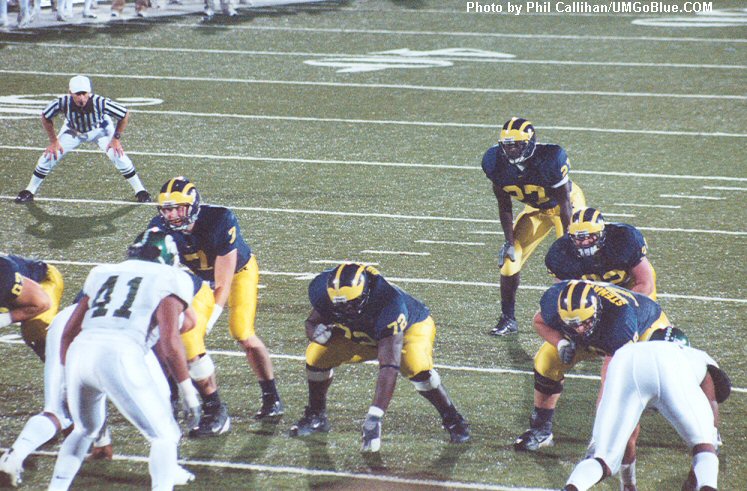
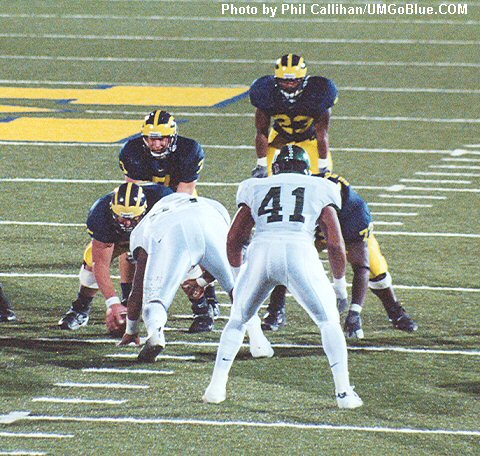
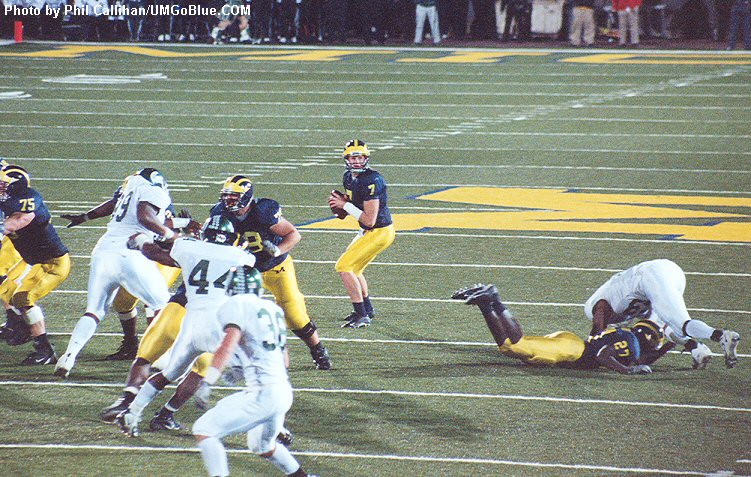
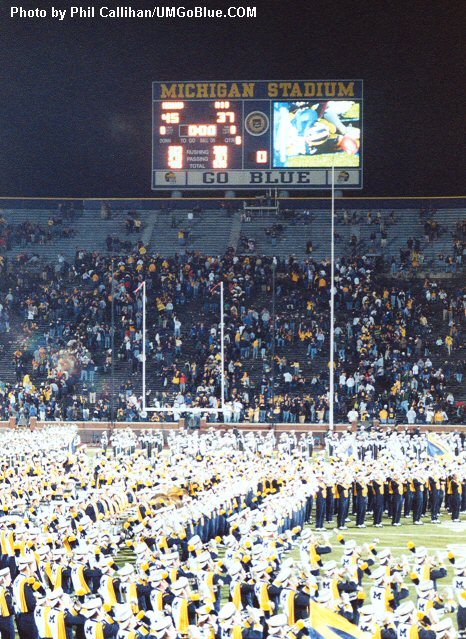
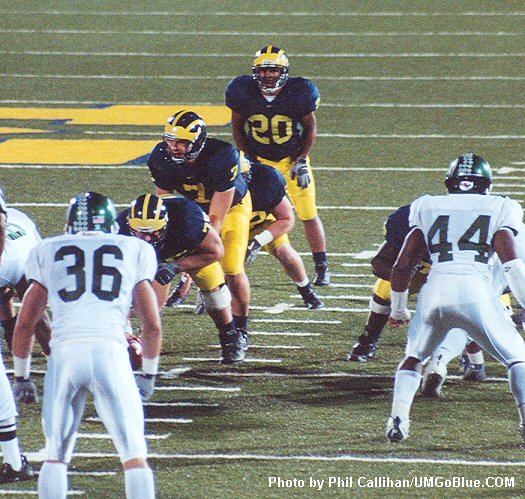
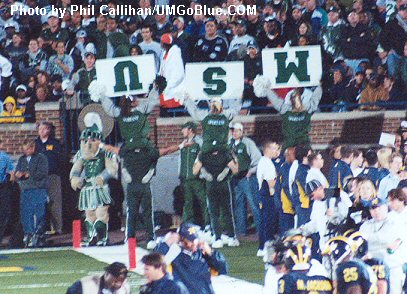
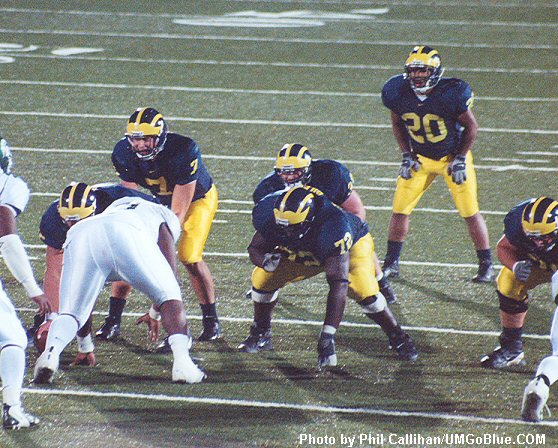
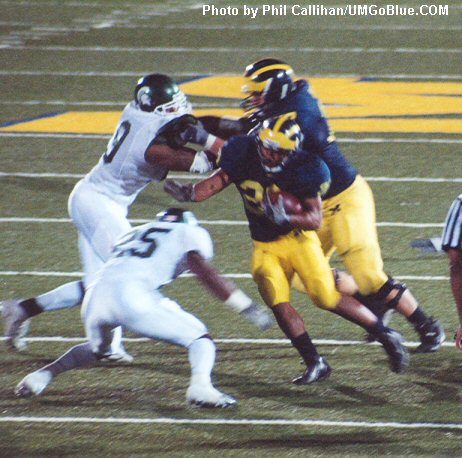
By the fourth game of the season, those helmets were on, and they buckled tightly. Michigan State roared into The Big House, and following a Bill Burke touchdown pass to Plaxico Burress, the Spartans led, 10-3. After a fumble on the ensuing kickoff, Michigan State got the ball back, but Paul Edinger missed a field goal, giving the ball back to Michigan. Tom Brady then put the ball in the very capable hands of Anthony Thomas, who rumbled 69 yards to tie the score. The Wolverines led by three at the half, but Michigan State had the momentum, and the ball starting the second half. That’s when the Wolverines regained their identity. The defense shut out Sparty in the second half, Jay Feely kicked his third field goal of the day, and 49-yard pass from Brady to Marcus Knight set up a Brady sneak, and Michigan went on to beat Michigan State, 29-17, highlighting all the usual strengths of a Lloyd Carr team.

The Wolverines finished 10-3 in 1998, losing to Ohio State, but topping Arkansas in a bowl game. The shame is that if the Wolverines had started the season with the same focus they had the previous year, things might have turned out much better.

Thanks to YouTube, ABC Sports, and YouTube poster CMB 7686 for the video. As always, I own nothing, and I do not profit in any way from this blog post.