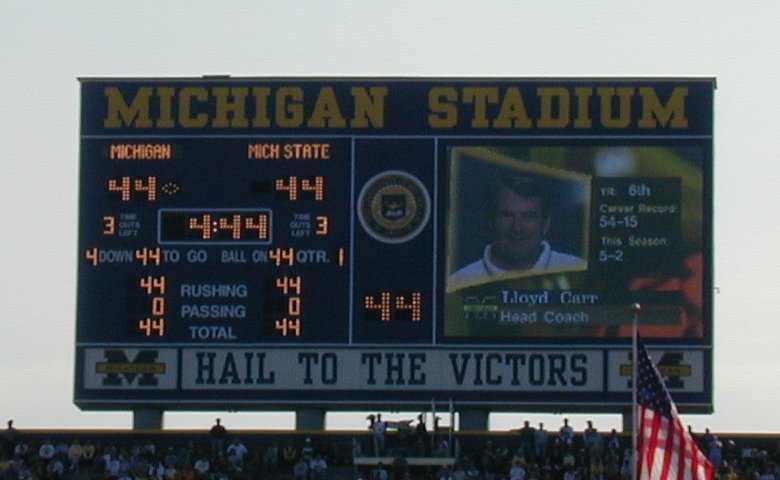
Michigan Football vs Michigan State — Looking Back – 1968

The second installment of this year’s series looking back at the football rivalry between Michigan and Michigan State takes us to 1968. With the notable exception of 1964, the Wolverines hadn’t exactly prospered in the ‘60s. Michigan had two players who were named to several All-America squads in 1968. Running back Ron Johnson gained more than 2,500 yards that season, while defensive back Tom Curtis intercepted 10 passes. The Michigan roster was stocked with many talented players, but the more talented team doesn’t always win the Michigan-Michigan State contest.

In fact, Michigan opened the 1968 season with a loss to California, which made coach Bump Elliott’s seat even warmer than it had been. Going into the game against Michigan State, the Wolverines had a 1-2 record, and they had lost the previous three games against the Spartans. For Johnson, in particular, this game would be his last hope for victory against Michigan State. If the Wolverines didn’t win this one, Johnson, and the other seniors on the Michigan squad, would be haunted by the result for the rest of their lives.

Johnson didn’t take long to make his presence felt, scoring on a 38-yard run to give Michigan the early lead. But in the fourth quarter, Michigan State quarterback Charlie Wedemeyer found receiver Frank Foreman in the end zone, and after the two-point conversion, Michigan State led, 14-13. Facing yet another potential defeat by their rivals, the Wolverines leaned heavily on Johnson, and he delivered. Johnson carried the ball 19 times in the game, gaining 152 yards, and touchdowns by future All-America tight end Jim Mandich and Montclair, New Jersey native Garvie Craw led the Wolverines to a 28-14, giving the outgoing seniors their shining moment in the in-state rivalry.

After college, many members of the 1968 team went on to prominent careers. After prospering in a blue jersey in college, Johnson wore blue with the New York Football Giants, where he became the first player in franchise history to gain at least 1,000 yards in a season. Curtis, too, wore blue in the NFL, where he won Super Bowl V in the 1970 season with the Baltimore Colts. Mandich went on to win two Super Bowls with the Miami Dolphins, and served as the de facto spokesperson for the undefeated 1972 Miami Dolphins for many years after his retirement. Sadly, both Johnson and Mandich passed away in recent years.

Thanks to YouTube, the University of Michigan, and YouTube poster WolverineHistorian for the following video clip. As always, I do not profit in any way from this blog post and video, which are presented strictly for the enjoyment of blog readers.
Michigan Football vs Michigan State — Looking Back – 1954

The first installment of this year’s series looking back at the football rivalry between Michigan and Michigan State takes us back to 1954. The nation was enjoying postwar prosperity, fueled largely by the automobile industry, which was headquartered in Michigan. The season before, a trophy was introduced into the rivalry. Michigan State won the Paul Bunyan Trophy in the first game involving the trophy, but Michigan had dominated the rivalry for the most part until 1953. In 1954, the Wolverines were ready to re-establish control of the rivalry.

In terms of the game, sadly, few details remain, other than Michigan’s victorious 33-7 score. Arguably the most noteworthy event of the whole game was how Michigan treated the Paul Bunyan Trophy. Unlike recent victories, the 1954 team showed a disdain for the trophy, and that’s been the pervasive attitude for decades. Unlike the Little Brown Jug, which is treasured by everyone with maize & blue in their DNA, the Paul Bunyan Trophy has long been regarded as more of locker room trophy, the logic being that Michigan should always beat the Spartans.

If anything, the most important thing to come out of the 1954 game was that the Paul Bunyan Trophy breathed new life into a rivalry that had been one-sided for decades. Michigan State’s win in 1953 marked only the 10th time that the Spartans had defeated Michigan in a series that dated back to 1898. Suddenly, some of Michigan’s hubris was replaced by animosity, and football fans in Michigan benefited, whether they wore maize & blue or green & white.

But make no mistake, in 1954, Michigan proved that the best team in the state resided in Ann Arbor, trophy or no trophy.

Michigan Football vs Michigan State — Looking Back — 2000

The fifth and final installment of this year’s series looking back at the football rivalry between Michigan and Michigan State takes us back to 2000. Prior to the new year, there were widespread fears about Y2K, and what it would mean to computers around the world. There were fears of mass transit problems, complete with concerns that Y2K could seriously hurt the trains in this country.

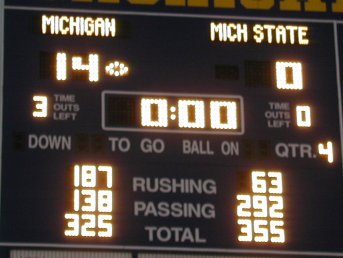
As it turned out, the Y2K computer problems never materialized, and computer problems were really Michigan State’s only hope of stopping the A Train, Anthony Thomas. In his final game against the Spartans, Thomas rushed 25 times for 175 yards and two touchdowns, averaging a whopping seven yards per carry. Throw in a Michigan defense that had bad memories of the previous year in East Lansing, and it was the perfect recipe for a 14-0 shutout of the Spartans.

The game started with junior quarterback Drew Henson deftly mixing the run and the pass, but the Wolverines failed to score very much. In the first quarter, Thomas punched the ball over from the 1-yard line, and that was really all Michigan would need. Later in the game, the Wolverines’ defense put its stamp on this game with a goal line stand that ended with Michigan linebacker Victor Hobson stripping the ball away and Eric Wilson making the recovery to give Michigan possession of both the ball and the momentum. In the third quarter, Thomas scored on a 31-yard run that was just icing on the cake. The Wolverines’ defense had already established which team was better.

All in all, the Wolverines were young in 2000 and struggled when playing away from Michigan Stadium. The Pasadena heat doomed them in an early season loss to UCLA, and losses to Big Ten foes Purdue and Northwestern prevented the Wolverines from going to a more serious bowl. The season ended with a 31-28 win over Auburn in the Citrus Bowl, hardly a fitting conclusion to the careers of Thomas and offensive lineman Steve Hutchinson. Henson left school permanently in the offseason, lured by the baseball dollars of New York Yankees owner George Steinbrenner.

Thanks to ABC Sports and YouTube poster WolverineHistorian. As always, we own nothing, and this video and blog are strictly for the enjoyment of readers.

Michigan Football vs Michigan State — Looking Back – 1986

The fourth installment of this year’s series looking back at the football rivalry between Michigan and Michigan State takes us to 1986. Wall Street was roaring and Americans were feeling good. On the gridiron, Michigan was enjoying a very good season, though we don’t hear much about it. I suspect that’s due to a loss the Little Brown Jug game and a loss to Arizona State in the Rose Bowl. Other than those games, the Maize & Blue were hitting on all cylinders that year.

The Spartans came to Ann Arbor in 1986 much as they will this week, fresh off a loss to Iowa. They had a pair of good receivers in Andre Rison and Mark Ingram, Sr., and they had an All-Big Ten linebacker in Shane Bullough, whose family is required to send players to Michigan State every 10 years or so. Michigan had Jim Harbaugh at quarterback, with diminutive tailback Jamie Morris running behind massive offensive tackle Jumbo Elliott. Harbuagh also had a reliable tight end in 6-foot-8 Paul Jokisch, and a pair of underrated receivers in John Kolesar and Greg McMurtry. The Wolverines also had an excellent secondary, featuring All-America cornerback Garland Rivers, and Erik Campbell, who split time at safety and cornerback.

Once the game started, it was pretty clear that Harbaugh & Company would rule the day. Harbaugh connected with a wide open Kolesar early, while Morris and Thomas Wilcher each found easy running lanes outside the tackles., and placekicker Pat Moons kicked a field goal to give the Wolverines the early lead. The play that best illustrated Michigan’s dominance was the Wolverines’ first touchdown, which came when Jim Harbaugh dove into the end zone on a busted play. Even when the Wolverines didn’t perform perfectly, they were still able to ad lib their way to success.

That’s not to say that Michigan was flawless. Harbaugh threw an interception when he was hit while throwing, which ultimately led to a Michigan State field goal.

The Wolverines led by 10 in the third quarter when Harbaugh broke the game open with a 42-yard touchdown pass to John Kolesar in the north end zone to give Michigan a 20-3 lead. In the fourth quarter, Harbaugh found sophomore tight end Jeff Brown for a short touchdown pass to close out the scoring in a game in which the Wolverines dominated play much more than the score would indicate.

Thanks to CBS Sports and YouTube poster WolverineHistorian. As always, we own nothing, and this blog and video are provided strictly for the enjoyment of readers.

Michigan vs Michigan State Football – Looking Back – 2008

The second installment of the Michigan-Michigan State series takes us to 2008. For the preceding 39 seasons, Michigan had been coached by descendants of the Bo Schembechler coaching tree, and those coaches produced fairly consistent success, including one perfect season, one national championship, 20 seasons in which Michigan won or tied for the Big Ten championship, and last but not least, pretty consistent success against Michigan State, with the Wolverines winning 30 of the previous 39 games. This produced an expectation of success against the Spartans.

All of that changed in 2008. Having been befuddled on several occasions by coaches who ran the spread offense, Michigan hired Rich Rodriguez, a spread guru, as its new head coach. Both sides will debate the reasons, but the Rodriguez regime didn’t produce the results that Michigan fans and alumni were anticipating. Conversely, Michigan State chose the opposite path, and had hired Mark Dantonio as its head coach the year before. Dantonio brought a basic I-formation offense back to Michigan State, and his focus on the power running game probably should have concerned Michigan from the outset. In 2007, Michigan defeated Michigan State with a classic comeback victory, prompting an exchange of comments in the media between Michigan running back Mike Hart and Dantonio. The rivalry probably would have experienced a shift at that point anyway, but Hart’s comments probably didn’t help matters.

Once the game started, it featured an interesting call, which is consistent with many of the games in this series. Running back Brandon Minor caught a pass and got his foot on a pylon, but it was initially ruled incomplete. After a review, the play was ruled a touchdown, which the network broadcast later said was incorrect. Ultimately, it didn’t matter much. Michigan State seized control the game in the final quarter, and came away with a 35-21 win, signaling the beginning of a Spartan green trend in the series.

Sadly, Rich Rodriguez never did figure out how to win in this series.

https://youtu.be/VQDgV7cFUo4