๐‘ณ๐‘ถ๐‘ถ๐‘ฒ๐‘ฐ๐‘ต๐‘ฎ ๐‘ฉ๐‘จ๐‘ช๐‘ฒ: ๐‘ด๐‘ฐ๐‘ช๐‘ฏ๐‘ฐ๐‘ฎ๐‘จ๐‘ต ๐‘ฝ๐‘บ. ๐‘ด๐‘ฐ๐‘ช๐‘ฏ๐‘ฐ๐‘ฎ๐‘จ๐‘ต ๐‘บ๐‘ป๐‘จ๐‘ป๐‘ฌ, 1998

Looking Back is a Special Feature by Jeff Cummins Highlighting Key Rivalry Games

The fifth and final installment of this weekโ€™s series looking back at the football rivalry between Michigan and Michigan State takes us to 1998. The previous year had been one of the greatest seasons of the last half century. Michigan fans, players, and alumni spent months basking in the glory. They followed that up with a stadium renovation that made Michigan Stadium the largest on-campus stadium in the nation. And the Wolverines signed Drew Henson, the nationโ€™s top-rated quarterback prospect. It seemed as if there werenโ€™t enough accolades in the world for the Michigan football program.

Then came the hangover. Michigan lost its first two games of the 1998 season. By the fourth week of the season, the opponent was Michigan State, and the Spartans were hungry for some revenge.

Plaxico Burress gave Michigan State an early 10-3 lead with a catch in the north end zone. He then introduced himself to Grady Brooks on the ensuing kickoff. The meeting didnโ€™t go well for Brooks, and Michigan State wound up with the football. The Michigan defense stopped the Spartans, and then Anthony Thomas took matters into his own hands. Thomas ran 70 yards on a counter for the tying touchdown. With that play, Michigan was wide awake.

Then a young quarterback named Tom Brady began to show off his talent. Brady displayed surgical precision in connecting with his receivers. His fade pass to Tai Streets in the north end zone gave Michigan its first lead of the game. As the teams went into the locker room at halftime, Michigan held a tenuous 3-point lead. It looked as if the 1998 game would be another nail-biter between the two in-state foes.

Instead, the second half showcased Michigan’s quiet dominance. The Wolverines produced the type of performance that has warmed the hearts of โ€œOld Bluesโ€ for generations. Jay Feely made his third field goal of the day. Brady connected with Marcus Knight for what seemed like a 49-yard touchdown pass. The officials spotted the ball just short of the goal line. Then, Brady sneaked over for a touchdown to give Michigan the winning margin of 29-17.

The Wolverines had a slow start that year. However, they enjoyed a fair amount of success in 1998. They finished the season with 10 wins. They also claimed a victory over Arkansas in the Citrus Bowl. The most critical win of the season was on a late September day against Michigan State. That day, the Wolverines got back to basics.

This and other great content can be found at newyorkwolverine.com

๐‘ณ๐‘ถ๐‘ถ๐‘ฒ๐‘ฐ๐‘ต๐‘ฎ ๐‘ฉ๐‘จ๐‘ช๐‘ฒ: ๐‘ด๐‘ฐ๐‘ช๐‘ฏ๐‘ฐ๐‘ฎ๐‘จ๐‘ต ๐‘ฝ๐‘บ. ๐‘ด๐‘ฐ๐‘ช๐‘ฏ๐‘ฐ๐‘ฎ๐‘จ๐‘ต ๐‘บ๐‘ป๐‘จ๐‘ป๐‘ฌ, 1995

Looking Back is a Special Feature by Jeff Cummins Highlighting Key Rivalry Games

The fourth installment of this weekโ€™s series looking back at the football rivalry between Michigan and Michigan State takes us to 1995. This series has a long history of giving first-year head coaches rude introductions to the rivalry. In keeping with that tradition, the Michigan State Spartans gave Michigan coach Lloyd Carr a greeting that was as cold as the chilly, snowy day in East Lansing.

It started out well enough for Michigan. Remy Hamilton kicked a 35-yard field goal to put the Wolverines up, 3-0. But special teams play turned out to be a give and take proposition on that day, as Derrick Mason returned a punt for a 70-yard touchdown in the second quarter. That play turned the momentum in the Spartansโ€™ favor. Itโ€™s always a challenge to trail Michigan State on the road in a rivalry game.

Still, the Wolverines fought gamely as the struggle went back and forth. Quarterback Brian Griese connected with Mercury Hayes for a 22-yard touchdown pass that gave the Wolverines a 4-point lead, but Michigan State still had 3:38 to work with, and that was more than enough time. Then the ghosts of Paul Bunyan games past went to work. On a 4th down and 11 yards to do, Tony Banks connected with Mason along the Michigan sideline, and got the first down on a controversial spot. That play breathed new life into Michigan State. Michigan started missing tackles and Michigan State enjoyed some very fortunate bounces. Finally, Banks connected with Nigea Carter, who twisted and turned his way into the end zone for the winning score, as Michigan State beat Michigan, 28-25.

Michigan went on to finish the season with some excellent victories, but on this day, the Spartans reminded Lloyd Carr that itโ€™s not easy for a newcomer to win in this rivalry.

This and other great content can be found at newyorkwolverine.com

๐‘ณ๐‘ถ๐‘ถ๐‘ฒ๐‘ฐ๐‘ต๐‘ฎ ๐‘ฉ๐‘จ๐‘ช๐‘ฒ: ๐‘ด๐‘ฐ๐‘ช๐‘ฏ๐‘ฐ๐‘ฎ๐‘จ๐‘ต ๐‘ฝ๐‘บ. ๐‘ด๐‘ฐ๐‘ช๐‘ฏ๐‘ฐ๐‘ฎ๐‘จ๐‘ต ๐‘บ๐‘ป๐‘จ๐‘ป๐‘ฌ, 1997

Looking Back is a Special Feature by Jeff Cummins Highlighting Key Rivalry Games

The third installment of this weekโ€™s series looking back at the football rivalry between Michigan and Michigan State takes us to 1997. The national economy was roaring, and so were the Michigan Wolverines. Years of hearing โ€œThe Block M stands for mediocrityโ€ lit a fire under the Wolverines in 1997, and they approached every opponent with a fierce intensity.

But the Michigan State game always presents some unusual scenarios, so the Wolverines were prepared for a fight. Michigan State made the first big play when Bill Burke connected with Sedrick Irvin for an easy touchdown pass on a fake field goal, giving the Spartans a 7-3 lead.

But this series has been built on running the football, and in the second quarter, the Wolverines embarked on a 95-yard drive puntucated by the hard running of Chris Howard, featuring a 51-yard run by Howard right up the middle. Brian Griese capped the drive with a 1-yard touchdown run to reclaim the lead for Michigan.

Once Michigan grabbed the lead, the Wolverines took matters into their own hands on defense, literally. The Michigan defense intercepted six passes that day, two each by Marcus Ray and Charles Woodson, including a spectacular one-handed interception by Woodson along the sideline that will be shown on highlights for 100 years.

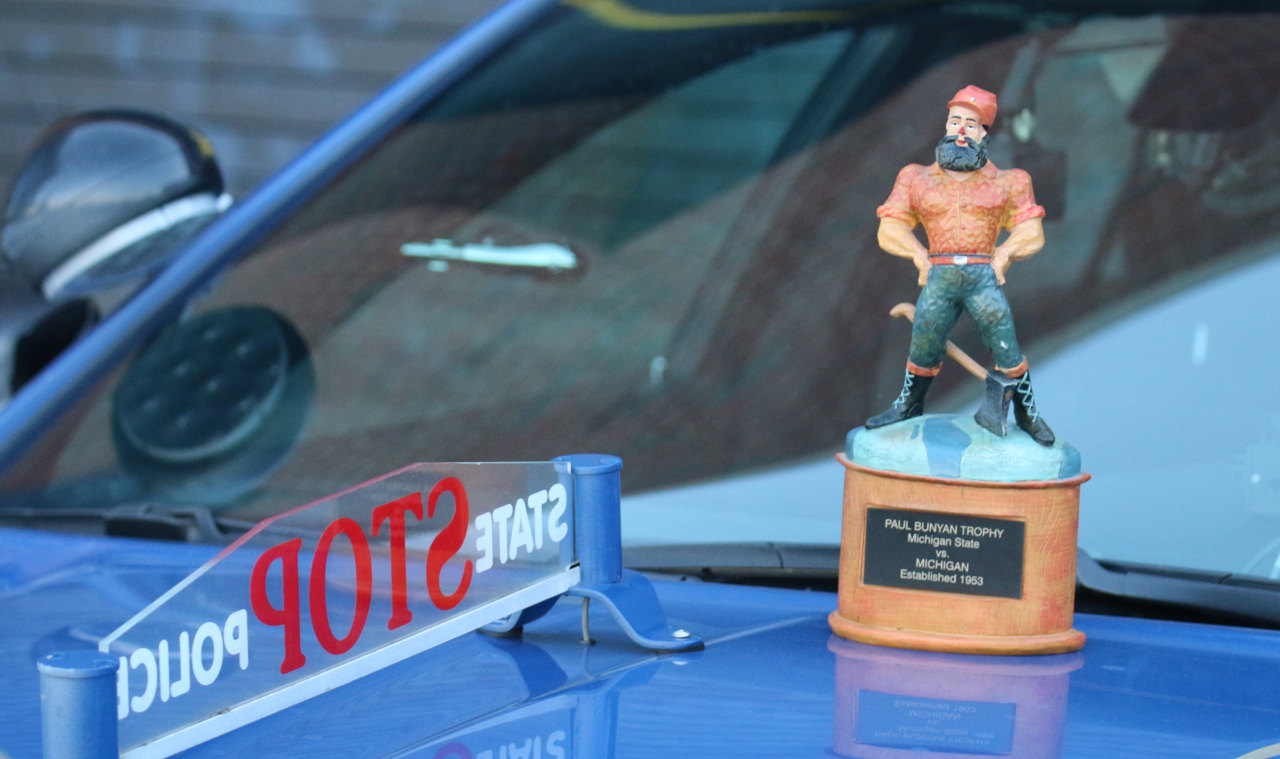
When it was over, Michigan won, 23-7, retaining the Paul Bunyan Trophy. It marked another milestone for the Wolverines on their march to a historic season. The Wolverines finished with a perfect 12-0 record and were named national champions by the Associated Press. Head coach Lloyd Carr would become a fixture in Ann Arbor, and many players went on to enjoy excellent careers, notably Charles Woodson and Tom Brady.

This and other great content can be found at newyorkwolverine.com

๐‘ณ๐‘ถ๐‘ถ๐‘ฒ๐‘ฐ๐‘ต๐‘ฎ ๐‘ฉ๐‘จ๐‘ช๐‘ฒ: ๐‘ด๐‘ฐ๐‘ช๐‘ฏ๐‘ฐ๐‘ฎ๐‘จ๐‘ต ๐‘ฝ๐‘บ. ๐‘ด๐‘ฐ๐‘ช๐‘ฏ๐‘ฐ๐‘ฎ๐‘จ๐‘ต ๐‘บ๐‘ป๐‘จ๐‘ป๐‘ฌ, 2006

Looking Back is a Special Feature by Jeff Cummins Highlighting Key Rivalry Games

This weekโ€™s series looks back at the football rivalry between Michigan and Michigan State. The first installment takes us back to 2006. The previous season had been a disappointment for Wolverine fans, but 2006 turned out to be a renaissance year. A big win over Notre Dame served notice that Michigan was back, setting the stage for a memorable season.

This series has mostly been about smash-mouth football. However, every now and then, someone tries something new. Michigan State head coach John L. Smith was in his fourth season, and his teams ran a spread offense. By contrast, Michigan coach Lloyd Carr used a multiple offense. However, the Wolverines leaned heavily on a time-tested formula, relying on a stingy defense and the running of Mike Hart behind a dominant offensive line. On this day, Michiganโ€™s reliable formula worked to perfection. As the game unfolded, Michigan used that balance to set up Chad Henneโ€™s first touchdown pass to Adrian Arrington. This play put the Wolverines in front. In 2006, once the Michigan defense was handed a lead, the Wolverines were usually in pretty good shape.

With a 7-0 lead, Michigan continued to pound away with Hart running the ball, almost lulling the Spartans to sleep. After repeated runs, Henne found Mario Manningham wide open for a 41-yard touchdown pass, and the rout was on.

From that pont, Michigan cruised to a 31-13 win that was most dominant than the score would indicate. The Wolverines were never seriously threatened, and this game set them on a collision course with Ohio State.

This and other great content can be found at newyorkwolverine.com

Michigan vs Alabama – Looking Back – 2000

Looking Back is a Special Feature by Jeff Cummins Highlighting Key Rivalry Games

The third installment of the series looking back at football games between Michigan and Alabama takes us to the Orange Bowl on Jan. 1, 2000. Itโ€™s difficult to fathom, but there was a time when people didnโ€™t recognize Tom Brady’s excellence.

Brady spent the first half of 2000 platooning with Drew Henson. Henson was the more recruited quarterback, having been rated as a five-star recruit in high school. Brady gradually seized full-time control of the quarterback position as the season went along, and Michiganโ€™s play improved with Brady at the helm.

Twice, Michigan fell behind by 14 points, but each time Brady calmly rallied the Wolverines, honing his reputation as the master of comeback victories.

Trailing 14-0, Brady connected with David Terrell for a pair of touchdown passes in the second quarter, one for 27 yards and one for 57 yards. By halftime, the game was tied at 14 apiece, and fans realized they were watching a classic.

Alabama reclaimed the lead and the momentum in the third quarter when Shaun Alexander scored on a 50-yard run and Freddie Milons added a 62-yard punt return to extend Alabamaโ€™s lead to 28-14.

Undeterred, the Wolverines came roaring back again. Brady found Terrell again for a 20-yard scoring strike and Anthony Thomas added a 3-yard touchdown run to tie the score and send the game to overtime. Brady wasted no time in overtime, throwing a 25-yard touchdown pass to Shawn Thompson. Hayden Epstein added the extra point, and the Wolverines had the lead for the first time. Alabama responded promptly as Andrew Zow threw a 21-yard touchdown pass to Antonio Carter. A mere extra point by Ryan Pflugner would now tie the score.

Except, Pflugner’s kick sailed wide, and the Wolverines claimed the Orange Bowl championship with a 35-34 overtime victory. It’s always tempting to wonder how Michigan’s season might have turned out had Brady been the sole quarterback since the first game, but that was useless to consider now. Michigan had won the Orange Bowl and concluded the decade of the ’90s with a bang.

We thank YouTube and ABC Sports for the attached broadcast.