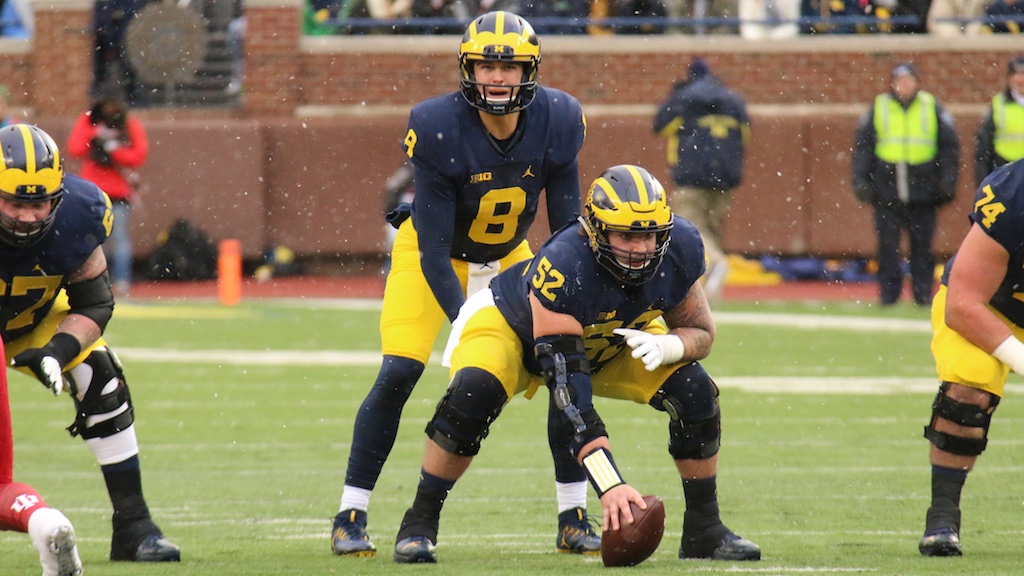
Michigan vs Michigan State Football – Looking Back – 1989

The third installment of the Michigan-Michigan State series takes us back to 1989. It was Bo Schembechler’s last season as Michigan head coach, and it began with a loss to Notre Dame and ended with a loss to USC in the Rose Bowl. Sandwiched in between those losses were 10 victories, marked by old school, Schembechler power football. The game against Michigan State was no different, and the 10-7 score is evidence of the hard-nosed, helmet-rattling sort of football that Bo loved.

One of the challenges for the Maize & Blue was that George Perles, who had made his name as the defensive line coach for the great Pittsburgh Steeler teams of the 1970s, coached the 1989 Michigan State team. The game pitted a veteran offensive line guru (Bo) vs. a veteran defensive line guru, in Perles. As you can guess, style points didn’t matter in that sort of game, and it meant that every detail became that much more important. Michigan blocked a field goal, and the Michigan running game finally got rolling when Tony Boles used his shiftiness to loosen up the Spartan defense. Still, the Michigan State defense stiffened after Michigan got a first down at the Spartan 4-yard line. Suddenly, Michigan was facing 4th down and goal to go inside the State 1 yard line. With the Wolverines lined up in a wishbone formation, Leroy Hoard got the ball and burst through a hole on the right side of the offensive line to give Michigan a hard-earned lead. Michigan continued to alternate between Hoard and Boles, and the Wolverines’ offensive line began to push the Spartans back consistently, setting up a 35-yard field goal by J.D. Carlson.

In the fourth quarter, State threatened to put a green tint on the game, but the Michigan defense wasn’t having any of it. Tripp Welborne stopped Blake Ezor at the goal line, as Michigan completed a classic goal line stand. With less than five minutes remaining in the game, Spartan QB Hyland Hickson found Courtney Hawkins just over the goal line, and Michigan’s lead was trimmed to three points. With seconds remaining, the Michigan defense stood tall, as Lance Dottin intercepted a pass by Dan Enos to foil the final Spartan threat.

The win capped a 17-4 lifetime record for Bo against the Spartans. Not bad for a coach who lost his inaugural game in the rivalry.

Thanks to youtube poster WolverineHistorian and ABC Sports for the broadcast clip. As always, I own nothing and this is presented strictly for the enjoyment of our readers.

Michigan vs Michigan State Football – Looking Back – 2008

The second installment of the Michigan-Michigan State series takes us to 2008. For the preceding 39 seasons, Michigan had been coached by descendants of the Bo Schembechler coaching tree, and those coaches produced fairly consistent success, including one perfect season, one national championship, 20 seasons in which Michigan won or tied for the Big Ten championship, and last but not least, pretty consistent success against Michigan State, with the Wolverines winning 30 of the previous 39 games. This produced an expectation of success against the Spartans.

All of that changed in 2008. Having been befuddled on several occasions by coaches who ran the spread offense, Michigan hired Rich Rodriguez, a spread guru, as its new head coach. Both sides will debate the reasons, but the Rodriguez regime didn’t produce the results that Michigan fans and alumni were anticipating. Conversely, Michigan State chose the opposite path, and had hired Mark Dantonio as its head coach the year before. Dantonio brought a basic I-formation offense back to Michigan State, and his focus on the power running game probably should have concerned Michigan from the outset. In 2007, Michigan defeated Michigan State with a classic comeback victory, prompting an exchange of comments in the media between Michigan running back Mike Hart and Dantonio. The rivalry probably would have experienced a shift at that point anyway, but Hart’s comments probably didn’t help matters.

Once the game started, it featured an interesting call, which is consistent with many of the games in this series. Running back Brandon Minor caught a pass and got his foot on a pylon, but it was initially ruled incomplete. After a review, the play was ruled a touchdown, which the network broadcast later said was incorrect. Ultimately, it didn’t matter much. Michigan State seized control the game in the final quarter, and came away with a 35-21 win, signaling the beginning of a Spartan green trend in the series.

Sadly, Rich Rodriguez never did figure out how to win in this series.

https://youtu.be/VQDgV7cFUo4

How Can Jabrill Peppers Win the Heisman? History Shows the Way

If you told me before the season started for Michigan Football that star athlete, Jabrill Peppers could take home the 2016 Heisman Trophy, I would have probably slapped you and called you absolutely crazy.

Yes, I know that Peppers was on the Heisman Watch and he was one of the most versatile athletes in 2015 but, the odds are stacked against a pure “defensive” player taking home the trophy.

Ok, let’s think about it for a second. Nineteen of the previous twenty Heisman winners has either been won by a quarterback or a running back. Ironically, the last winner that wasn’t either of those happened to be Michigans’ very own, Charles Woodson.

But after looking back at the glory days of maize and blue, there is actually a strong correlation between the Redshirt Sophomore and Michigans’ first and last Heisman winners: Tom Harmon (1940) and recently retired, and no doubt about it, future NFL Hall of Famer Charles Woodson (1997).

Big Plays Like Woodson

One of the biggest upsets in Heisman history is said to be in 1997, when Charles Woodson out dueled the Tennessee Vols playing, future Omaha yelling quarterback, Peyton Manning. Before his sophomore year, Woodson would be asked by than Michigan coach Lloyd Carr if he would contemplate playing on offense while keeping his starting Cornerback position. Carr knew what kind of athlete that he had in Woodson like Harbaugh does with Peppers. Woodson would wrap up his second season as an offensive threat, with 13 receptions for 164 yards and a touchdown, 6 rushes for 152 yards and a touchdown. While on defense he would set Michigan record with pass breakups with 15. While leading Michigan through a perfect season, Woodson caught 11 passes for 231 yards and 2 touchdowns. He also rushed 9 times for 167 yards and 2 touchdowns. I would say that this sounds a bit familiar

What set Woodson apart from Manning, is that he always delivered big plays in big games. If it was a catch, rush, reception or even his presence, When the team needed a spark he would set the entire field on fire. For instance, one of his most iconic plays was his 1-handed interception on the sideline against Michigan State which he finished with two in that game. An even better example, when he single handedly beat Ohio State when he returned a 78-yard punt for a touchdown, made an interception in the end-zone, and had a 37-yard reception that led to Michigan’s only offensive touchdown of the game. Yes, Peyton Manning finished the year with a 11-2 record and throwing for 3,819 yards and 36 touchdowns but Charles Woodsons’ non-stop playmaking ability would fare to be too much and would eventually help Michigan earn a trip to the Rose Bowl which later earned a share of the national title after beating Washington State 21-16 and give Michigan its third Heisman winner in 6 years.

The Forgotten Renaissance Man

In 1940, when the world was at war, the late great Thomas Harmon became Michigans first ever Heisman Trophy Winner. The grid iron has certainly changed from 76 years ago. They wore leather for helmets for Pete’s sake. There wasn’t even facemask or even concussion protocols like they have today. The highlights that Peppers is putting on this season is absolutely ridiculous. But would you believe me if I told you in his final College football game, Harmon led the Wolverines to a 40–0 win over the notorious Ohio State, scoring three rushing touchdowns, two passing touchdowns, four extra points, intercepting three passes, and punting three times for an average of 50 yards? Did you get that? That kind of stuff sounds damn near impossible these days After three magnificent years, Harmon rushed for 2,134 yards, scored 33 touchdowns and kicked the same number of point-after-touchdown, and booted two field goals for 237 career points. Oh yeah, he also threw sixteen touchdown passes. He literally put the team on his back and made play after play. Just like Peppers.

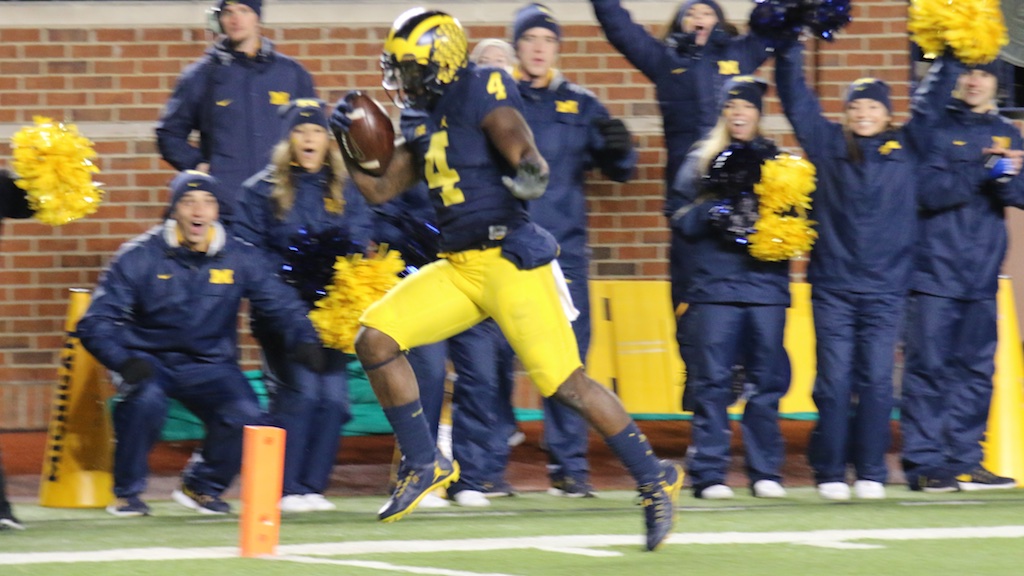
If given the opportunity, Peppers has the skill set to replicate “Old 98”. For example, after only playing the first half, Peppers would rush 3 times for 74 yards and two touchdowns. Late in the 1st Quarter, he would dodge six missed tackles and house a 44-yard punt return. My ankles were hurting for Rutgers after witnessing the run into the end zone. However, the touchdown was called back after a block in the back penalty early into the play. On defense, he also recorded two tackles at Linebacker. Are you following the trend yet?

“I really don’t know how I did that,” Peppers said when asked about the return. “But it felt good.”

Heisman is NOT a Long Shot

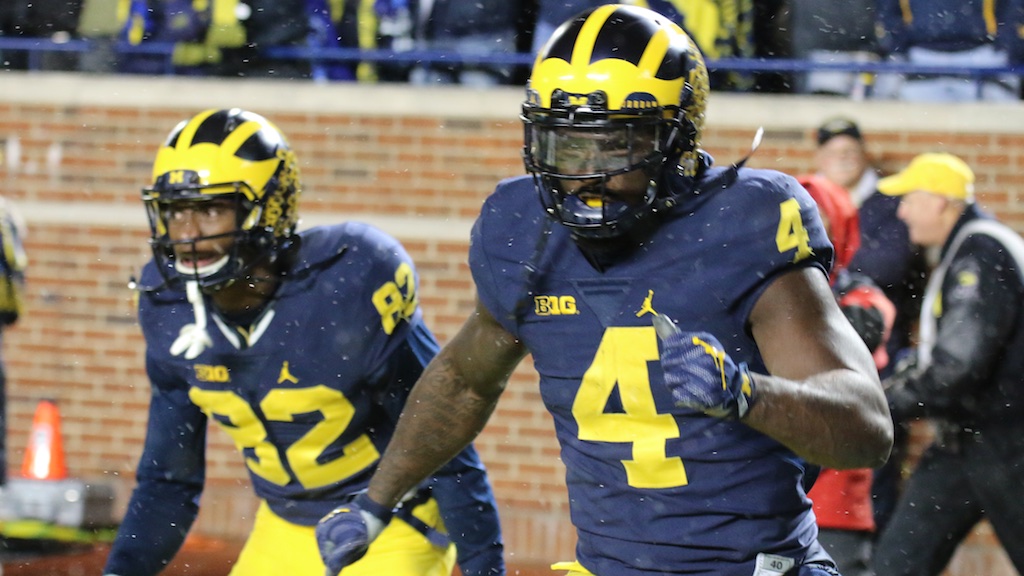
Through Michigan first half of the season, Peppers has played 13 different positions. Accumulating 442 all-purpose yards. With an average of 19.6, Peppers has rushed the ball 5 times for 98 and 2 touchdowns. 37 tackles, 10 tackles for loss with 2.5 sacks and six quarterback hurries.

“If there’s a better player in the country I don’t know who it is,” Harbaugh concluded. “To be able to coach a guy like Jabrill Peppers is a real joy. There’s nothing he can’t do. It’s the darndest thing I’ve ever seen. My humble opinion is we are looking at a Heisman Trophy winner. ”

Jim Harbaugh would later come out in a press interview and said that his second rushing touchdown was actually intended to be a roll out pass from Jabrill. My initial thought to this was, “He can throw too?” I’m not sure how true it is, but apparently the kid can throw a football 65 yards. If he was to do that against Ohio State, they might as well give him the Heisman Trophy.

2016-wisc-027

Even though he is putting up ridiculous numbers this year and making everyone mouths drop. Peppers thinks he has been playing below average.

“I don’t think I’ve been playing as well as people say I’ve been playing,” Peppers said on Tuesday, per the Detroit Free Press. “If I had to give myself a grade, I’d probably say C-minus. Definitely not where I want to be or where the team needs me to be.”

If he is grading himself that poorly, then I really don’t think we have seen everything that Peppers has to offer. He’s definitely no Woodson and there never will be another one like him. But Woodson never played linebacker and all of sudden wanted to throw for a touchdown. When it comes to the 2016 Heisman Trophy, one question still remains.

How can Jabrill win the Heisman if he prominently plays defense? In a very short answer, take over November like Charles Woodson did, and lead Michigan Football team to a National Championship run. Let’s be honest, I don’t even think he has broken a sweat yet.

Go Blue!

Michigan vs Michigan State Football – Looking Back – 1975

The college football landscape was much different in 1975. For that matter, the entire world was different. Nobody had even heard of the term “social media.” If you saw anyone carrying anything like a cell phone, it was either part of a science fiction movie, or one of those spectacular gadgets that James Bond used. On the gridiron, Michigan fans hadn’t yet developed a fear of mobile quarterbacks and spread offenses, and the team certainly didn’t have a defensive coordinator who designed blitzes to stop the spread. And if you wanted to wait for a sandwich at the corner of Kingsley and Detroit, you wouldn’t even have to wait on a line. Of course, that wouldn’t have helped you get a sandwich, since it was several years before Zingerman’s opened its doors.

There were a couple of things that were similar to our modern era, though. Michigan actually wore white pants in 1975, marking the last time a Wolverines team wore white pants in East Lansing. Of course, there are rumors of a Michigan uniform surprise this Saturday, but I digress.

The other thing the 1975 Wolverines had in common with the current Wolverines was a determination to run the ball behind a powerful offensive line. Head coach Bo Schembechler was so detail-oriented that he used a ruler to measure the splits between the stances of his offensive linemen. Schembechler was going to make sure his teams ran the ball well, a skill that has often proved to be the deciding factor against Michigan State. Michigan had a left tackle that season named Mike Kenn who went on to become one of the few offensive linemen in the NFL to have some success against Lawrence Taylor. The maize and blue also had a backup offensive lineman named Les Miles who went on to experience a fair amount of success as a football coach, though none of it occurred in Ann Arbor.

Most of all, the offensive line opened holes for running backs Gordon Bell and Rob Lytle. Together, Bell and Lytle combined for 216 yards on 39 carries against Michigan State, as the Wolverines seized possession of the ball and the game’s pace, averaging more than five yards a carry. Add in 69 yards on the ground by quarterback Rick Leach and it was obvious to see why Michigan controlled play that day. Ironically, Leach was the same type of quarterback who frustrated Michigan defenses in the early years of the 21st Century.

Still, the Spartans weren’t about to go quietly. After three quarters, the teams had split two field goals apiece, and it wasn’t until Bell scored on an 18-yard run in the fourth quarter that Michigan pulled away for good, leaving East Lansing with a 16-6 win over Michigan State. Unfortunately, the season ended in less-than-stellar fashion, as Michigan surrendered a late lead against Ohio State and fell to eventual national champion Oklahoma in the Orange Bowl. But with Leach, Bell, and Lytle on the offense, and linebacker Calvin O’Neal and safety Dwight Hicks on defense, 1975 was merely a prelude of things to come for Michigan football.

There was another thing that was interesting about 1975. President Gerald Ford was a Michigan graduate, having played on the undefeated national championship teams of 1932 and 1933.

Enjoy this clip of Michigan football practice from 1975.

The Tape, The Tape, The Tape – Michigan 41 Illinois 8– A Cornucopia of Manball

Michigan served notice to Illinois on the opening drive that there would be no rust or dawdling on Saturday.  The offense marched the field in 10 plays for an opening touchdown and never looked back.  The drive included three different quarterbacks, and oh yes, a formation that featured no less than five tight ends to serve as the perfect finale to an authoritative opening possession.
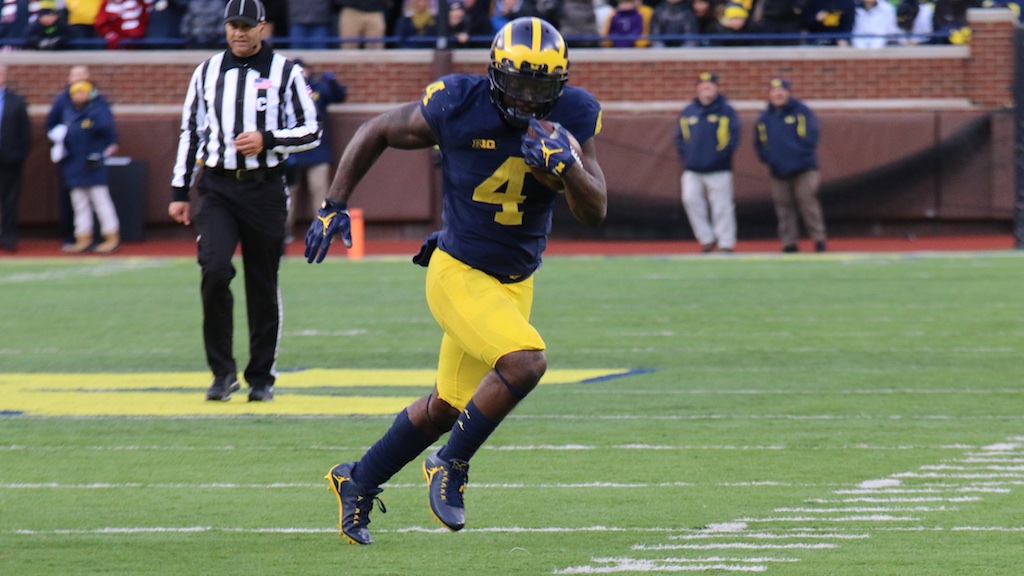
Have you ever seen a five Tight End formation?  No, you haven’t.  At least you hadn’t until Saturday.  The play started off with the second appearance of Michigan’s new “train” formation this year:
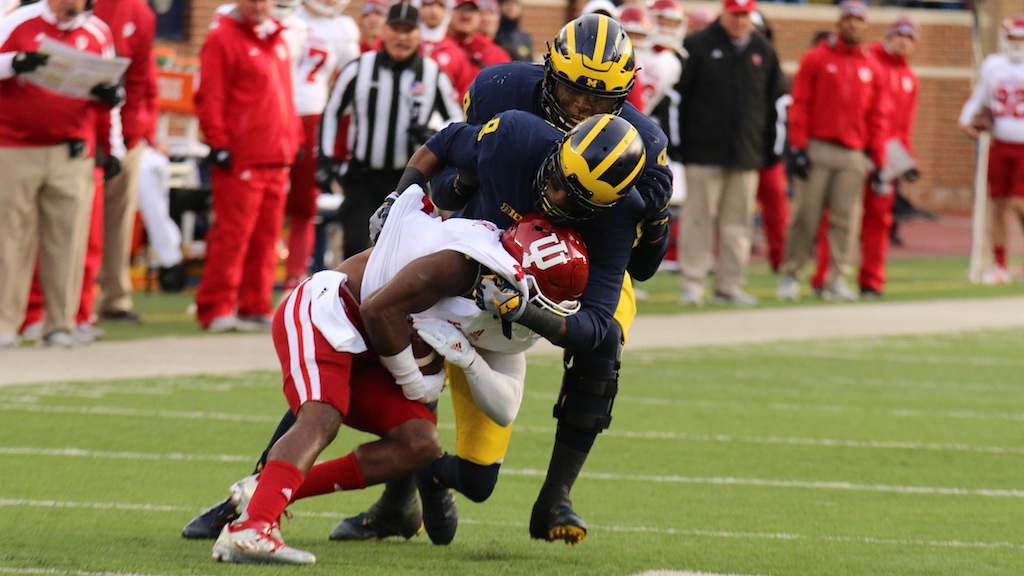
screen-shot-2016-10-25-at-4-12-54-pm

Let’s go ahead and circle the tight ends:

screen-shot-2016-10-25-at-4-13-21-pm

Yep, that’s five: Asiasi, Butt, Hill, Jocz, and Wheatley Jr.  All of the action of this play headed towards the bottom of the screen, save for Jake Butt.  Tyrone Wheatley Jr ran a perfect rub route that left Jake Butt uncovered coming across the field.

screen-shot-2016-10-25-at-4-13-42-pm

Unlike Michigan State’s receivers against Maryland, Wheatley Jr did not engage in a block on the defensive player and avoided an offensive pass interference flag for a pick play.

screen-shot-2016-10-25-at-4-14-28-pm


Continue reading “The Tape, The Tape, The Tape – Michigan 41 Illinois 8– A Cornucopia of Manball”