


UMGOBLUE.COM Michigan Wolverine Football & Basketball
By Fans…For Fans Since 1999
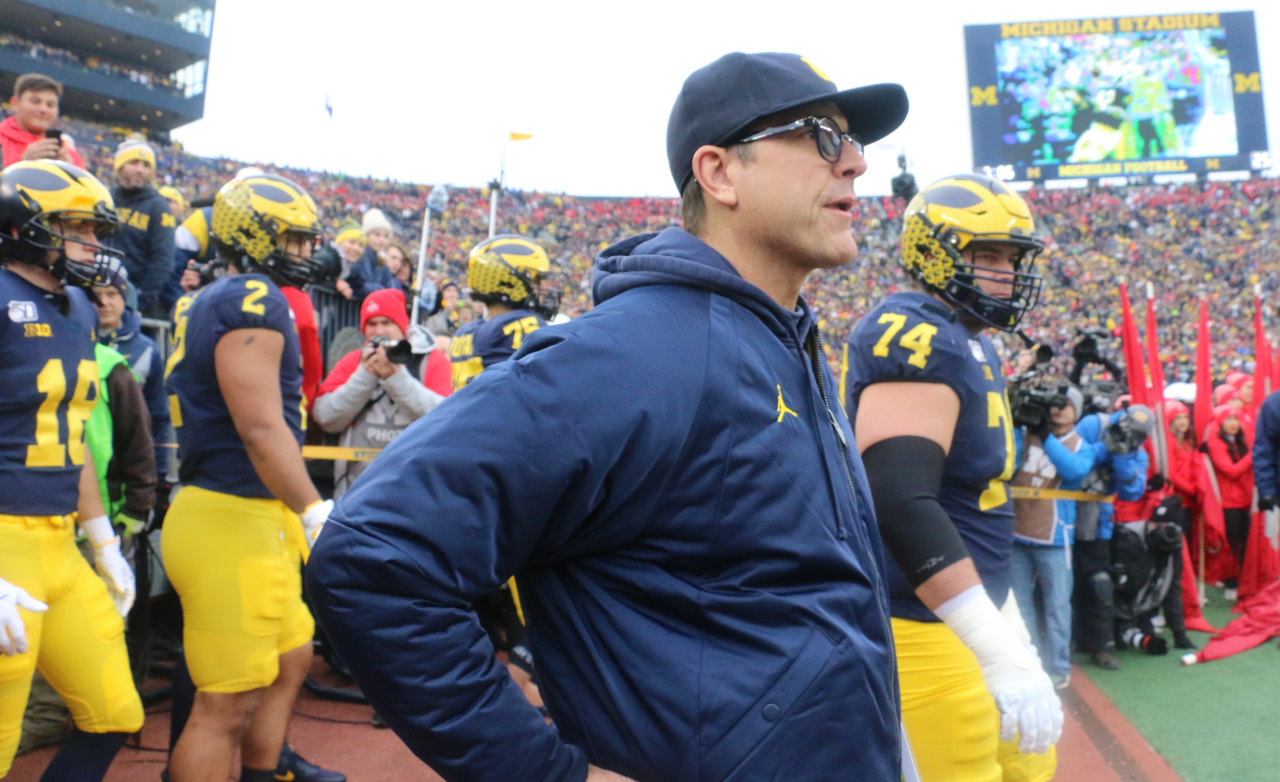
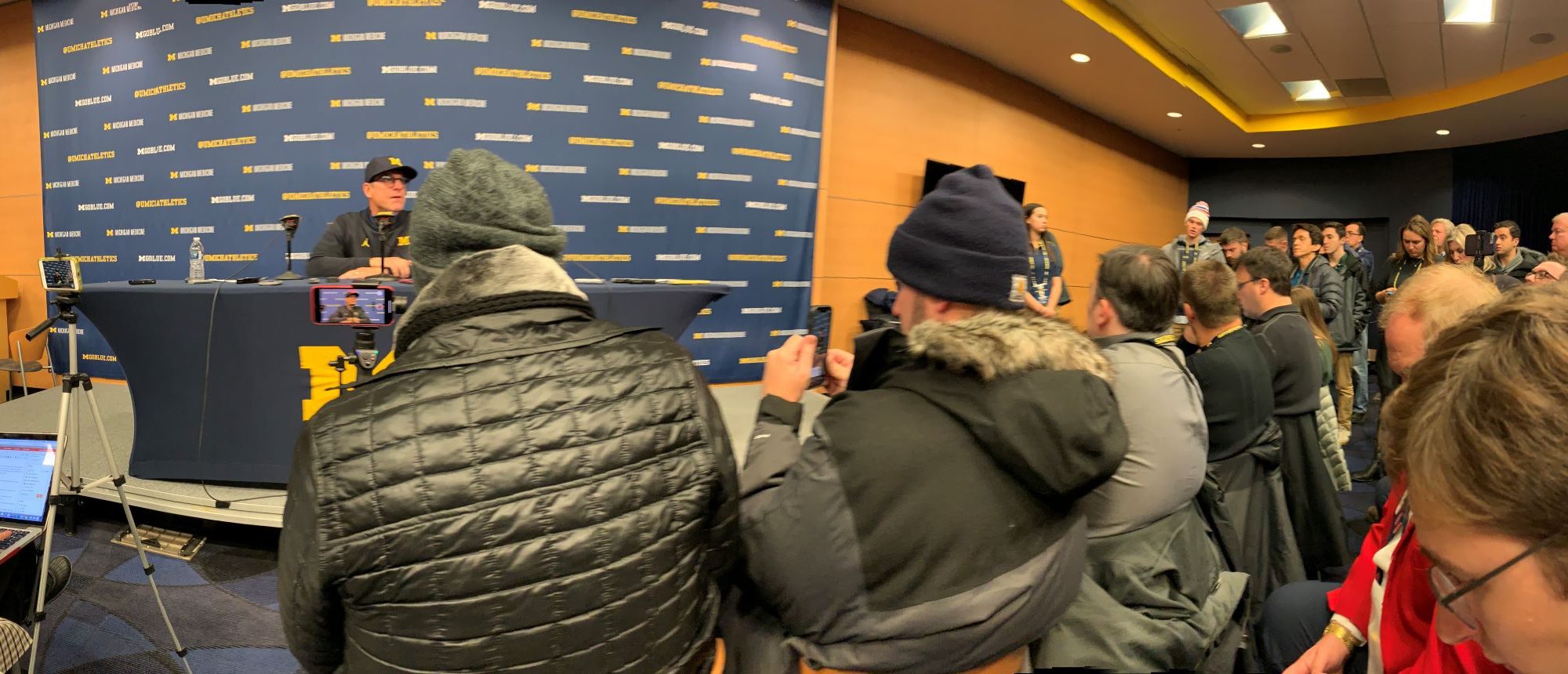
Michigan Head Coach Jim Harbaugh’s Week 12 Post Game Press Conference. Harbaugh jousts with the media while discussing Michigan’s 56-27 loss to Ohio State.
Support the Podcast- Get Gear -> shrsl.com/12ybi
iTunes -> Subscribe
Google Play -> Subscribe
Spotify -> Follow
Pandora -> Listen

Final Score: 56-27, Ohio State by 29 over Michigan
SP+ Projection: Ohio State by 11.0 (-18.0)
CD Projection: Michigan by 3 (-32)

This became another version of The Game that looked a lot like Michigan-Ohio State games of this generation. The Wolverines came out strong and scored on their first drive. They stood toe-to-toe through the first quarter at 14-13. But, as the 2nd quarter and 3rd quarter wore on, Ohio State continued to execute and make big plays. Michigan ran out of steam and looked hapless as the Buckeyes pulled away.
The offensive game plan provided a solid foundation for Michigan on the day. However, the Buckeyes’ #1 defense gave the Wolverines a dose of their own medicine by choking them out after halftime. The Wolverines could only muster 111 total yards against the smothering OSU defense in the 3rd and 4th quarters combined. Plays were available to be made, especially in the 3rd quarter, but too many of Shea Patterson’s passes hit the wide receivers and then hit the turf. As the clock turned to the 4th quarter, Michigan had completed just one pass in the 3rd frame. While Michigan’s 39% success rate is only slightly below average, looking at it by quarter is more telling: 53% (1st) 47% (2nd) 29% (3rd) 30% (4th).
While Michigan sputtered in the second half, Ohio State kept rolling. The Buckeyes scored 14 points in each quarter by staying true to their identity. JK Dobbins was explosive running the ball, and Justin Fields repeatedly hit deep shots through the air. OSU matched Michigan’s hot start with a 57% success rate and 8.4 yards per play in the 1st quarter. Unlike the Wolverines offense, Ryan Day and his staff had the next round of answers for their opponents’ in game adjustments. The Buckeyes’ 7.5 yards per play will likely send Jim Harbaugh’s staff back to the drawing board. That is the most Michigan allowed per play all season, including the early season blow out in Madison (6.9 YPP).
This puts the final stamp onto a frustrating season for Jim Harbaugh and the Michigan Wolverines football program. With the experience and talent returning from 2018, this team had their eyes set on much loftier goals. The goals are the correct ones. To achieve those championship goals, this program needs to execute in big games. There is nothing to do at this point but get back to work.

Looking Back is a Special Feature Highlighting
Key Rivalry Games by Jeff Cummins
The fifth installment of this year’s series looking back at the football series between Michigan and Ohio State takes us back to 1999. The economy was roaring, and on the football front, the Wolverines were maddeningly close. So close, but yet so far.
Much of that distance was due to an embarrassment of riches at the quarterback position. Michigan had two excellent quarterbacks. Tom Brady was a fifth-year senior who had a tremendous final season, while sophomore Drew Henson was the top quarterback recruit in the nation in the 1998 recruiting class. In the beginning of the 1998 season, Michigan coach Lloyd Carr let the two players split time at quarterback, which contributed to losses against Michigan State and Illinois. In hindsight, had Tom Brady played the entire way in both of those games, the Wolverines would likely have won both, and there’s a very good chance the Wolverines would have finished with their second perfect season in three years, and their second national championship in three years.
Brady nearly led Michigan back against Michigan State, which led Carr to pick Brady as the starter for the rest of the season. Suddenly, Michigan’s offense became one of the most clutch units in the nation down the stretch. Brady developed a knack for making big plays at big times, and his performance in the final three games of his Michigan career was arguably the most impressive three-game stretch by any quarterback in Michigan history. Against Ohio State, the Wolverines started slowly, and on several occasions, they appeared to be in serious trouble. With fewer than five minutes remaining in the third quarter, Ohio State running back Jonathan Well broke a tackle and ran from the Buckeyes’ 18-yard line to the Michigan 5-yard line, where cornerback Todd Howard saved the day, tackling Wells from behind. Michigan trailed by seven points at the time, and it appeared that Ohio State was on the verge of taking a commanding lead. That’s when the Michigan defense rose up and produced a series for the ages. On third down, Michigan safety Tommy Hendricks sacked Ohio State quarterback Steve Bellisari, who fumbled the ball. Still, Ohio State recovered, and had a shot at a field goal that would a comeback very difficult for Michigan. Following a bad snap, Dan Stultz missed the field goal, and Michigan had dodged a bullet. Suddenly, the Wolverines had new life, and a little momentum.
In the final minute of the third quarter, Michigan linebacker Ian Gold intercepted Bellisari, and returned the ball to the Ohio State 8-yard line. Brady wasted no time; connecting with tight end Shawn Thompson on a play action pass for the tying touchdown. With one quarter to go, the game had the feel of a classic contest between the two arch rivals.
On the ensuing possession, Michigan cornerback James Whitley tackled the football on an Ohio State pass, forcing a fumble that was recovered by safety Cato June. Once the Wolverines took possession, Brady was masterful; deftly mixing the pass and the run. On second down and nine yards to go, Brady connected with sophomore wide receiver Marquise Walker, who dove into the end zone for a touchdown, giving Michigan its first lead of the game. Finally, Michigan had given its defense a lead to protect, and the defense wasn’t about to let this game slip away. On Ohio State’s next possession, Michigan linebacker Dhani Jones sacked Bellisari, grabbing one leg and holding on until his teammates swarmed over Bellisari. On fourth down, Bellisari threw a pass for receiver Reggie Germany, but it fell harmlessly incomplete, as Dhani Jones waved his arms like a referee to signal the incomplete pass. Now, with just over two minutes remaining, the Michigan offense had the chance to put the game away, and the Wolverines delivered, with Brady sneaking for a first down on 3rd and 1 to cement the victory.
In the final moments of the game, several reporters in the press box remarked that this had started slowly, but wound up being a very good game. In essence, the 1999 Wolverines were much the same, finishing the season with five consecutive wins, including three consecutive comeback victories to end the season. Many players went on to prominent careers in the NFL, but this team will always be remembered for being so close to winning so much more. Yet, on the other hand, Michigan fans over the past 20 years would crave that kind of ending to their season. Ultimately, I think most historians will consider the 1999 Wolverines to be successful. On a personal note, this was the second time I attended a game at Michigan Stadium, and the only time I’ve attended a Michigan-Ohio State game. I flew in the day before with a press pass, and arrived at the Pioneer High School parking lot shortly before 9 a.m. I walked on the field before pre-game warmups had even started, and saw a couple of Ohio State players in their sweats, casually throwing a ball around. The day was in the low 40s, with a constant dampness in the air, and a morning dew on the stadium grass. After the game, I was in the postgame press conference in the then Crisler Arena (now the Crisler Center). I stood within a few feet of Brady while he was being interviewed, and I was next to massive guard Steve Hutchinson while he asked an assistant coach how Michigan State had done that day. For obvious reasons, the 1999 game was one of the most memorable in my opinion.
Thanks to ABC Sports, YouTube, and YouTube poster WolverineHistorian. As always, I own nothing, I do not profit in any way from this blog post.
Looking Back is a Special Feature Highlighting
Key Rivalry Games by Jeff Cummins
The fourth installment of this year’s series looking back at the football rivalry between Michigan and Ohio State takes us to 1990. Now, Michigan had a new coach, and the last remnants of The Ten Year War were gone. Three losses in the first six games left Michigan with no hope for a national championship, and the Wolverines played The Game strictly for pride.
Fortunately, pride is one of the greatest motivators for the Wolverines when they play Ohio State. In the third quarter, things weren’t going all that well for the Wolverines. Greg Frey (yes, that Greg Frey) completed a 12-yard touchdown pass to Jeff Graham and Ohio State took a seven-point lead. Momentum changed quickly when Derrick Alexander took the ensuing kickoff back inside the Ohio State 40-yard line. Then the Cleveland connection struck for Michigan, as Elvis Grbac found Desmond Howard on a 12-yard post pattern to tie the score, and it remained tied well into the fourth quarter. Late in the fourth quarter, Ohio State went for it on fourth and less than a yard to go from the Ohio State 30. On fourth down, the Wolverines stuffed Frey at the 29, and took possession there. Michigan moved the ball carefully, methodically, and with time for one final play, a field goal attempt.
Memories of the 1974 game were still fresh in the minds of many Michigan fans. In 1974, Mike Lantry kicked into the north end zone, and the referees ruled the kick was no good, while many said they thought it was good. This time, the kick would be toward the south end zone, and that’s when UM’s Floridian connection took over. Steve Everett snapped the ball, and J.D. Carlson kicked it straight down the middle for a 37-yard field goal as time expired to give Michigan a 16-13 win.
Michigan went on to beat Ole Miss in the Gator Bowl, 35-3, and Carlson went on to become the chief financial office of Penske Automotive Group. Everitt, one of the most ardent Wolverines of all time, made it to the NFL and is frequently seen at Michigan games. Grbac played in the NFL and served as the quarterbacks coach at St. Ignatius High School in Cleveland. Derrick Alexander enjoyed a successful career in the NFL, as did Desmond Howard, who won the Heisman Trophy, the Super Bowl MVP, and is currently seen on ESPN’s College Gameday broadcasts.
Thanks to ABC Sports, YouTube, and YouTube poster WolverineHistorian. As always, I own nothing and I do not profit from this blog post in any way.