The (#6) University of Michigan men’s basketball team played one (exhibition) game this past week, and they won it. On Friday (11/05/2021), they beat Wayne State 87-54. The game was played in Wayne State’s brand new fieldhouse, as the inaugural game. Since it was only an exhibition, Michigan’s record is still 0-0.
What Happened?
As I mentioned last week, it is rare for Michigan to play an exhibition game on the road, but this game was arranged as a courtesy to Wayne State so they could have a big-name opponent for the grand opening of their new fieldhouse, called, amazingly enough, Wayne State Fieldhouse.
The game itself was pretty much what you’d expect from a matchup between the defending Big Ten Champions and a Division II team. After a brief choppy period in the first 3 minutes, Michigan went ahead for good, 7-6, at the 17:00 mark. They didn’t pull very far ahead for the next 11 minutes, only leading by 8 (27-19) with 5:39 left in the half. That’s when they broke the game open, going on a 21-0 run to put the game out of reach, 48-19. WSU finally broke the UM scoring run with a basket with 16 seconds left in the half, to make it 48-21 at halftime.
WSU scored the first 4 points of the 2nd half, to get within 23 points (48-25) with 18:13 to go, but that was as close as they got. Michigan pushed the lead as high as 37 points, and coasted to a 33-point win.
Stats
The game stats were predictably good. Michigan shot well overall (31-for-59 = 52.5%), they shot 3-pointers well (9-for-21 = 42.9%), and they shot free throws decently (16-for-24 = 66.7%). They won the rebounding battle handily (51-39), but they lost the turnover battle (17-13). They won this game with good shooting, solid rebounding, and good defense (WSU shot 28.8%, 23-for-80).
Dickinson was tied for high scorer for Michigan, with 14 points, and he almost had a double-double, with 9 rebounds. He only played 23 minutes, so he could have easily had several more points and rebounds. With the game firmly in hand, Coach Howard rested him, and gave other players a chance to play.
Brooks had 12 points, going 4-for-4 from 3-point range. Of course, he missed his 3 shots inside the arc, to finish 4-for-7. He played mostly shooting guard, with a few minutes running the point.
Jones hit double figures, with 10 points on decent shooting (3-for-6 overall, 1-for-2 from 3-point range). He did a nice job running the offense, with 7 assists, although he did have 4 turnovers.
Houstan also hit double figures, with 10 points. He didn’t have a great night shooting (3-for-7 overall, 1-for-4 from 3-point range), but he did haul down 5 rebounds.
Johns almost hit double figures, with 8 points.
Moussa Diabate was the only sub to hit double figures, with 14 points, which tied him for high scorer for Michigan. He was the first player to sub in, and he did a nice job, shooting 6-for-9 and collecting 5 rebounds.
Terrance Williams II almost hit double figures, with 8 points on decent shooting (3-for-5 overall, 1-for-3 from 3-point range).
Who Looked Not-So-Good?
Nobody looked not-so-good.
Who Else Played?
Kobe Bufkin played for 17 minutes, mostly at shooting guard, with a couple minutes at point guard. He scored 3 points, shooting 1-for-4 overall, 1-for-3 from 3-point range.
Adrien Nuñez played for 13 minutes, and scored 3 points, shooting 1-for-3, all 3-pointers.
Brandon Wade played for 5 minutes, and scored 2 points, making his only shot attempt inside the arc and missing his only 3-point attempt.
Will Tschetter played for 5 minutes, and scored 2 points, making his only shot attempt.
Isaiah Barnes played for 6 minutes, and went 1-for-2 from the free throw line for 1 point.
Jace Howard played for 5 minutes, but didn’t attempt a shot.
Who Didn’t Play?
Ian Burns is on the scout team, so he’s a lower priority for minutes.
Frankie Collins is the only scholarship freshman who didn’t play. He has a groin injury.
Jaron Faulds is on the scout team, so he’s a lower priority for minutes.
What can we learn from an exhibition game against an overmatched opponent? Not much. It was nice to see the new players in an actual game, even if it was just an exhibition. Coach Howard got to try some lineup combinations, but it was too early to see if he has anything interesting in mind.
What’s Next?
This week, Michigan plays two games. On Wednesday (11/10/2021, 6:30 p.m., BTN) they play Buffalo in Crisler Arena, then on Saturday (11/13/2021, 8:00 p.m., BTN) they play Prairie View A&M in Washington, DC.
Buffalo was 16-9 last season, 12-5 in the MAC. They didn’t have any impressive wins, and they lost in the 1st round of the NIT. They don’t have any superstar players on their roster, but they do have decent height, with 6’10” and 6’11” centers. This should be a decent test for Michigan, but one they can pass if they stay focused.
Prairie View A&M was 16-5 last season, 13-0 in the SWAC. They didn’t have any impressive wins, and they lost in their conference tournament, so they didn’t go on to postseason play. They don’t have any superstar players, and they don’t have much height. This is a game Michigan should win handily.
So, why is Michigan playing Prairie View A&M in Washington, DC? This game is part of a project called “Coaches vs. Racism”, which will match up Big 10 schools against HBCU (Historically Black Colleges and Universities) in basketball. The first game in the series is this one between Michigan and Prairie View A&M.
Check back next week to find out what happened and why.
Yeah, it’s time for college basketball again. We’re still dealing with the COVID-19 pandemic, but at least there will be fans in the seats in Crisler Arena again this season, after a full season of playing in empty arenas. That means I’ll be ushering again, in Sections 209-210. Drop by to say hi when you’re in Crisler.
Here’s my traditional standard description of this weekly column:
Yeah, it’s time for University of Michigan men’s basketball, and this is the place to read all about it: “Nothing But ‘Net” on UMGoBlue.com. Check back every Monday morning between now and the end of the season for a quick, concise wrap-up of the previous week, and a look ahead at the upcoming week, all in one easy-to-read article.
As always here at UMGoBlue.com, the perspective is “by fans, for fans”. I’m a fan (since 1974), and I go to all the home games, and watch/listen to all the away games. I don’t have any special access (other than being an usher in Sections 209-210), I don’t go to the press conferences, and I don’t interview high school recruits. I see the same things you do, and write about them as a fan.
Once again, it was a very busy off-season, with lots of surprises and changes. Let’s get to it.
Executive Summary
The big question: how good is Michigan going to be this season?
The big answer: very good. Final Four good. National Championship contender good.
What’s New?
There are lots of changes to the roster from last season:
7 graduating seniors
1 player departure
7 incoming freshmen
1 incoming transfer player
Graduating Seniors
Graduating seniors are a natural part of the college sports experience. In the current environment of players leaving early for the NBA, or transferring to other schools, it is getting to be a rare event when a player stays all 4 years at the same school and graduates. While it is sad to see players leave after having watched them for 4 years, it is really something to be celebrated and appreciated. Michigan had a large senior class last season, 8 players in all. They all graduated, and 7 of them moved on, but one of them took advantage of the “free year” that the NCAA allowed due to COVID-19. The 7 that moved on are:
C.J. Baird – C.J. was mostly a scout team player, although he did get a little more playing time and scored a few more points than your average scout team player.
Chaundee Brown – Chaundee was a one-year player at Michigan, having used the “grad transfer” rule to transfer from Wake Forest. He was the “6th man” on the team, and he played pretty well. He will be missed.
Austin Davis – Austin was a rare redshirt senior last season. He was a regular contributor, and an occasional starter. He will be missed.
Isaiah Livers – Isaiah was a 4-year starter, and arguably the most valuable player on the team for 2-3 seasons. He was drafted by the Detroit Pistons in the 2nd round of the NBA Draft (42nd pick overall). He will definitely be missed.
Rico Ozuna-Harrison – Rico was a scout team player who didn’t get to play much.
Mike Smith – Mike was a one-year player at Michigan, having used the “grad transfer” rule to transfer from Columbia. He was the starter all season at point guard, and he had a great year. He will be missed.
Luke Wilson – Luke was a scout team player who didn’t get to play much.
I wish that Chaundee Brown, Austin Davis, Isaiah Livers, and Mike Smith had taken advantage of the one-time “free year” COVID-19 policy by the NCAA to come back for one more year, but we still wish them well, along with the other 3 seniors.
The one player who chose to come back for the “free year” is Eli Brooks, profiled below.
Player Departures
The only player to leave the Michigan program with remaining eligibility was Franz Wagner, who was drafted by the Orlando Magic is the 1st round (8th pick overall). He will definitely be missed.
Incoming Freshmen
This is the big story this season: Michigan has the #2 (was #1 until Memphis grabbed a couple reclassified players) recruiting class in the nation. There are 7 incoming freshman players this season, 6 of them on scholarship:
Isaiah Barnes #11 (6’7”, 185 pounds, G/F) – Isaiah is a 4-star small forward, and the #25 small forward in his class. He’s listed as a “guard/forward” on the official roster, but we unofficially call him a “wing”. He’s got the shooting ability of a guard, with the size and strength of a forward.
Kobe Bufkin #2 (6’4”, 175 pounds, G) – Kobe is a 4-star combo guard, and the #4 combo guard in his class.
Ian Burns #13 (6’6”, 200 pounds, G) – Ian is the only non-scholarship freshman this season. He’ll be on the scout team.
Frankie Collins #10 (6’1”, 185 pounds, G) – Frankie is a 4-star point guard, and the #10 point guard in his class.
Moussa Diabate #14 (6’11”, 210 pounds, F) – Moussa is a 5-star power forward, and the #6 power forward in his class.
Caleb Houstan #22 (6’8”, 205 pounds, G/F) – Caleb is a 5-star power forward, the #3 power forward in his class, and the highest ranked of the incoming freshmen.
Will Tschetter #42 (6’8”, 230 pounds, F) – Will is a 3-star power forward.
Once again, this is the #1 recruiting class in the Big Ten this season. The only question is, can Coach Howard combine all the elements into a cohesive team.
Incoming Transfer Players
Last season, Coach Howard went to the transfer portal and picked up two very talented players who played for one season at Michigan: Chaundee Brown and Mike Smith. This season, he’s going to the well again, looking for another one-year player to be the main point guard:
DeVante’ Jones #12 (6’1”, 200 pounds, G) – DeVante’ is a transfer from Coastal Carolina. He will be the main point guard this season. He’ll have senior eligibility, with one season left to play.
Who’s Coming Back?
Michigan is a very young team this season, with a lot of new faces. However, there is a solid core of returning players.
Let’s look at the returning players on the team:
Sophomore Eligibility
Hunter Dickinson #1 (7’1”, 260 pounds, C) – Hunter was the heart of the team last season. He led the team in scoring (14.1 points/game), rebounding (7.4 rebounds/game), and blocked shots (40). He was 2nd on the team in shooting percentage (59.8%). He played in all 28 games, and started the last 23. He scored in double figures in 23 games, and broke 20 points in 5 of them, including 26 and 28 points. On the “minus” side, he did lead the team in turnovers (64) and fouls (71), and he went 0-for-4 for the season from 3-point range. Still, he was the undisputed MVP, and he earned 2nd team All America honors on all four of the major teams.
Jace Howard #25 (6’7”, 225 pounds, G) – Jace is on scholarship, but he wasn’t part of the main rotation of players last season. He played in 11 games, for a total of about 32 minutes, and scored 12 points. It’s not clear if he will play much more this season.
Zeb Jackson #3 (6’5”, 190 pounds, G) – Zeb is on scholarship, but he wasn’t part of the main rotation of players last season. He played in 16 games, for a total of about 86 minutes, and scored 16 points. He’ll get his chance at point guard this season.
Terrance Williams II #5 (6’7”, 230 pounds, F) – Terrance is on scholarship, but he wasn’t part of the main rotation of players last season. He played in 21 games, for a total of about 159 minutes, and scored 40 points. He looked good in some of the non-conference games (7 points vs. Oakland, 10 points vs. Central Florida), but he had way too many 0-point games. He’ll get his chance at small forward this season.
Junior Eligibility
Brandon Wade #4 (6’1”, 190 pounds, G) – Brandon is a preferred walk-on. Last season, he played in 3 games, for a total of about 3 minutes, but didn’t take any shots. He’s part of the scout team.
Senior Eligibility
Eli Brooks #55 (6’1”, 185 pounds, G) – Eli is actually a “super senior”, with a rare fifth year of eligibility due to COVID-19 rules. Last season, Eli mostly played shooting guard, with occasional stints at point guard. He was 4th on the team in scoring (9.5 points/game), 1st on the team in free throw percentage (90.9%), 2nd on the team in steals (29), and he hustled when he was in there. He’s a very good defender, and he’s what’s known as a “glue guy”.
Jaron Faulds #44 (6’10”, 240 pounds, F) – Jaron is a preferred walk-on. Last season, he played in 10 games, for a total of about 29 minutes, and scored 4 points. He’s part of the scout team.
Brandon Johns, Jr. #23 (6’8”, 240 pounds, F) – Last season, Brandon played a lot at center when Michigan played “small ball”, and the results were uneven. He didn’t score much (4.9 points/game), and he didn’t rebound as well as he did before (2.3 rebounds/game).
Adrien Nuñez #0 (6’6”, 220 pounds, G) – Adrien is on scholarship, but he wasn’t part of the main rotation of players last season. He played in 10 games, for a total of about 32 minutes, and scored 6 points. He’s part of the scout team.
Starting Lineup/Depth Chart
This is really tricky this season, with all the new players. My guess:
Point guard: Jones (backups: Collins, Jackson, and Brooks) Shooting guard: Brooks (backups: Bufkin, Collins, and Jackson) Small forward: Johns (backups: Barnes, Houstan, Williams, and Tschetter) Power forward: Houstan (backups: Diabate, Johns, Tschetter, and Williams) Center: Dickinson (backups: Diabate and Johns)
Last Season
From last season’s Wrap-Up article:
Preseason expectations were mixed for Michigan. Most of the experts picked Michigan to finish 5th or 6th in the Big Ten, although a few picked Michigan as a “dark horse” contender for the title. Here are the results.
Due to the COVID-19 pandemic, the season started about three weeks later than usual, and the schedule was smaller than usual. The last few years, teams were allowed to play 31 games, but this year most teams played 25-27 games. Michigan played five non-conference games, along with 20 Big Ten games. Michigan started the season ranked #25 in the polls, but quickly dropped out after a couple underwhelming victories over outmatched opponents, including an overtime win over Oakland. Still, they were victories, as Michigan tried to develop team chemistry on the fly. The only interesting non-conference game was going to be against North Carolina State, in the ACC/Big Ten Challenge, but it was cancelled due to COVID-19 issues on the NC State team. Fortunately, Michigan managed to hustle up a last-minute replacement (Toledo), and they got in all five non-conference games, and won them all.
UM started the Big Ten schedule with six straight wins, including three 19+ point victories in a row over Top 25 teams: (#19) Northwestern, (#16) Minnesota, and (#9) Wisconsin. The Wisconsin game in particular was a good, old-fashioned butt-whipping, probably the best game of the season. By this time, Michigan had climbed to #7 in the polls, with an 11-0 (6-0 in Big Ten) record. Despite having crushed Minnesota in Ann Arbor (82-57), Michigan lost the rematch in Minneapolis badly, 75-57, for their first loss. This was easily the worst game and the low point of the season. They won their next two games, to raise their record to 13-1 (8-1 in Big Ten), and then … the whole UM athletic department shut down for two weeks, even the teams with no COVID-19 problems, like the basketball team. That forced them to postpone five games, including one that had already been postponed once before. They ended up rescheduling two of these five games, so they only played 17 of their 20 Big Ten games, which became an issue later. Read on.
When UM finally returned from their two-week shutdown, they won their next five games, which gave them a new seven-game winning streak, and pushed them up to #2 in the polls. At this point, the Big Ten realized that a few of the Big Ten teams, including Michigan, weren’t going to be able to play all 20 games, so they announced that the regular season champion would be decided by winning percentage. Based on the standings at that point, it meant that Michigan had to win just one of their three remaining games to win the regular season championship outright. The good news is that Michigan did win one of the games. The bad news is that they lost the other two games. One of the losses was a 23-point beatdown by the 2nd place team, (#4) Illinois. The other loss was a heartbreaker on Michigan State’s Senior Night. Sandwiched in between was a 19-point thrashing of MSU in Ann Arbor.
Michigan stumbled into the Big Ten Tournament with 2 losses in their last 3 games, and didn’t do very well in the tournament, beating the #8 seed (Maryland) and losing to the #5 seed (Ohio State).
On to the NCAA Tournament. Michigan was the #1 seed in the East Region, and they won 3 games (16-seed Texas Southern, 8-seed LSU, and 4-seed Florida State) before losing to the 11-seed UCLA.
So, what was the issue mentioned above? The final Big Ten standings showed:
Michigan 14-3 (0.824) Illinois 16-4 (0.800)
The Illinois team, fanbase, and even athletic director got it into their heads that they were the regular season champions, since they beat Michigan head-to-head and won more games. They didn’t seem to understand the concept of “winning percentage”. As it happened, Illinois won the Big Ten Tournament, so they got their championship, but not the regular season crown.
Karma is a b*tch. Illinois went into the NCAA Tournament convinced that they were going to beat up everyone, but they were upset in the 2nd round by Loyola-Chicago. Actually, other than Michigan, the Big Ten laid an egg in the Big Dance. All of the other Big Ten teams in the field were eliminated in the first week (first two rounds):
Michigan State (11-seed) lost to UCLA (11-seed) in a “First Four” game on Thursday
Ohio State (2-seed) lost to Oral Roberts (15-seed) in a 1st round game on Friday
Purdue (4-seed) lost to North Texas (13-seed) in a 1st round game on Friday
Illinois (1-seed) lost to Loyola-Chicago (8-seed) in a 2nd round game on Sunday
Wisconsin (9-seed) lost to Baylor (1-seed) in a 2nd round game on Sunday
Rutgers (10-seed) lost to Houston (2-seed) in a 2nd round game on Sunday
Iowa (2-seed) lost to Oregon (7-seed) in a 2nd round game on Monday
Maryland (10-seed) lost to Alabama (2-seed) in a 2nd round game on Monday
Of those eight losses by the Big Ten teams, one of them was a “toss up” (MSU), three of them were expected (Wisconsin, Rutgers, and Maryland), and four of them were upsets (OSU, Purdue, Illinois, and Iowa).
Even though they did the best of the Big Ten teams, Michigan still was eliminated earlier than their #1 seed suggested. They really should have beaten UCLA in the Elite Eight and gone on to the Final Four.
This Season
After the weird schedule last season (only 25 games [5 non-conference and 20 Big Ten], with no exhibition games and no holiday tournament), Michigan has a normal schedule again.
Let’s look at Michigan’s schedule for this season:
Some comments on the schedule:
It’s very unusual for Michigan to play an exhibition game on the road. It’s even more unusual for Michigan to play an away non-conference game against a much smaller opponent. However, it all makes sense when you realize that Michigan is helping Wayne State inaugurate a brand new arena, which is still unnamed, but tentatively called “Wayne State Arena”. This 3,000 seat arena will be used by Wayne State and the Pistons NBA G-League team, the Motor City Cruise.
Michigan is playing in four special events close together, involving five games, four of those games away from Crisler:
The ACC/Big Ten Challenge game vs. North Carolina is going to be very challenging.
The six “generic” non-conference games (Buffalo, Tarleton State, San Diego State, Southern Utah, Purdue – Fort Wayne, and Central Florida) are all winnable, and will be good preparation for the Big Ten schedule.
Once again, it’s very unusual for Michigan to play an away non-conference game against a smaller school, but Michigan is playing Central Florida (UCF) away on 12/30/2021.
The two December Big Ten games (at Nebraska, home vs. Minnesota) are both very winnable.
There are a couple particularly tough stretches in the schedule:
The first six Big Ten games in 2022 are all against teams that are either ranked or “getting votes” in the AP preseason poll.
The five games starting with the away Purdue game (02/05/2022) through the away Wisconsin game (02/20/2022) have the Wolverines playing four out of five games on the road.
Each Big Ten team plays 6 teams once (3 home/3 away) and 7 teams twice, for a total of 20 games. This season, Michigan plays:
Once: Minnesota (home), Maryland (home), Indiana (away), Northwestern (home), Penn State (away), Wisconsin (away).
I like to divide the games up into 3 categories (“Should Win”, “Should Lose”, and “Toss Up”):
Should Win (18) – Buffalo, Prairie View A&M, Seton Hall, UNLV, Arizona/Wichita State, Tarleton State, San Diego State, Nebraska (twice), Minnesota, Southern Utah, Purdue-Fort Wayne, Central Florida, Rutgers (twice), Northwestern, Penn State, Iowa (home).
Should Lose (5) – North Carolina, Illinois (away), Michigan State (away), Purdue (away), Ohio State (away).
Toss Up (8) – Michigan State (home), Purdue (home), Maryland, Indiana, Ohio State (home), Iowa (away), Wisconsin, Illinois (home).
If UM can win all 18 of the “Should Win” games, and half (4) of the 8 “Toss Up” games, that would give them a record of 22-9 (12-8 in the Big Ten). That should be good enough to get UM into the NCAA Tournament with a decent seed. They’ll need to win more like 6 of the 8 “Toss Up” games and 2 of the “Should Lose” games to contend for the Big Ten title.
The Big Ten
The Big Ten looks very tough again this season, with 5 teams in the Top-25 of the AP Preseason Poll:
In addition, 2 teams (Michigan State and Indiana) were in the “Also Receiving Votes” list (#26 and #27, respectively).
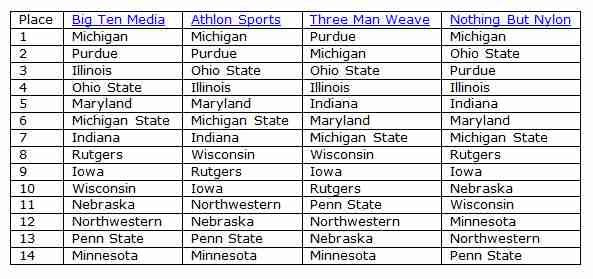
Here is the predicted order of finish for the Big Ten, according to various sites:
This Week
This week, Michigan only plays one game. On Friday (11/05/2021, 7:00 p.m., No TV) they play at Wayne State, in their only exhibition game.
Wayne State was 12-7 (12-5 in the GLIAC) last season. They are a Division II team, and they didn’t play any Division I schools last season. They don’t have any noteworthy players, and they don’t have much height. This should be an easy exhibition game.
Check back next week to find out what happened and why.
The season is over for the University of Michigan men’s basketball team, and it was a good one. Not quite as great as it could have been, but way beyond the preseason expectations. Michigan won the Big Ten regular season championship, and advanced to the Elite Eight in the NCAA Tournament. They ended up with a record of 23-5. It was a good season.
Season Wrap-Up
Preseason expectations were mixed for Michigan. Most of the experts picked Michigan to finish 5th or 6th in the Big Ten, although a few picked Michigan as a “dark horse” contender for the title. Here are the results.
Due to the COVID-19 pandemic, the season started about three weeks later than usual, and the schedule was smaller than usual. The last few years, teams were allowed to play 31 games, but this year most teams played 25-27 games. Michigan played five non-conference games, along with 20 Big Ten games. Michigan started the season ranked #25 in the polls, but quickly dropped out after a couple underwhelming victories over outmatched opponents, including an overtime win over Oakland. Still, they were victories, as Michigan tried to develop team chemistry on the fly. The only interesting non-conference game was going to be against North Carolina State, in the ACC/Big Ten Challenge, but it was cancelled due to COVID-19 issues on the NC State team. Fortunately, Michigan managed to hustle up a last-minute replacement (Toledo), and they got in all five non-conference games, and won them all.
UM started the Big Ten schedule with six straight wins, including three 19+ point victories in a row over Top 25 teams: (#19) Northwestern, (#16) Minnesota, and (#9) Wisconsin. The Wisconsin game in particular was a good, old-fashioned butt-whipping, probably the best game of the season. By this time, Michigan had climbed to #7 in the polls, with an 11-0 (6-0 in Big Ten) record. Despite having crushed Minnesota in Ann Arbor (82-57), Michigan lost the rematch in Minneapolis badly, 75-57, for their first loss. This was easily the worst game and the low point of the season. They won their next two games, to raise their record to 13-1 (8-1 in Big Ten), and then … the whole UM athletic department shut down for two weeks, even the teams with no COVID-19 problems, like the basketball team. That forced them to postpone five games, including one that had already been postponed once before. They ended up rescheduling two of these five games, so they only played 17 of their 20 Big Ten games, which became an issue later. Read on.
When UM finally returned from their two-week shutdown, they won their next five games, which gave them a new seven-game winning streak, and pushed them up to #2 in the polls. At this point, the Big Ten realized that a few of the Big Ten teams, including Michigan, weren’t going to be able to play all 20 games, so they announced that the regular season champion would be decided by winning percentage. Based on the standings at that point, it meant that Michigan had to win just one of their three remaining games to win the regular season championship outright. The good news is that Michigan did win one of the games. The bad news is that they lost the other two games. One of the losses was a 23-point beatdown by the 2nd place team, (#4) Illinois. The other loss was a heartbreaker on Michigan State’s Senior Night. Sandwiched in between was a 19-point thrashing of MSU in Ann Arbor.
Michigan stumbled into the Big Ten Tournament with 2 losses in their last 3 games, and didn’t do very well in the tournament, beating the #8 seed (Maryland) and losing to the #5 seed (Ohio State).
On to the NCAA Tournament. Michigan was the #1 seed in the East Region, and they won 3 games (16-seed Texas Southern, 8-seed LSU, and 4-seed Florida State) before losing to the 11-seed UCLA.
So, what was the issue mentioned above? The final Big Ten standings showed:
Michigan 14-3 (0.824)
Illinois 16-4 (0.800)
The Illinois team, fanbase, and even athletic director got it into their heads that they were the regular season champions, since they beat Michigan head-to-head and won more games. They didn’t seem to understand the concept of “winning percentage”. As it happened, Illinois won the Big Ten Tournament, so they got their championship, but not the regular season crown.
Karma is a b*tch. Illinois went into the NCAA Tournament convinced that they were going to beat up everyone, but they were upset in the 2nd round by Loyola-Chicago. Actually, other than Michigan, the Big Ten laid an egg in the Big Dance. All of the other Big Ten teams in the field were eliminated in the first week (first two rounds):
Michigan State (11-seed) lost to UCLA (11-seed) in a “First Four” game on Thursday
Ohio State (2-seed) lost to Oral Roberts (15-seed) in a 1st round game on Friday
Purdue (4-seed) lost to North Texas (13-seed) in a 1st round game on Friday
Illinois (1-seed) lost to Loyola-Chicago (8-seed) in a 2nd round game on Sunday
Wisconsin (9-seed) lost to Baylor (1-seed) in a 2nd round game on Sunday
Rutgers (10-seed) lost to Houston (2-seed) in a 2nd round game on Sunday
Iowa (2-seed) lost to Oregon (7-seed) in a 2nd round game on Monday
Maryland (10-seed) lost to Alabama (2-seed) in a 2nd round game on Monday
Of those eight losses by the Big Ten teams, one of them was a “toss up” (MSU), three of them were expected (Wisconsin, Rutgers, and Maryland), and four of them were upsets (OSU, Purdue, Illinois, and Iowa).
Even though they did the best of the Big Ten teams, Michigan still was eliminated earlier than their #1 seed suggested. They really should have beaten UCLA in the Elite Eight and gone on to the Final Four.
Final Grades
Here are the final grades, with the mid-term grades included for comparison:
Freshman Eligibility
Hunter Dickinson (A/A) – Hunter was the heart of this team. He led the team in scoring (14.1 points/game), rebounding (7.4 rebounds/game), and blocked shots (40). He was 2nd on the team in shooting percentage (59.8%). He played in all 28 games, and started the last 23. He scored in double figures in 23 games, and broke 20 points in 5 of them, including 26 and 28 points. On the “minus” side, he did lead the team in turnovers (64) and fouls (71), and he went 0-for-4 for the season from 3-point range. Still, he was the undisputed MVP, and he earned 2nd team All America honors on all four of the major teams.
Jace Howard (Inc./Inc.) – Jace is on scholarship, but he wasn’t part of the main rotation of players this season. He played in 11 games, for a total of about 32 minutes, and scored 12 points. He did have an exciting moment when he scored 3 points in the closing minutes of the Florida State game in the NCAA Tournament on an “and-one”.
Zeb Jackson (Inc./Inc.) – Zeb is on scholarship, but he wasn’t part of the main rotation of players this season. He played in 16 games, for a total of about 86 minutes, and scored 16 points. He also had an exciting moment in the NCAA Tournament, when he hit back-to-back 3-pointers in the 1st half of the Texas Southern game. He’ll get his chance at point guard next season.
Terrance Williams II (C/C) – Terrance is on scholarship, but he wasn’t part of the main rotation of players this season. He played in 21 games, for a total of about 159 minutes, and scored 40 points. He looked good in some of the non-conference games (7 points vs. Oakland, 10 points vs. Central Florida), but he had way too many 0-point games. He’s learning.
Sophomore Eligibility
Brandon Wade (Inc./Inc.) – Brandon is a preferred walk-on. He played in 3 games, for a total of about 3 minutes, but didn’t take any shots. He’s part of the scout team.
Franz Wagner (B+/A-) – Franz was very good defensively, but inconsistent offensively. He was 3rd on the team in scoring (12.5 points/game), 2nd on the team in rebounds (6.5 rebounds/game), 2nd on the team in blocked shots (29), and 1st on the team in steals (35). He never quite found his 3-point shot this season (35-for-102 = 34.3%).
Junior Eligibility
Jaron Faulds (Inc./Inc.) – Jaron is a preferred walk-on. He played in 10 games, for a total of about 29 minutes, and scored 4 points. He’s part of the scout team.
Brandon Johns, Jr. (B/B+) – Brandon played a lot at center when Michigan played “small ball”, and the results were uneven. He picked up a lot of the slack when Isaiah Livers went down with an injury at the end of the regular season. He didn’t score much (4.9 points/game), and he didn’t rebound as well as he did last season (2.3 rebounds/game).
Adrien Nuñez (Inc./Inc.) – Adrien is on scholarship, but he wasn’t part of the main rotation of players this season. He played in 10 games, for a total of about 32 minutes, and scored 6 points.
Senior Eligibility
C.J. Baird (Inc./Inc.) – C.J. is a walk-on. He played in 4 games, for a total of about 11 minutes, and scored 2 points. He was part of the scout team.
Eli Brooks (B+/A-) – Eli mostly played shooting guard, with occasional stints at point guard. He was 4th on the team in scoring (9.5 points/game), 1st on the team in free throw percentage (90.9%), 2nd on the team in steals (29), and he hustled when he was in there. He’s a very good defender, and he’s what’s known as a “glue guy”.
Chaundee Brown Jr. (B/B) – Chaundee was the “6th man” on the team this season, and he had some great games and a lot of mediocre games. He was 6th on the team in scoring (8.0 points/game), and 2nd on the team in made 3-pointers (39) and 3-point shooting percentage (41.9%).
Austin Davis (B/B) – Austin was the starter at center for the first 5 games, until he injured his foot. Dickinson started in his absence, and did well enough to keep starting, even when Austin returned after missing 5 games. Austin was very smooth and efficient scoring in the paint, and he played good defense. He led the team in shooting percentage (70.5%).
Rico Ozuna-Harrison (Inc./Inc.) – Rico is a walk-on. He played in 1 game, for about 3 minutes, attempted 2 shots, but didn’t score. He was part of the scout team.
Isaiah Livers (A/A) – Isaiah is the other MVP on this team. He’s a senior leader, and a fierce competitor. Unfortunately, he broke a bone in his foot midway through the season, played on it despite the pain, re-injured it late in the season, and missed the last 5 games. He was 2nd on the team in scoring (13.1 points/game), 3rd on the team in rebounds (6.0 rebounds/game), 3rd on the team in blocked shots (17), 1st on the team in 3-point shooting percentage (43.1%), and 2nd on the team in free throw percentage (87.0%).
Mike Smith (B/A-) – Mike did a very nice job running the team as the main point guard. He had some very good games offensively, and a lot of mediocre games offensively. Michigan didn’t really need him to score much, so any points he chipped in were a bonus. He led the team in assists (149), but was 2nd in turnovers (59). He was 3rd on the team in 3-point shooting percentage (41.8%).
Luke Wilson (Inc./Inc.) – Luke is a walk-on. He played in 2 games, for a total of about 4 minutes, but he didn’t attempt a shot. He was part of the scout team.
Coach
Juwan Howard (A+) – Juwan has done a fabulous job as head coach, in only his 2nd season. He has recruited well (see below), he does a great job preparing the team before the game, and he does a great job during the game. He was voted Big Ten and National Coach of the Year by several organizations, and he deserves it.
Looking Ahead
Here comes the hard part: predicting who will even be on the team next season. In years past, this was a lot easier, with only the seniors leaving, and all the incoming freshmen lined up and ready to join the team. Now, it’s chaos. Here’s why:
It is much more common for underclassmen to leave school early for the NBA Draft.
Many of the incoming freshmen change their minds and go to a different school, or skip school all together and go to the G-League or play overseas.
For this season only, due to the COVID-19 pandemic, the NCAA has a new rule allowing players with senior eligibility to return to their current team (no transferring) for a “free year” of eligibility. These “free year” players won’t count against a team’s scholarship limits.
The infamous Transfer Portal.
With all these complications, it’s almost impossible to guess what Michigan’s roster will look like next season. So, here’s what we know or can assume at this point:
Graduating
Baird – Probably won’t come back for his “free year”.
Brooks – Has announced that he is coming back for his “free year”.
Brown – Has announced that he’s entering the NBA Draft.
Davis – Hasn’t announced his plans, but would be a good candidate for a “free year”.
Ozuna-Harrison – Probably won’t come back for his “free year”.
Livers – Hasn’t announced his plans, but would be a good candidate for a “free year”. If he hadn’t injured his foot, he would be a lock for the NBA Draft, but his recovery time after surgery is 6 months, well past the draft.
Smith – Has announced that he’s entering the NBA Draft.
Wilson – Probably won’t come back for his “free year”.
Leaving Early for the NBA
Dickinson – Hasn’t said anything about the NBA Draft, but he’s certainly good enough to be drafted. I expect him to return for his sophomore season.
Wagner – Hasn’t officially announced his NBA Draft intentions, but he’s projected to be a lottery pick, so he’s probably gone.
Transfer Portal
No one on the team has entered the Transfer Portal at this point. Coach Howard might try to pick up a seasoned point guard in the Transfer Portal to replace Smith, and maybe a backup center.
Incoming Freshmen
Michigan signed a fabulous class of incoming freshmen for next season, the #1 recruiting class in the nation. Whether they will all show up on campus in the fall remains to be seen. Several of them are good enough to skip college and go right to the G-League or play overseas, and some of them may look at Michigan’s crowded roster and decide to play elsewhere. As of right now, the incoming class looks like this:
Isaiah Barnes (6’7”, 195 pounds, F) – Isaiah is a 4-star small forward, and the #25 small forward in his class.
Kobe Bufkin (6’4”, 185 pounds, G) – Kobe is a 4-star combo guard, and the #4 combo guard in his class.
Frankie Collins (6’1”, 180 pounds, G) – Frankie is a 4-star point guard, and the #10 point guard in his class.
Moussa Diabate (6’10”, 220 pounds, F) – Moussa is a 5-star power forward, and the #6 power forward in his class.
Caleb Houstan (6’8”, 205 pounds, F) – Caleb is a 5-star power forward, the #3 power forward in his class, and the highest ranked of the incoming freshmen.
Will Tschetter (6’8”, 235 pound, F) – Will is a 3-star power forward.
Of the players listed, only Faulds and Wade are not on scholarship, which adds up to 12 out of 13 possible, so Coach Howard will have at least one scholarship to play with. His son, Jace Howard, could easily move to “preferred walk-on” status to free up another scholarship, if necessary.
Let’s look at positions:
Point Guard
Brooks, Bufkin, Collins, Jackson
Shooting Guard
Brooks, Bufkin, Jackson, Nuñez
Small Forward
Barnes, Howard, Johns, Livers, Williams
Power Forward
Diabate, Houstan, Johns, Livers, Tschetter
Center
Davis, Diabate, Dickinson, Johns
The two forward positions seem well stocked, if Livers returns, but both guard positions are a little thin on experience, other than Brooks. The center position is in great shape, IF both Davis and Dickinson actually return to the team. Look for Coach Howard to try to find an experienced point guard or combo guard in the Transfer Portal, and maybe a backup center.
Very early (way-too-early) preseason predictions for 2021-2022 all have Michigan as a Top 5 team, based on their performance this season and the great incoming class. Those predictions could easily change, depending on who actually shows up in the fall. If the players mentioned above all show up, Michigan could have a special season.
Check back in October for another season of Nothing But ‘Net.
UCLA is a good team, but Michigan is much better, and should have won this game handily. UM played one of their worst games of the season, and still had a chance to win the game in the final seconds. Unfortunately, they picked the absolute worst time to go completely cold, and it cost them the game and the chance to move on to the Final Four. It’s a real shame.
The game started out fairly well, but slowly, with Michigan getting a 7-point lead (11-4) with 10:47 to go in the 1st half. Michigan still led by 3 points (17-14) at the 6:12 mark, when the momentum shifted. UCLA went ahead by 3 points (20-17) with 3:01 left, and led by 4 points at halftime (27-23). They quickly pushed the lead up to 9 points (34-25) with 18:15 to go, then Michigan rattled off 8 points to pull within 1 (34-33). Michigan actually got the lead back a couple times (43-42 with 7:06 left, and 47-46 at the 4:30 mark), but they missed their last 8 shot attempts, with only a pair of free throws in the last minute. Several of those shots were wide open, and a couple were layups. If any one of them had gone in, Michigan could have won the game, or at least forced overtime, but no.
Stats
The game stats are horrible. Michigan shot terribly overall (20-for-51 = 39.2%), they shot 3-pointers terribly (3-for-11 = 27.3%), and they shot free throws terribly (6-for-11 = 54.5%). They won the rebounding battle (38-28), but lost the turnover battle (14-8). They lost this game with terrible shooting.
Dickinson was the only Michigan player in double figures, with 11 points. He had more turnovers (4) than rebounds (2).
Brooks almost hit double figures, with 8 points. He out-rebounded Dickinson, with 5.
Johns also almost hit double figures, with 8 points. He was one of the few Michigan players to shoot a good percentage, 4-for-5.
Chaundee Brown, Jr. also scored 8 points, on decent shooting (3-for-5). He led the team in rebounds (9), and hit 2 of Michigan’s 3 made 3-pointers.
Smith had a miserable day shooting (3 points, on 1-for-7 shooting), but he did a fine job running the offense. His only basket was Michigan’s other made 3-pointer. He did miss 2 important free throws right before halftime.
Austin Davis did a good job spelling Dickinson, with 7 points.
Who Looked Not-So-Good?
Wagner had a terrible day shooting (1-for-10 overall, 0-for-4 from deep), but he did have 8 rebounds.
Michigan is done for the season. It was a sad end to a very good season. Michigan greatly exceeded pre-season expectations, they made it to the Elite Eight, but they lost a game they should have won.
On the other hand, if they had made it to the Final Four, they probably would have lost to (#1) Gonzaga in the semifinal game.
What’s Next?
Pack up the lockers, the season is over.
Check back next week for the Season Wrap-Up, Final Grades, and A Look Ahead.
These two wins are HUGE! The first (LSU) put Michigan in the Sweet Sixteen for the 4th tournament in a row, and the second (FSU) put Michigan in the Elite Eight for the 4th tournament in the last 8 years. Michigan played good, solid ball in both games, and didn’t let the pressure faze them.
The LSU game was close and tense for most of the game, with LSU leading most of the time, controlling the tempo, and having the momentum. UM actually led early, 2-0, but LSU quickly went ahead and stayed ahead by 5-7 points for most of the 1st half. Michigan tied the game (40-40) with 1:02 to go in the half, and led by 1 point (43-42) at halftime. The 2nd half was more of the same: Michigan led early (45-44 at the 18:17 mark), then LSU went ahead. The lead went back and forth, but the momentum was still lousy for Michigan. LSU went up by 5 points (63-58) with 10:48 to go, and things looked grim. Michigan called a timeout, regrouped, and started their final push. They pulled back ahead for good (64-63) with 9:13 left, pushed the lead up into the 6-8 point range, and kept it there the rest of the game. It was a big, important win.
The FSU game was not as close. Michigan led for most of the game, except for the first 5 minutes. The early going was close, with FSU leading 4-2 with 18:44 to go in the 1st half. Michigan tied it up (4-4), and went ahead for good (5-4) at the 15:13 mark. They pushed the lead as high as 13 points in the 1st half, keeping it in the 10-12 point range for most of the half. Michigan led by 11 (32-21) at halftime. Michigan kept the lead in the 9-11 point range in the early part of the 2nd half, until FSU finally starting hitting their 3-pointers. FSU missed their first 10 3-point attempts, then hit 3 in a row, to cut the Michigan lead to 5 points (41-36) with 14:51 to go. Michigan kept their composure, and pushed the lead back into the 9-11 point range, then up to the 16-18 point range for the rest of the game. With 1:35 left, both coaches emptied their benches and let the scrubs battle it out. It was a dominant victory.
Stats
The stats for the LSU game are pretty good. Michigan shot well overall (28-for-52 = 53.8%), they shot 3-pointers pretty well (10-for-25 = 40.0%), and they shot free throws well (20-for-25 = 80.0%). Michigan won the rebounding battle (37-30), but lost the turnover battle badly (12-3). Michigan won this game with overall shooting, rebounding, and defense.
The stats for the FSU game are not very good. Michigan shot pretty well overall (29-for-59 = 49.2%), they shot 3-pointers pretty poorly (3-for-11 = 27.3%), and they shot free throws pretty poorly (15-for-23 = 65.2%). They won the rebounding battle (37-31) and the turnover battle (9-14). They won this game with defense. If you had told me before the game that Michigan would only make three 3-pointers, I would have predicted a double-digit loss.
The hero for this week isn’t a starter, it’s Chaundee Brown, Jr. He tied for high scorer in the LSU game, with 21 points (his season high), and scored another very important 12 points in the FSU game, including 2 of Michigan’s 3 made 3-pointers. He really helped make up for the absence of Livers.
The other hero of the LSU game was Brooks, with 21 points, a career high. However, he had a sub-par game vs. FSU, with only 6 points, on 3-for-9 shooting.
Wagner had two solid games, with 15 points vs. LSU and 13 points vs. FSU. He also had 10 rebounds in the FSU game, for a double-double.
Dickinson also had two solid games, with 12 points vs LSU and a team-high (tied) 14 points vs. FSU. He had 11 rebounds in the LSU game, for a double-double.
Smith was a warrior out there, especially in the FSU game. FSU played an aggressive full-court press the whole game, and Smith was the guy who had to bring the ball up court, often against a double-team. He wasn’t perfect (2 turnovers), but he did a very good job. He also chipped in 5 points vs. LSU and 8 points vs. FSU.
Johns had a decent game vs. LSU (7 points), and a great game (tied for team-high 14 points) vs. FSU. He did a very good job filling in for Livers.
Austin Davis did a good job spelling Dickinson, with 1 point vs. LSU and 6 points vs. FSU.
Who Looked Not-So-Good?
Terrance Williams II played in both games, scoring 4 and 0 points. He still plays too fast, and makes too many unforced mistakes. Of course, he is still a freshman…
Who Else Played?
Jaron Faulds played in the closing minutes of the FSU game, and didn’t attempt a shot.
Jace Howard played in the closing minutes of the FSU game, and scored 3 points on an “and-1”.
Zeb Jackson played in the closing minutes of the FSU game, and missed his only shot attempt.
Adrien Nuñez played in the closing minutes of the FSU game, and missed his only shot attempt.
Michigan is still alive in the Big Dance, which is all you can ask. Survive and advance. All of the other Big Ten teams in the field were eliminated in the first two rounds:
Michigan State (11-seed) lost to UCLA (11-seed) in a “First Four” game on Thursday
Ohio State (2-seed) lost to Oral Roberts (15-seed) in a 1st round game on Friday
Purdue (4-seed) lost to North Texas (13-seed) in a 1st round game on Friday
Illinois (1-seed) lost to Loyola-Chicago (8-seed) in a 2nd round game on Sunday
Wisconsin (9-seed) lost to Baylor (1-seed) in a 2nd round game on Sunday
Rutgers (10-seed) lost to Houston (2-seed) in a 2nd round game on Sunday
Iowa (2-seed) lost to Oregon (7-seed) in a 2nd round game on Monday
Maryland (10-seed) lost to Alabama (2-seed) in a 2nd round game on Monday
Of those eight losses by the Big Ten teams, one of them was a “toss up” (MSU), three of them were expected (Wisconsin, Rutgers, and Maryland), and four of them were upsets (OSU, Purdue, Illinois, and Iowa). The Big Ten hasn’t looked very good in this year’s tournament.
What’s Next?
This week, Michigan is scheduled to continue play in the NCAA Tournament, in Indianapolis. They play on Tuesday (03/30/2021, 10:00 p.m. EDT, TBS) vs. the #11 seed (UCLA). If they win that game, they’ll move on to the Final Four, and play the winner of the West Region, either the #1 seed (Gonzaga) or the #6 seed (USC), on Saturday (04/03/2021). The full bracket is here.
UCLA is currently 21-9. So far in the NCAA Tournament, they beat 11-seed Michigan State in a “First Four” play-in game, beat 6-seed BYU in the 1st round, beat 14-seed Abilene Christian in the 2nd round, and beat 2-seed Alabama in the Sweet Sixteen. During the regular season, they had impressive wins over Colorado, Arizona, and Oregon State, and less-than-impressive losses to San Diego State, Stanford, Washington State, and Oregon State. They don’t have any superstars on the roster, and they don’t have much height: one 6’10” guy. On paper, it looks like Michigan should be able to handle them, but they have played very well in the tournament so far. This could be a tough, challenging game.
Check back next week to see what happened, and why.