𝑳𝑶𝑶𝑲𝑰𝑵𝑮 𝑩𝑨𝑪𝑲: 1986

Looking Back is a Special Feature by Jeff Cummins Highlighting Key Games

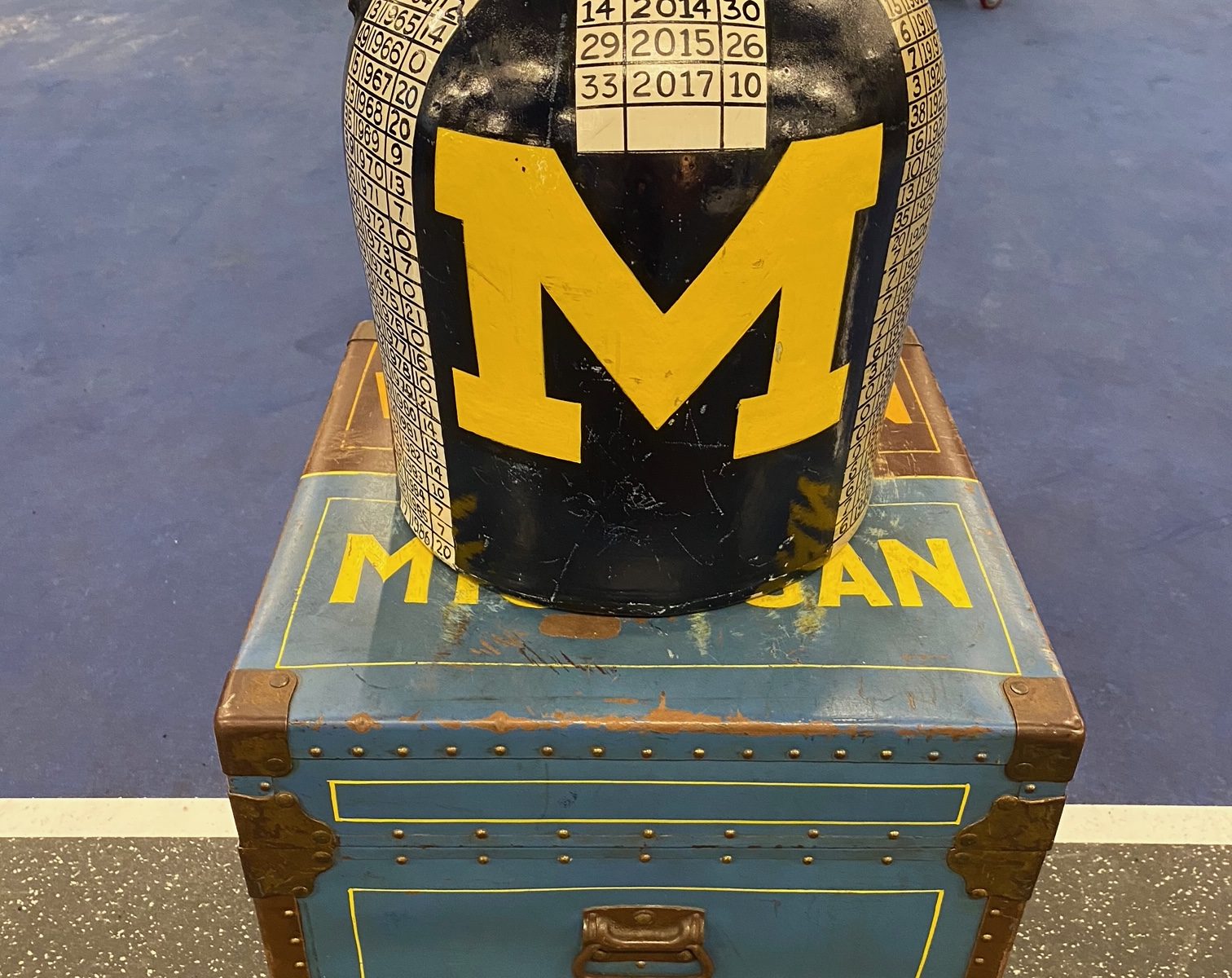
The third installment of the series focusing on the Little Brown Jug takes us back to 1986. Michigan was roaring, and just one more opponent was on the schedule before Ohio State. Unfortunately, the game before “The Game” just happened to be the Little Brown Jug, and as everyone knows, anything can happen in a rivalry game.

On the surface, Michigan appeared to be well prepared for Minnesota. The Wolverines entered the game with a perfect record, while the Golden Gophers already had four losses on their record. Michigan’s roster was loaded with talent, and the game was scheduled for Michigan Stadium. It seemed ideal.

Unfortunately for Michigan, the Jug meant a lot to the Minnesota players, too. With just a few games left in the regular season, the Gophers brought a desperate hunger to the game. Michigan surrendered three turnovers in its own territory throughout the game, but with 2:26 left, Gerald White scored on a 1-yard run to the game, 17-17. Michigan’s defense was now charged with stopping the Minnesota attack to give the Wolverines’ offense one final shot at victory. The Wolverines needed one stop from their defense. Kicker Mike Gillette was pacing the sidelines; poised for a chance at a field goal that would give Michigan the victory.

Sadly for the Wolverines, Gillette never got that chance. Sparked by a 27-yard scramble by quarterback Rickey Foggie, the Golden Gophers gave Chip Lohmiller a shot at a 30-yard field goal, and he made it to win the game. Just like that, Michigan’s hope for a national title was all but finished. The Wolverines finished the season with victories over Ohio State and Hawaii, before falling to Arizona State in the Rose Bowl. Would the Wolverines have beaten Arizona if they entered that game with a perfect record and a shot at the national championship? We’ll never know.

Thanks to YouTube and YouTube poster College Football Historian for the attached broadcast of this game. As always, we own nothing, and this blog post is provided strictly for the enjoyment of readers.


This and other great content can be found at newyorkwolverine.com
𝑳𝑶𝑶𝑲𝑰𝑵𝑮 𝑩𝑨𝑪𝑲: 1975

Looking Back is a Special Feature by Jeff Cummins Highlighting Key Games

The second installment of the series focusing on the Little Brown Jug takes us back to 1975. After four consecutive double-digit victory seasons, Michigan had to break in a new quarterback in the 1975 season. Fortunately for the Wolverines, Ricky Leach possessed multiple skills, particularly carrying the ball. Leach was joined in the running attack by a trio of running backs including Rob Lytle, Gordon Bell and Russell Davis, and the backfield made it almost impossible for the Minnesota defense to concentrate on just one ballcarrier.

The Minnesota offense responded by handing the reins to quarterback Tony Dungy, ironically a native of Jackson, Michigan. Dungy riddled the Michigan defense for 17 completions, accumulating 198 yards in passing. The Golden Gophers scored 21 points on Michigan, the most points surrendered by Michigan in six seasons. Still, the Michigan offensive line controlled the line of scrimmage, allowing the Wolverines to amass 345 yards on the ground. The Wolverines had almost as much trouble with the officials as they did with the Minnesota defense. Bell appeared to have scored on a 27-yard sweep, only to have the touchdown called back by a penalty on the Minnesota offense that Michigan wasn’t permitted to refuse. Undaunted, the Wolverines scored on a 3-yard run by Leach that rendered the issue moot.

Minnesota provided feisty opposition, but the Wolverines held on for a 28-21 win, their ninth consecutive victory in the series. Michigan finished with a record of 8 wins, 2 losses and 2 ties, including a 14-6 loss to Oklahoma in the Orange Bowl, the first postseason appearance by a Big Ten team that had not won the conference title. The Wolverines’ postseason bowl appearance was one of several factors that led to bowl expansions in the 1970s and 1980s. Leach also served notice that he would be a factor for several seasons to come.

Thanks to YouTube and YouTube poster College Football Historian for the attached video of the game. As always, we own nothing, and this blog post is provided strictly for the enjoyment of readers.


This and other great content can be found at newyorkwolverine.com
𝑳𝑶𝑶𝑲𝑰𝑵𝑮 𝑩𝑨𝑪𝑲: 1998

Looking Back is a Special Feature by Jeff Cummins Highlighting Key Games

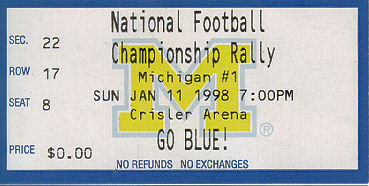
The first installment of the series focusing on the Little Brown Jug rivalry takes us back to 1998. Michigan spent much of the offseason basking in the glow of a national championship. The Wolverines had just secured two of the highest rated recruits in quarterback Drew Henson and running back Justin Fargas. As if those weren’t enough reasons to celebrate, the university had just added 5,000 seats to make Michigan Stadium the largest on-campus college football stadium in the nation. These were heady times for the Wolverines.

The Wolverines rode a 5-game winning streak into the game, but the battle for the Jug has humbled many successful teams. The game took on a traditional Big Ten style, featuring heavy doses of defense and special teams. Tom Brady gave Michigan the lead when he connected with Tai Streets for a 76-yard touchdown pass in the first quarter to put Michigan ahead, 7-3. Trevis Graham responded before the end of the quarter by recovering a Michigan punt in the end zone for touchdown. Michigan kicker Jay Feely then answered with an 18-yard field goal to send the teams in the locker room tied at 10-10.

Brady and his cohorts weren’t able to mount a scoring effort in the third quarter, so Michigan used defense to break the tie in the fourth quarter when James Hall dropped Minnesota quarterback Billy Cockerham for a safety to put the Wolverines ahead to stay. Feely then extended the lead with a 42-yard field goal, and the defense held off the Golden Gophers to secure a 15-10 victory.

Michigan completed the 1998 campaign with a 45-31 win over Arkansas in the Florida Citrus Bowl, giving the Wolverines their second consecutive 10-win season. What started out as a hangover season proved that the Wolverines still had the grit to grind out a tough win when things weren’t completely going in their favor.

Thanks to ESPN and YouTube poster College Football Historian for the attached broadcast of the game. As always, we own nothing and this blog post is provided strictly for the entertainment of readers.


This and other great content can be found at newyorkwolverine.com
𝑳𝑶𝑶𝑲𝑰𝑵𝑮 𝑩𝑨𝑪𝑲: 𝑯𝒂𝒓𝒃𝒂𝒖𝒈𝒉 𝑹𝒆𝒕𝒖𝒓𝒏𝒔

Looking Back is a Special Feature by Jeff Cummins Highlighting Key Games

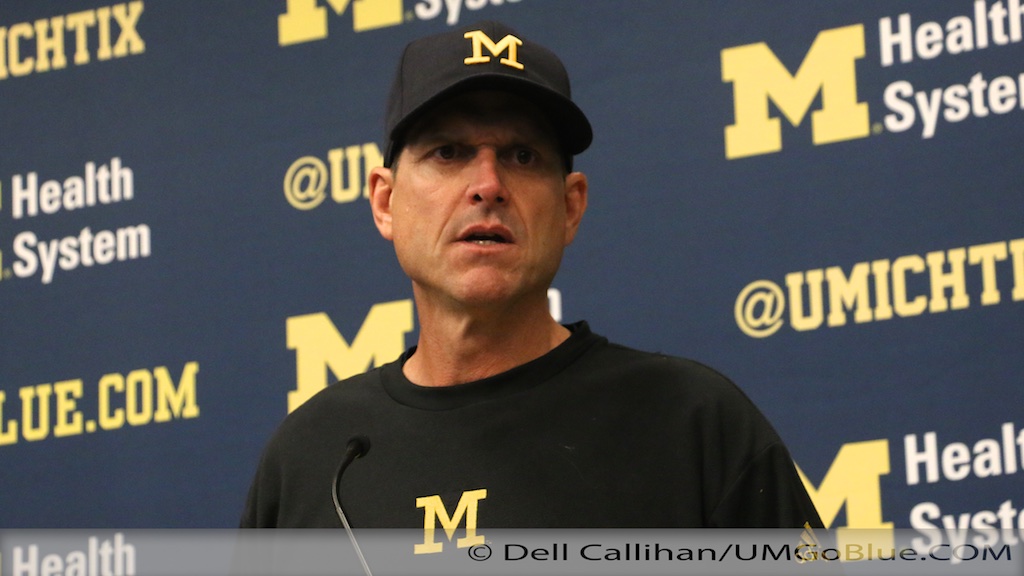
The fifth installment of the series examining the first games of Michigan coaches takes us to 2015. By the end of the 2014 football season, Michigan was in desperate need of change. Once again, optimism had faded into disappointment, with even a tinge of embarrassment. The fan base clamored for a coach who could restore confidence, belief, and success.

That December, a Michigan graduate close to the athletic department sent out a text to a blogger. He’d just seen a potential coach with the initials “JH” enter Schembechler Hall. On Dec. 30, 2014, Michigan hired Jim Harbaugh as the next head coach of the Michigan Wolverines. It would be an understatement to say that Harbaugh rejuvenated the fan base immediately.


Harbaugh returned to Michigan as a veritable “prodigal son.” A Michigan graduate who played for Bo Schembechler in the 1980s, Harbaugh had been critical of his alma mater on occasion. More important, he was a winner who had succeeded at the highest levels, and he brought instant credibility to the Michigan football program.

On Sept. 3, 2015, Michigan entered Rice-Eccles Stadium in Salt Lake City to begin the Jim Harbaugh era with a visit to Utah. Michigan alumni traveled to Utah in droves, and there were numerous spots of maize and blue throughout the stadium. Local news reports indicated Michigan fans had been spending a lot of money at nearby restaurants, and tipping well. The excitement around Harbaugh’s return was palpable, and even Utah residents appreciated the enthusiasm. Once the game began, Utah wasn’t so hospitable.

The Utes had an established roster, and they were able to open holes for Devontae Booker and Travis Wilson, enabling Utah to take a 17-3 lead in the third quarter. Gradually, Michigan woke up. Quarterback Jake Rudock connected with Jake Butt and Amara Darboh for a pair of touchdowns, but the Wolverines were never able to close the gap, and Utah won, 24-17.
Still, the tenacity that Michigan showed in the second half made it clear that Harbaugh was the right person to lead the Wolverines, and he eventually led them back to college football Valhalla.


Harbaugh’s counterpart, Kyle Whittingham, defeated Michigan for the third team in three attempts as Utah coach. Each time, I remember thinking “I wish that guy was on our side.” Now, he is. Tomorrow, we’ll see his first game as Michigan coach, and get a better idea where he’ll take the football program.

Thanks to Fox Sports and YouTube poster College Football Archive for the following broadcast of the 2015 Michigan game against Utah. As always, we own nothing and do not profit from this blog post in any way.


This and other great content can be found at newyorkwolverine.com
𝑳𝑶𝑶𝑲𝑰𝑵𝑮 𝑩𝑨𝑪𝑲: 𝑳𝒍𝒐𝒚𝒅 𝑪𝒂𝒓𝒓

Looking Back is a Special Feature by Jeff Cummins Highlighting Key Games

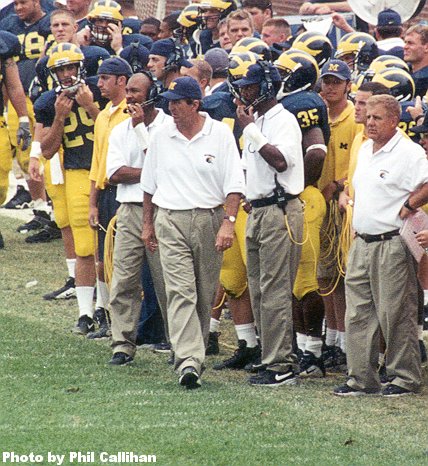
The fourth installment of this series examining the first games of Michigan coaches takes us to 1995. Before the season even began, 1995 had been a tumultuous year for Michigan. Gary Moeller resigned due to an off-field incident, and athletic director Joe Roberson hired defensive coordinator Lloyd Carr, but only on an interim basis.

Carr was thoroughly qualified to be a head coach, having served as Michigan’s defensive coordinator since 1987. In addition, Carr had been assistant head coach for the past five seasons. Nothing about the job would surprise him.

Still, the offseason left Michigan followers with an uneasy feeling, which only got worse when the Virginia Cavaliers jumped out to a 17-0 lead on a brutally hot day in the Pigskin Classic at Michigan Stadium.

Michigan followers, both fans and alumni, couldn’t be blamed for fearing the worst. Michigan was facing a large deficit in a season opener at Michigan Stadium. That’s not the sort of start that develops a lot of confidence.

Gradually, Carr’s Wolverines began to make plays, notably Mercury Hayes, who wrestled a ball away from a defensive back when the game seemed all but lost. Hayes’ tenacity ignited a spark in his teammates, who fought back with what felt like a sense of anger. Was there enough time left for them to pull off a miracle?

With time left for just one play, Michigan had the ball at Virginia’s 15-yard line. Scott Dreisbach faded back and threw a fade pass into the far corner of the north end zone. Hayes caught the ball, and managed to get one foot in bounds. Just like that, Michigan won. The only time Michigan had the lead was when time had run out. In one play, Hayes made himself a name for the ages among the Michigan faithful, and the Wolverines had won arguably the most exciting season opener in their illustrious history.

The victory also proved to be an outstanding first step for Carr’s Wolverines, and by November, the interim tag been removed from his title. Lloyd Carr was head coach of the Michigan Wolverines, and he was here to stay.

By now it’s common knowledge that Carr led the Wolverines to heights they had not achieved in decades. At the time, it required a leap of faith. After a win like that, Michigan supporters were more than happy to put a little faith in Lloyd Carr.

Thanks to ABC Sports and YouTube poster RXwolverine2 for the broadcast of this game. As always, we own nothing, and we do not profit in any way from this blog post.

https://www.youtube.com/watch?v=7NpTXz_q6mM

This and other great content can be found at newyorkwolverine.com