Michigan vs Ohio State Football – Looking Back – 1933

The fourth installment of this year’s series on the football rivalry between Michigan and Ohio State takes us to 1933. The world was different then. America was in the midst of the Great Depression, and if you had a job, it was a good job. Things were different in college football, as well. The Michigan-Ohio State game was in the middle of the season, in October. But the competition was fierce, and that’s one thing this rivalry has always been known for.

Another thing that was consistent with the modern era is that both teams were in the thick of the battle for the conference title. So when the teams got ready for The Game on that morning in October 1933, they each knew they would get the best shot their opponent had.

But only one team had Willis Ward, and he played for Michigan.

Both teams entered The Game with perfect records, and Ohio State hadn’t even surrendered one point all season. Michigan had won both its games, setting up a classic matchup for the ages. As always, both teams featured ferocious defenses, and the Michigan defense carried the day. With Michigan up by just six points in the third quarter, Ward returned an interception 50 yards to the Ohio State 25-yard line. The Wolverines failed to capitalize on the interception, and Ohio had the ball in the fourth quarter when the Michigan defense rose up again, sparked by a Chuck Bernard interception. Several plays later, Herman Everhardus scored from the Ohio State 2-yard line, giving Michigan the final points, and the Wolverines won, 13-0. Michigan went on to finish with a record of 7 wins, 0 losses and 1 tie, winning the National Championship and the Big Ten Championship. Ohio State lost only that game to Michigan, finishing with a record of 7 wins and 1 loss, ending the season second to Michigan in the Big Ten.

Several decades after the 1933 season, Michigan center Gerald Ford became the president of the United State of America, following the resignation of President Richard Nixon.

Notably, a couple of other things were different for Michigan back in the 1933 season. Michigan had yet to don the famous winged helmet, and the team hadn’t yet run under the banner while entering the stadium. I’d imagine most Michigan alums would be happy with the National Championship and the Big Ten Championship, though.

I wasn’t able to find any video of the 1933 game, but I found this youtube video with nine facts about the 1933 Michigan team, so I present the video below with many thanks to youtube poster Drusilla. As always, I own nothing and I do not profit from this article or video in any way. The content presented here is strictly for the enjoyment of readers.

Michigan vs Ohio State Football – Looking Back – 1944

For the third installment of the series looking back at the Ohio State-Michigan rivalry, we go back to 1944. The mood in America was upbeat. In June, the Allies had undertaken Operation Overlord, better known as D-Day, and were on their way to winning World War II. Americans were looking forward to a better economy and a more peaceful world. The end of the war also encouraged people to focus more attention on leisure time activities, and in the Midwest, that meant football. And at the time, college football was still more popular than the National Football League, so The Game was huge. Well, it’s always had a larger-than-life feel to it.

Michigan played valiantly without halfback Gene Derricotte, and the teams traded leads several times. After Bill Culligan’s second touchdown of the game gave the Wolverines a 2-point lead in the fourth quarter, Ohio State was left with a little more than nine minutes to come back. As it turned out, that was plenty of time for the Buckeyes to mount a 52-drive that culminated with Les Horvath diving over the line for a touchdown that made the final score Ohio State 18, Michigan 14. Sadly, Michigan was hampered by the fact that its kickoff went only 12 yards, allowing the Buckeyes to start their critical drive at their own 48-yard line. One final Michigan drive was thwarted by a Dick Flanagan interception, and the Buckeyes held on for the win. Ohio Sate finished the season with a record of nine wins and no losses, and the Buckeyes won the championship of the Big Nine Conference, which preceded the Big Ten. Michigan finished with a record seven wins and two losses. In December, Michigan lost Derricotte when he was drafted into the military, and he joined the Tuskegee Airmen pilot training program. A few years later, he returned to continue his education, and his college football career, at the University of Michigan.

There is some grainy video of this game on youtube, and a box score that’s partially typed and partially handwritten, but both make for difficult viewing, and I didn’t feel that either one was worth including.

Michigan vs Ohio State Football – Looking Back – 1955

The second installment of this year’s series looking back at the Michigan-Ohio State rivalry takes us to 1955. The Brooklyn Dodgers FINALLY won the World Series, Americans were finally able to enjoy some peace after the conclusion of the Korean War a few years earlier, and the nation was experiencing broad, post-war prosperity. Many young people were leaving cities, buying homes in the suburbs and starting families. The American automobile industry continued to thrive and Ford introduced its new personal luxury car, the Ford Thunderbird. On the pop culture front, rock & roll was beginning to make its presence felt among American youth.

On the gridiron, Michigan raced to a 7-1 start before facing Ohio State in The Game in Michigan Stadium on Nov. 19. With that, the Wolverines were routed 17-0. The game itself can be summed up simply. Ohio State ran left halfback Howard “Hopalong” Cassady time and again, and the Wolverines simply couldn’t stop him. Michigan certainly had some outstanding players on the ’55 squad, most notably All-America tight end Ron Kramer. Still, the Wolverines were unable to succeed at much in that game, as Woody Hayes became only the third Ohio State coach in history to win two games in a row against Michigan.

The result left both teams with matching 7-2 records. Ohio State was ranked fifth in the nation by the Associated Press, and Michigan was ranked 12th.

I wasn’t able to find any video of The Game from 1955, so please enjoy the summary of the 1955 football season below, with credit and thanks to the Bentley Historical Library. As always, I own nothing and I do not profit from this in any way.

http://bentley.umich.edu/athdept/football/fbteam/1955fbt.htm

Michigan vs Ohio State Football – Looking Back – 1966

The first installment of this year’s series looking back at the Michigan-Ohio State football rivalry takes us back to 1966. It’s not often when both teams enter The Game with mediocre seasons, but in ’66, neither rival had accomplished much. It was a testament to the devotion inspired by the rivalry that more than 83,000 showed up at Ohio Stadium to watch two old foes wrap up a non-descript season. Still, the winner was bound to remember 1966 more fondly than the loser, and in this rivalry, that’s more than enough motivation.

Michigan’s fortunes had suddenly changed just four weeks before the game against Ohio State. With a 2-3 record, the Wolverines rose up and mauled Minnesota, 49-0, to seize both the Little Brown Jug and the season’s momentum. Entering the Ohio State game, Michigan had suddenly won three of the last four, and they were determined to send Woody Hayes into the offseason with a scowl on his face. After the teams traded field goals, Michigan began to take control of the game in the second quarter with its ground game. Running back Jim Detwiler scored on a 7-yard run to put the Wolverines up by a touchdown at halftime, and they extended the lead in the third quarter when Quarterback Dick Vidmer connected with Clayton Wilhite on a 28-yard touchdown pass to make the final score 17-3 in favor of Michigan. The scoring doesn’t tell the whole tale, though. Michigan stopped Ohio State on a fourth down at the Michigan 38-yard line, with the Buckeyes needing only inches for a first down. Ohio State’s momentum was stopped, and the play enabled Michigan to stay in the game until the Wolverines could establish their running game. In all, Michigan gained a net total of 272 yards on 44 carries, for an average of more than six yards per rush. Ohio State attempted the exact same number of running plays, 44, but gained only 146 yards on the ground.

Michigan finished the season with a record of six wins and four losses, while Ohio State finished with four wins and five losses, its first losing season since 1959. For all intents and purposes, the national championship was decided that same day in East Lansing, where Michigan State and Notre Dame played to an infamous 10-10 tie in which Notre Dame played it safe with 34 seconds remaining, running two plays into the middle of the offensive line to preserve the tie, with little risk and little sense of daring.

In the end, Michigan and Ohio State played a game with passion, despite the fact that 1966 was the rare year in which neither team made much of a splash in either the Big Ten or the national college football landscape. There was also a UFO sighting 1966 on a farm in Dexter, Michigan. Nobody is certain, but it’s entirely possible that much of Michigan’s offensive production might have disappeared onto that UFO.

Sadly, I wasn’t able to locate any video clips of the 1966 game, but a link to the official box score is below. Thanks to umich.edu. As always, I own nothing and I do not profit from this in any way. This article is strictly for the enjoyment of readers.
1966umosu

Michigan vs Michigan State Football – Looking Back – 1989

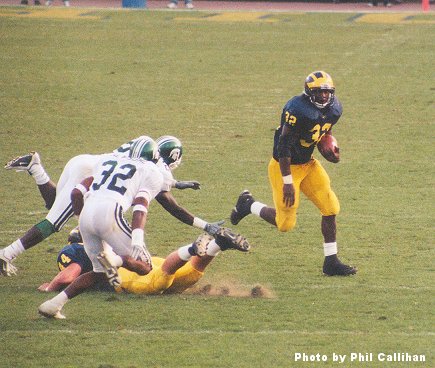
The third installment of the Michigan-Michigan State series takes us back to 1989. It was Bo Schembechler’s last season as Michigan head coach, and it began with a loss to Notre Dame and ended with a loss to USC in the Rose Bowl. Sandwiched in between those losses were 10 victories, marked by old school, Schembechler power football. The game against Michigan State was no different, and the 10-7 score is evidence of the hard-nosed, helmet-rattling sort of football that Bo loved.

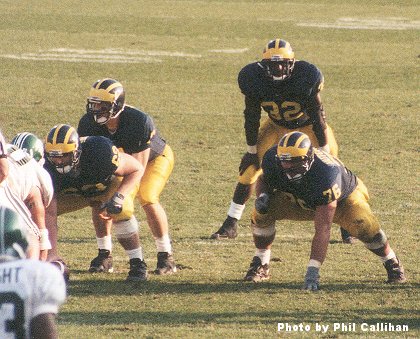
One of the challenges for the Maize & Blue was that George Perles, who had made his name as the defensive line coach for the great Pittsburgh Steeler teams of the 1970s, coached the 1989 Michigan State team. The game pitted a veteran offensive line guru (Bo) vs. a veteran defensive line guru, in Perles. As you can guess, style points didn’t matter in that sort of game, and it meant that every detail became that much more important. Michigan blocked a field goal, and the Michigan running game finally got rolling when Tony Boles used his shiftiness to loosen up the Spartan defense. Still, the Michigan State defense stiffened after Michigan got a first down at the Spartan 4-yard line. Suddenly, Michigan was facing 4th down and goal to go inside the State 1 yard line. With the Wolverines lined up in a wishbone formation, Leroy Hoard got the ball and burst through a hole on the right side of the offensive line to give Michigan a hard-earned lead. Michigan continued to alternate between Hoard and Boles, and the Wolverines’ offensive line began to push the Spartans back consistently, setting up a 35-yard field goal by J.D. Carlson.

In the fourth quarter, State threatened to put a green tint on the game, but the Michigan defense wasn’t having any of it. Tripp Welborne stopped Blake Ezor at the goal line, as Michigan completed a classic goal line stand. With less than five minutes remaining in the game, Spartan QB Hyland Hickson found Courtney Hawkins just over the goal line, and Michigan’s lead was trimmed to three points. With seconds remaining, the Michigan defense stood tall, as Lance Dottin intercepted a pass by Dan Enos to foil the final Spartan threat.

The win capped a 17-4 lifetime record for Bo against the Spartans. Not bad for a coach who lost his inaugural game in the rivalry.

Thanks to youtube poster WolverineHistorian and ABC Sports for the broadcast clip. As always, I own nothing and this is presented strictly for the enjoyment of our readers.