๐‘ณ๐‘ถ๐‘ถ๐‘ฒ๐‘ฐ๐‘ต๐‘ฎ ๐‘ฉ๐‘จ๐‘ช๐‘ฒ: ๐‘ด๐‘ฐ๐‘ช๐‘ฏ๐‘ฐ๐‘ฎ๐‘จ๐‘ต ๐‘ฝ๐‘บ. ๐‘ด๐‘ฐ๐‘ช๐‘ฏ๐‘ฐ๐‘ฎ๐‘จ๐‘ต ๐‘บ๐‘ป๐‘จ๐‘ป๐‘ฌ, 2012

Looking Back is a Special Feature by Jeff Cummins Highlighting Key Rivalry Games

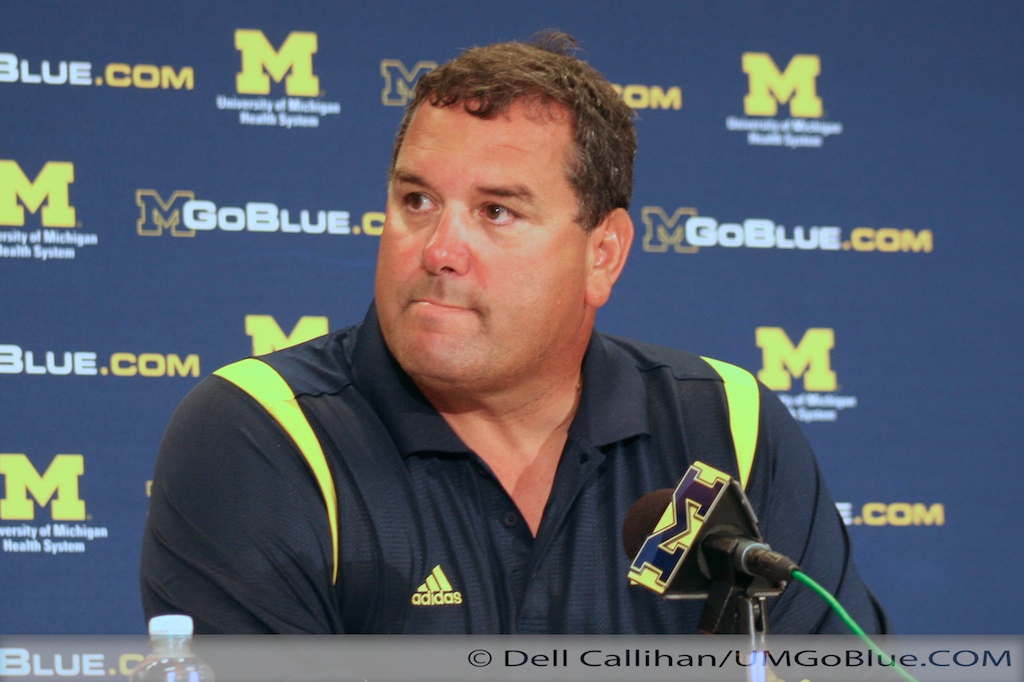
The second installment of the series examining the football rivalry between Michigan and Michigan State takes us to 2012. During the previous season, Michigan football experienced a complete restoration of pride under new head coach Brady Hoke. The Wolverines defeated many opponents, and even won the Sugar Bowl. By 2012, alumni began arriving at their tailgate parties earlier and staying longer. Yes, it certainly was great to be a Michigan Wolverine!

But as the warm glow of the tailgate party faded, there was one nagging irritation: Michigan had lost to Michigan State in 2011, and the Wolverines hadnโ€™t beaten the Spartans since 2007. Situations like that are simply intolerable. 

So as the teams took the field for the 105th meeting in the rivalry, the stage was set for an instant classic. The rivalry between Michigan and Michigan State has featured some of the hardest hits in college football history, and the 2012 game would be one of the most physically brutal contests in the history of the rivalry. In a series that has featured Bubba Smith and LaMarr Woodley, Tony Mandarich and Steve Hutchinson, the 2012 game would become a classic for the ages, as Michigan offensive tackle Taylor Lewan and Michigan State defensive end William Gholston put on a legendary battle. 

In the first quarter, Michigan quarterback connected with Jeremy Gallon, easily one of the most underrated receivers in Michigan history, and Gallon zigged and zagged for a 22-yard gain. As the game unfolded, it was clear that play was an aberration. Tough defense ruled the game, and both offenses had trouble moving the ball. In the second quarter, Michigan running back Fitz Toussaint carried the ball 38 yards to the Michigan State 6-yard line, giving the Wolverines their first good scoring opportunity. Four plays later, Brendan Gibbons kicked a 24-yard field goal to give Michigan a 3-0 lead. Later in the half, Matt Wile extended the Wolverinesโ€™ lead with a 48-yard field goal. Michigan had the lead, but it would be a long time before the Wolverines could breathe easily.

Michigan State gradually began to seize the momentum in the third quarter. Andrew Maxwell connected with Paul Lang in the north end zone for a touchdown, and suddenly the Spartans had the lead, 7-6. The teams traded field goals, and with two minutes remaining, the Wolverines had a first down at their own 38-yard line. Time for just one final offensive series. With time winding down, Robinson completed a 19-yard pass to Drew Dileo, who reached the Michigan State 22-yard line. Gibbons then kicked a field goal that narrowly went through the uprights, and Michigan won, 12-10, in one of the most intense games in the history of the series.

Michigan’s season ended in disappointing fashion, but on this day, the Wolverines settled an old score with the Spartans.

Thanks to YouTube, the Big Ten Network, and YouTube poster WolverineDevotee for the attached video. As always, we own nothing and this blog post is provided strictly for the enjoyment of readers.

This and other great content can be found at newyorkwolverine.com
๐‘ณ๐’๐’๐’Œ๐’Š๐’๐’ˆ ๐‘ฉ๐’‚๐’„๐’Œ: ๐‘ฉ๐’“๐’‚๐’…๐’š ๐‘ฏ๐’๐’Œ๐’†โ€™๐’” ๐’‡๐’Š๐’“๐’”๐’• ๐’ˆ๐’‚๐’Ž๐’† ๐’‚๐’” ๐’‰๐’†๐’‚๐’… ๐’„๐’๐’‚๐’„๐’‰

Looking Back is a Special Feature by Jeff Cummins Highlighting Key Games

The first installment in this weekโ€™s series on the first games of new Michigan coaches takes us back to 2011. Michigan was ready for a fresh start, and the Wolverines got a fresh hero in Brandon Herron.

Prior to that game, few among the Michigan faithful had even heard of Herron. The senior linebacker from Dallas, Texas had mostly toiled in anonymity during his time in Ann Arbor, but the hiring of Brady Hoke as head coach signaled a return to Michiganโ€™s core football approach, which included a heavy focus on defense.

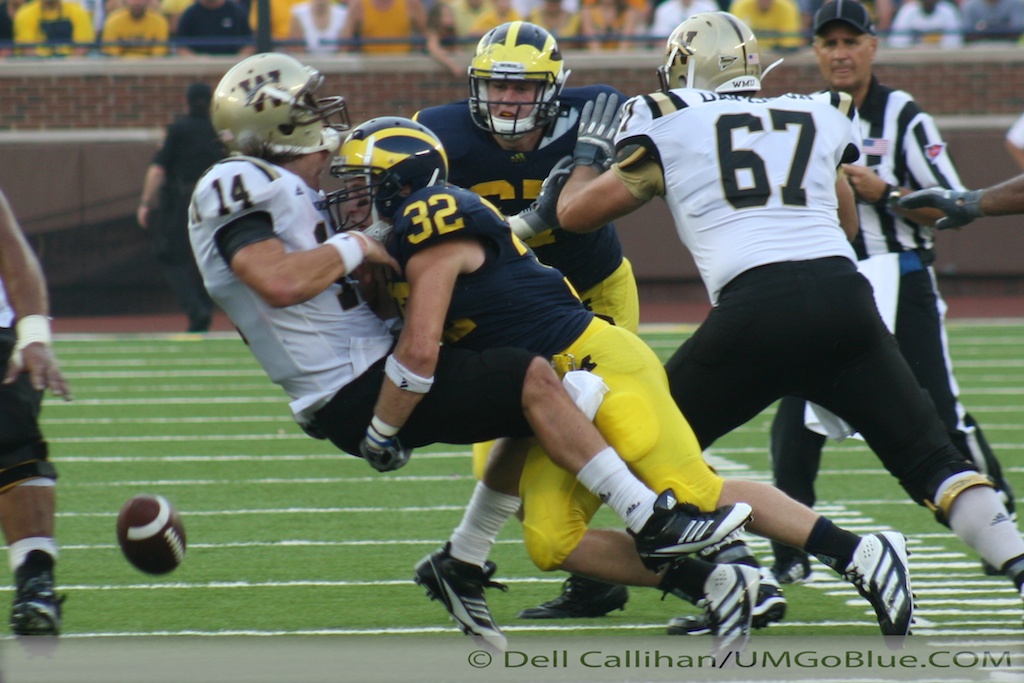
Still, midway through the second quarter, the Wolverines looked surprisingly sluggish, possibly due to a 30-minute weather-related stoppage. Western Michigan was threatening to take the lead for the second time, and the Wolverines were obviously in need of a spark. Freshman linebacker Jake Ryan blitzed and got just a piece of the ball, which landed in the waiting hands of Herron. Escorted by a squad of blockers, Herron made his way 94 yards into the south end zone of Michigan Stadium, and the Wolverines produced their first signature play of the 2011 season.

From that point, Michigan methodically increased its lead to 34-10, punctuated by Herronโ€™s second score of the game, when safety Jordan Kovacs forced a fumble that Herron gleefully returned 29 yards for a touchdown. With 1:27 left in the third quarter, ominous weather prompted officials from both schools to call the game, and for the first time in school history, weather forced an early end to a Michigan football game.

After a slow start, Hokeโ€™s first game as head coach produced a thoroughly Schembechler-esque domination. Kovacs led the defense with 10 tackles, two sacks and a forced fumble. Fitzgerald Toussaint was showcased as the teamโ€™s featured running back in a return to a traditional smashmouth Michigan running game, and quarterback Denard Robinson completed all five of his passes, foreshadowing a legendary performance just a week later.


Most important of all, Hoke earned a victory in his first game as head coach, returning the team to its hardnosed roots, which would pay dividends later in the season.
Thanks to ABC Sports and YouTube poster Mr_E_Man 8131 for this broadcast of the 2011 Michigan season opener.

As always, we own nothing and do not profit from this blog post.


This and other great content can be found at newyorkwolverine.com
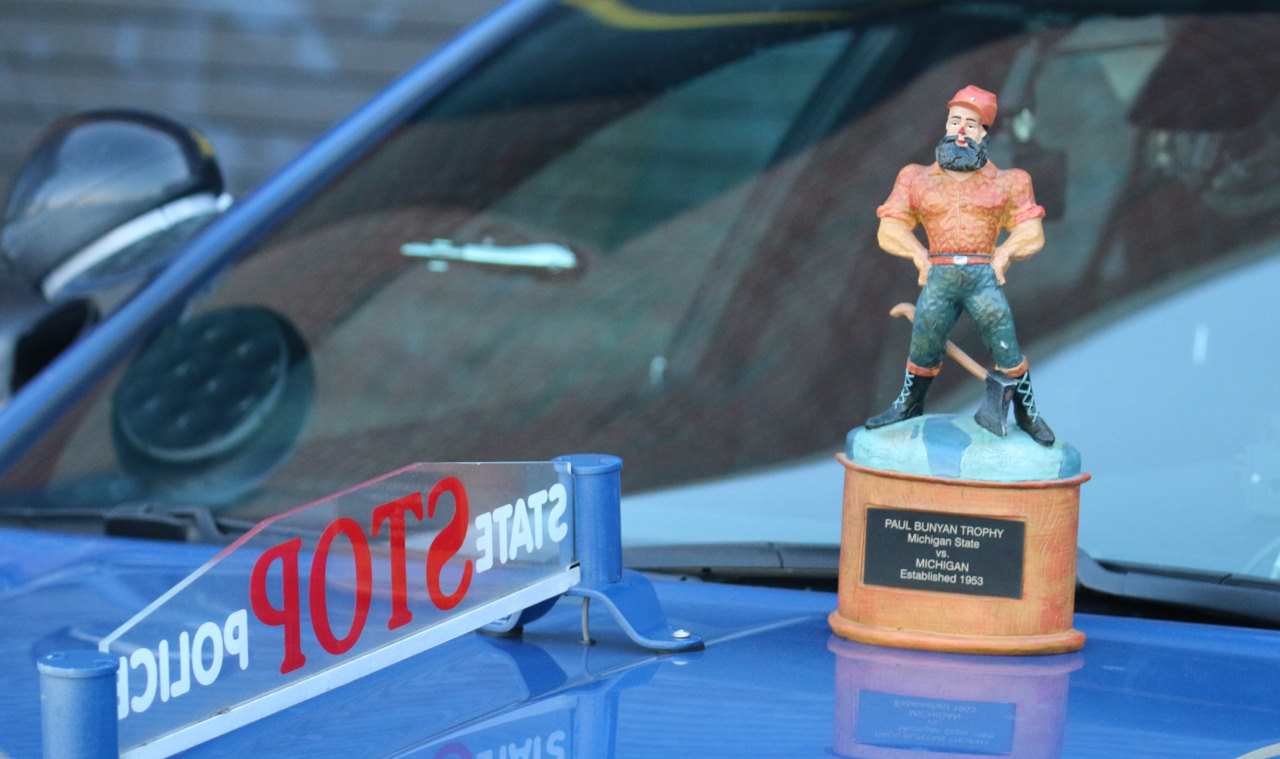
Paul Bunyan Trophy — Looking Back – 2012

Looking Back is a Special Feature by Jeff Cummins

The fifth and final installment of this yearโ€™s series looking back at the Michigan-MSU football rivalry takes us to 2012. Brady Hoke announced his presence with authority during the previous season, but the Wolverines were routed by Michigan State that year. Michiganโ€™s ascendence set the Wolverines on the trajectory for a head-on collision with the Spartans, and their 2012 matchup would prove to be a slugfest.

The Wolverines and the Spartans might adapt to high-scoring, flashy, modern football against other opponents, but when they play each other the game is usually decided by hard-nosed blocking and tackling. The game remained scoreless throughout the first quarter, but Michigan was able to find some success in the passing game when Denard Robinson connected with wide receiver Drew Dileo, who would play a much larger role later in the game. With the defense concentrating on Dileo, Fitzgerald Toussaint rumbled 36 yards on a trap play, taking the ball to the Michigan State 6-yard line. The drive stalled as the Michigan State defense stiffened, and Michigan settled for a field goal from Brendan Gibbons, who would also play a very big role late in the game.

But Michigan State wouldnโ€™t go quietly. Spartan quarterback Andrew Maxwell connected with Bennie Fowler for a 45-yard gain, and Michigan State was marching down the field. This time, the Michigan defense rose to the occasion and the Spartan drive ended when Dan Conroy missed a critical field goal. The game continued in that vein until Maxwell found tight end Paul Lang in the end zone on a play action pass in the third quarter, giving Michigan State its first lead. A lonely cheer went up in The Big House, but most in the crowd of 113,833 remained silent, concerned by Michigan Stateโ€™s sudden rally. The Spartans threatened to extend their lead, but Jordan Kovacs put an end to that when he intercepted a Maxwell pass and returned it 34 yards to the Michigan State 38-yard line, shifting the possession and the momentum back to Michigan.

With 18 seconds remaining in regulation time, Robinson connected with Dileo for a 20-yard gain to the Michigan State 21-yard line, setting up a field goal attempt. Gibbons then knocked a 38-yard field goal through the uprights, and Michigan held on for a 12-10 victory in a classic defensive struggle.

Thanks to the Big Ten Network, YouTube, and YouTube poster Pizza Pizzichetti for the broadcast of this game. As always, we own nothing and this blog post is provided strictly for the enjoyment of readers.

Paul Bunyan Trophy — Looking Back – 2011

Looking Back is a Special Feature by Jeff Cummins

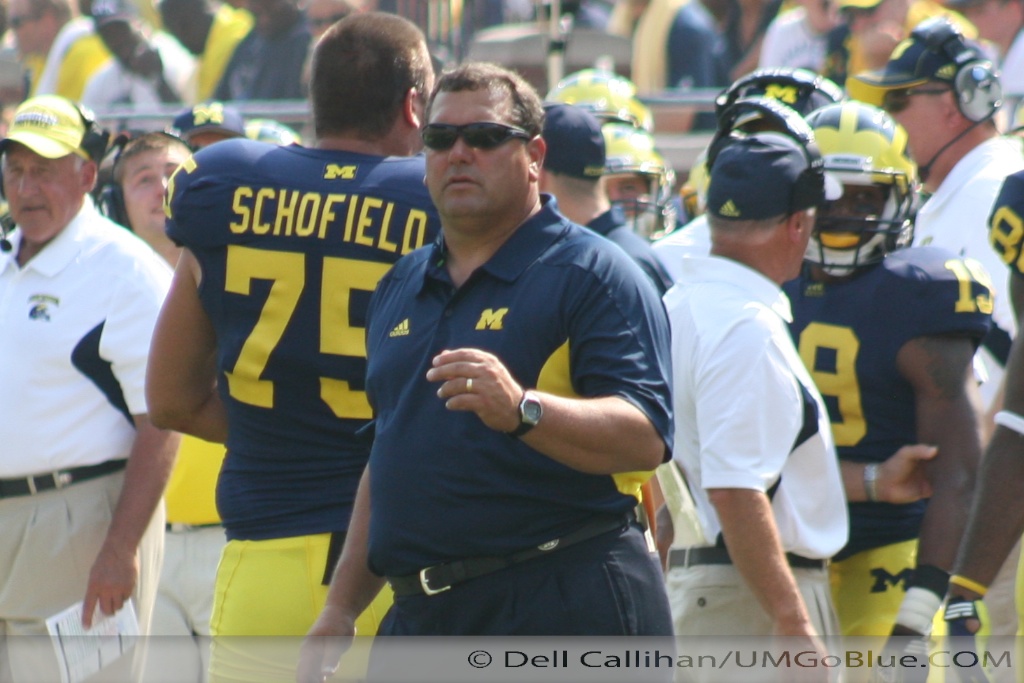
The fourth installment of the series looking back at the football rivalry between Michigan and Michigan State takes us back to 2011. After three years of Rich Rodriguez, the football gods (and Dave Brandon) rescued the maize and blue from the defensive chaos that existed throughout the Rodriguez regime. Brady Hoke was named the new coach, and his team tore through the first six games on its schedule, highlighted by a thrilling comeback victory over Notre Dame. Suddenly, Michigan fans and alumni were looking at the football world through maize and blue shades!

Unfortunately, every party ends on a sober note, eventually. Hoke had long served as an assistant under both Gary Moeller and Lloyd Carr, and he was well acquainted with the nuances of the Paul Bunyan rivalry. One of the quirks of the series is that first-year coaches are often given a rude introduction to the game.

Hoke appeared to have the Wolverines ready to face Michigan State, but Spartan coach Mark Dantonio was obsessed with beating Michigan. Adding another challenge, this game would be played at Spartan Stadium in East Lansing, a venue with a dubious history in the series.

Wearing throwback alternate uniforms, the Wolverines struck first when Denard Robinson scored on a 15-yard run. Michigan got off to a good start, but Hoke sensed a serious threat to his teamโ€™s perfect record.

By 2011, many teams preferred to use complicated passing schemes, but the Paul Bunyan rivalry has always been decided by fundamental execution of no-nonsense power football. On this day, Michigan State seized the moment by committing to a hard-nosed running game, gaining 213 yards on 39 carries. After repeatedly probing the Michigan defense, Edwin Baker rammed the ball over the goal line to tie the score in the first quarter. Bakerโ€™s touchdown enabled the Spartans to take control of the game, and it also opened up the Michigan secondary, allowing Kirk Cousins to connect with Keshawn Martin for a pair of touchdown passes in the third quarter. Michigan closed the gap when Robinson connected with Roy Roundtree for a 34-yard scoring pass, but that was as close the Wolverines got. Michigan State went on to win, 28-14, for the Spartansโ€™ fourth consecutive victory in the rivalry.

Michigan rebounded from the loss to finish the season with an 11-2 record, topping Virginia Tech in the Sugar Bowl. The victory restored Michiganโ€™s place in the national college football discussion. Unfortunately, the next step wouldnโ€™t be so easy.

Thanks to ESPN, YouTube, and YouTube poster MSUAndyHRCMB for the accompanying highlight video of the game. As always, we own nothing and this blog postis provided strictly for the enjoyment of readers.

Looking Back — Michigan Football Season Openers – 2011 Western Michigan

Looking Back is a Special Feature by Jeff Cummins

The fourth installment in this weekโ€™s series looking back at opening games takes us to 2011.

Michigan had been trying to recapture the magic of the late 1990s for an entire decade. In 2008, the Wolverines hired Rich Rodriguez with the thought that his spread offense would narrow the gap between Michigan and many of the prevailing powerhouses in college football at that time. Rodriguez was an innovator, but once the college football community caught up to his spread offense, he had little else to offer.

Enter Brady Hoke, a coach who warmed the hearts of Michigan traditionalists everywhere. Hoke had been a defensive line coach at Michigan, and his teams were known for defense. He brought former Michigan defensive coordinator Greg Mattison with him, and the hearts of Old Blues everywhere were suddenly as warm as an overcooked bratwurst. For those yearning for a return to tradition, this was the answer.

Hoke possessed a midwestern charm that was magic on the recruiting trail. High school coaches throughout Michigan and Ohio welcomed him with open arms, and recruits responded favorably to his personality.

Western Michigan was the opponent in the 2011 season opener. The game started with renewed optimism, but Western Michigan struck first, driving 74 yards for an early touchdown to take a 7-0 lead. It didnโ€™t last long. Michigan tied the score on a 16-play touchdown drive. The fans learned Brandon Herronโ€™s name.

Herron, a fifth-year linebacker from Texas, returned an interception 94 yards for a touchdown to start the party. He kept the party going by returning a fumble 29 yards for another touchdown, courtesy of a jarring hit on the quarterback by safety Jordan Kovacs. If the season had ended after the first game, he would have merited consideration for the All-America team. By halftime, Michigan led 20-10, and the competitive portion of the game was over. However, the second half proved to be interesting for unexpected reasons.

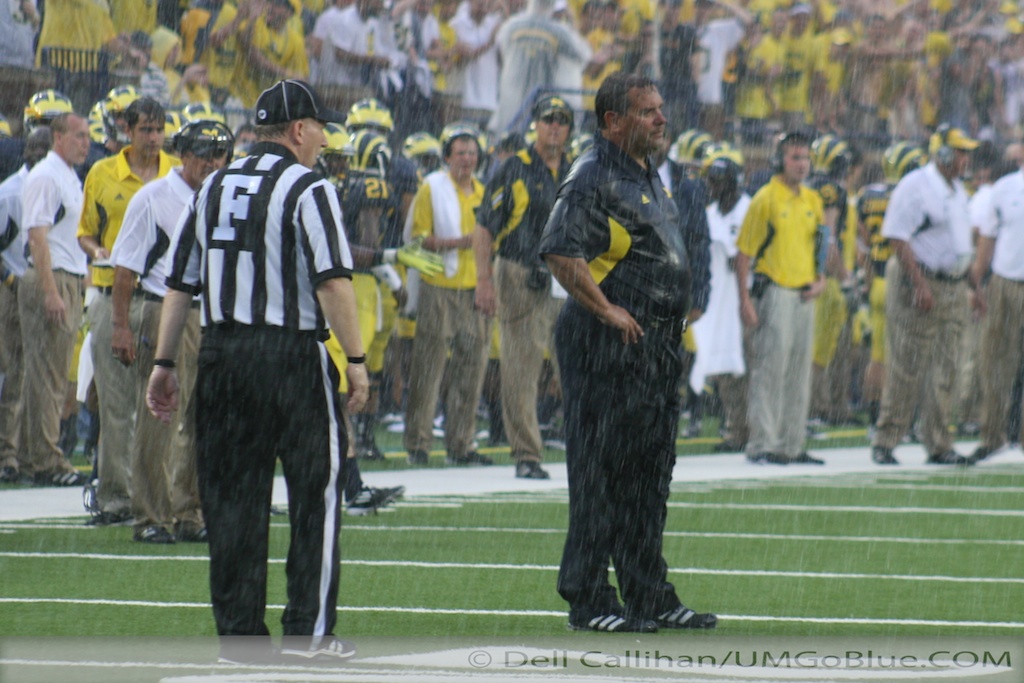
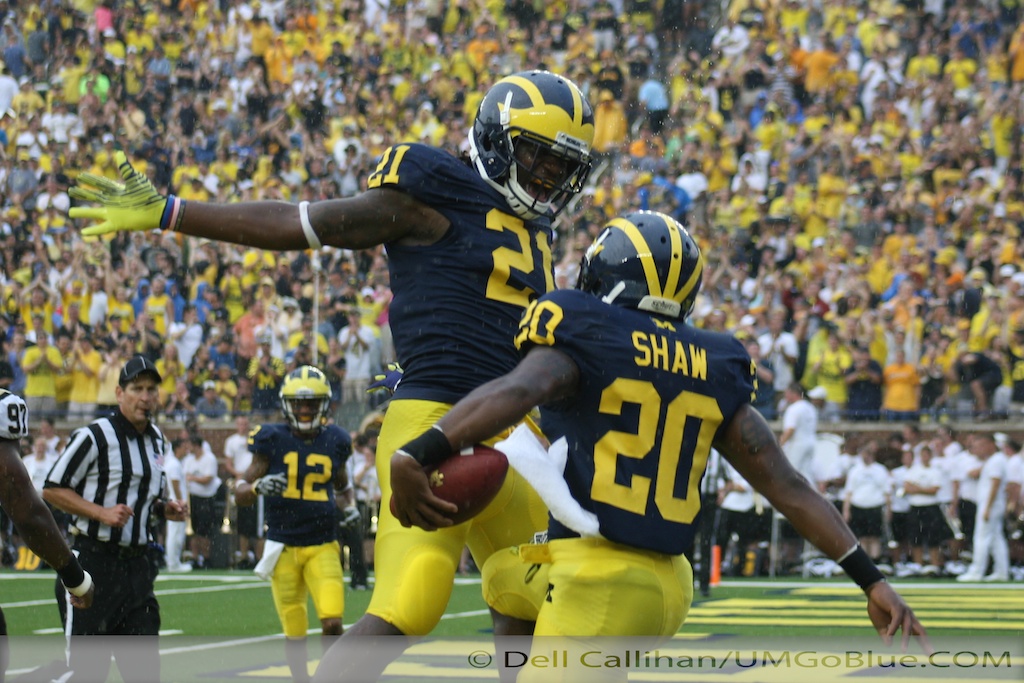
A sudden deluge drenched the stadium, with rain flowing sideways. After a brief rain delay, Michigan took solid control of the game, and Michael Shaw ended the scoring with a 44-yard touchdown run. After lightning struck on a later Michigan possession, officials ended the game. Michigan won by a final score of 34-10, giving Brady Hoke and the Wolverines a win in one of the most unique opening games in school history.

Thanks to YouTube, ESPN, and YouTube poster WolverineDevotee for the highlights below. As always, neither I nor anyone involved with this website owns anything, and we do not profit from this blog post.